
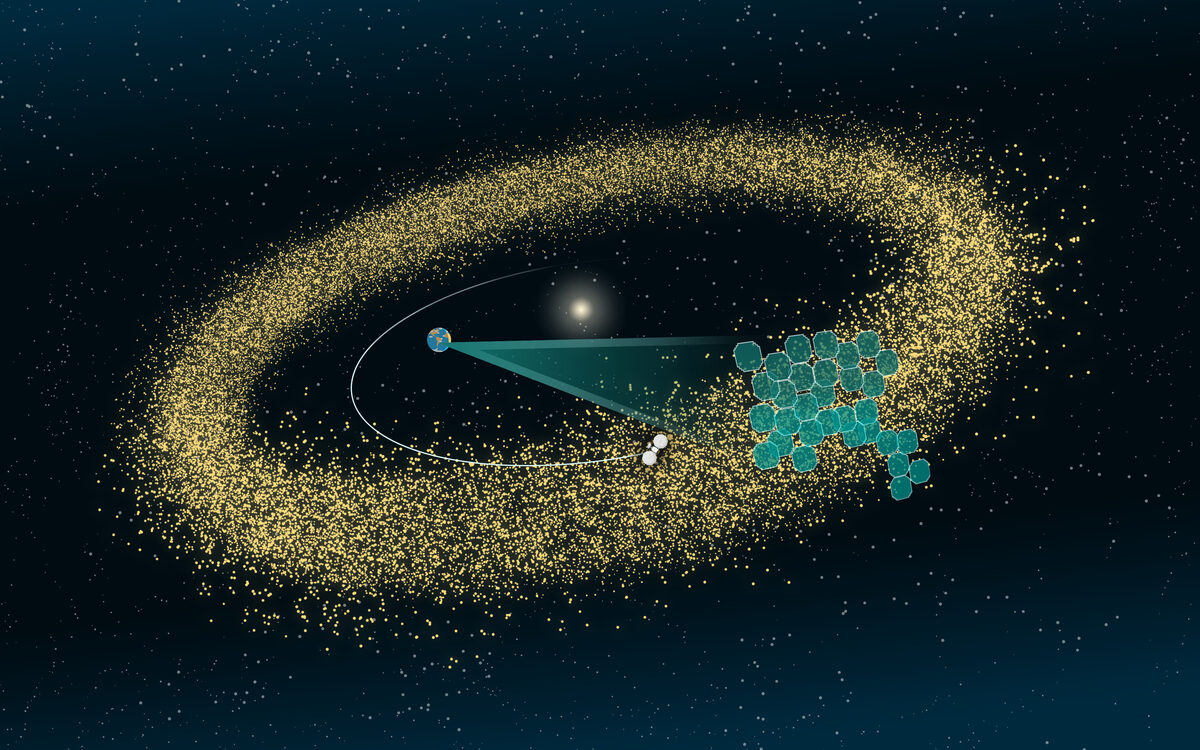
Congress passed the George E. Brown, Jr. Near-Earth Object Survey Act in 2005, mandating that NASA detect, track, and catalog 90 percent of all near-Earth objects 140 meters in diameter or larger by 2020. The mandate came 13 years after a 1992 congressional directive to survey kilometer-scale objects, which was largely achieved by ground-based surveys by the early 2010s. The 140-meter threshold matters because an object that size, impacting Earth, could devastate a region the size of a small country or generate catastrophic tsunamis if it hit the ocean. In 2005, NASA estimated roughly 25,000 such objects existed. Two decades later, ground-based surveys have found approximately half of them. The other half remain uncatalogued.
Ground-based surveys face a structural limitation: they can only observe at night, when the sky is dark enough to see faint reflected sunlight from asteroids. Objects in orbits that keep them close to the Sun — interior to Earth's orbit, or on trajectories that make them bright only near the horizon — are systematically missed. An infrared space telescope, positioned near the Sun-Earth L1 point and observing in thermal emission rather than reflected light, sees these objects regardless of their solar elongation and can detect them based on their own heat rather than sunlight.
Why infrared
Asteroids come in a wide range of surface reflectivities. A carbonaceous, dark asteroid reflects only a few percent of the sunlight it receives; a bright metallic asteroid may reflect 30 to 40 percent. A ground-based telescope that measures an asteroid's brightness in visible light cannot distinguish between a small bright object and a large dark one without additional data. An infrared telescope that measures thermal emission sees the asteroid's heat, which is directly related to its size regardless of surface color. NEO Surveyor's thermal measurements will allow accurate size estimates for every object it finds, something ground-based surveys cannot provide without extensive follow-up.
The telescope's two infrared channels — centered at 4.6 and 8 microns — were chosen to maximize sensitivity to room-temperature objects (rocky asteroids heated by the Sun) while remaining feasible with a passively cooled telescope. Active cooling to liquid helium temperatures, required for mid-infrared sensitivity, would have been too expensive and heavy for the mission budget. The two-channel design also allows basic temperature estimation, which feeds into size determination.
Survey design
NEO Surveyor is designed for a five-year primary survey, repeatedly scanning the sky in a pattern optimized to find objects with a wide range of orbital types. Objects in interior orbits that are difficult for ground-based surveys to see will be detectable from L1 because the spacecraft observes sunward, toward the region of sky where those objects spend most of their time. The survey is projected to complete the 90-percent catalog requirement within five years of survey operations — something no combination of ground-based surveys could achieve in the same timeframe.
The mission's relevance to planetary defense is direct. NEO Surveyor will find thousands of objects that current surveys have missed, and statistical models suggest that some fraction of those objects will turn out to have non-negligible impact probabilities when their orbits are refined. Most will be quickly ruled out as threats; a small number will require continued monitoring or early planning for deflection. The time required to mount a deflection mission — years to a decade or more — means that the earlier an object is found, the larger the menu of response options. NEO Surveyor's mandate is to push that discovery timeline earlier, systematically, for all the objects big enough to matter. The asymmetry of planetary defense is stark: any given 140-meter asteroid has a probability of impact that is exceedingly small in any given century, but the consequence of an undetected impact is irreversible and potentially civilization-altering. NEO Surveyor is the infrastructure investment that converts that asymmetry from a statistical argument into a catalogued reality — one object at a time, across five years of dedicated infrared sky survey.
