
NASA has a new X-plane, and it is not the one the internet was hoping for. On Wednesday, Nov. 4, 2026, NASA unveiled the X-70 Fractal at the UP.Summit at Kennedy Space Center in Florida, with Administrator Jared Isaacman saying the agency expects its first flight within two years. It is a crewed research aircraft built around what the agency calls "advanced, rapidly reconfigurable flight-control technology." The goal is to explore kinds of maneuverability that, according to NASA, have never been demonstrated in crewed flight.
Before the event, Isaacman had already confirmed that another X-plane was on the way. That set off a round of speculation about the SR-71. He had already said the new aircraft was "not the one you're thinking of," Migflug reported. The X-70 is not a speed-record machine. It is a flying laboratory: a modest, subsonic jet built so researchers can change how it handles and what it carries.
The numbers NASA released
The NASA announcement gives a short spec sheet:
- Takeoff weight: 10,000 lb
- Cruise speed: Mach 0.75
- Ceiling: up to 45,000 ft
- Range: more than 1,500 nautical miles (about 1,726 statute miles)
- Experimental payload: up to 2,000 lb, carried internally and externally
- Crew: crewed
The payload figure stands out. About a fifth of the aircraft's takeoff weight is set aside for experiments, and NASA says those experiments can go inside the airframe or be mounted outside it. According to AVweb, the design is modular, so researchers can change equipment between flights. The reconfigurable flight controls let them evaluate different handling characteristics on the same airframe.
Isaacman described the aircraft as "a crewed, high-performance platform to test advanced flight-control, maneuverability, and other cutting-edge technologies in real flight." On timing, he said: "We expect her first flight under the NASA banner within the next two years."
What "reconfigurable" buys you
Most research aircraft are built to answer one question. Their aerodynamics, control laws and instruments are fixed around that goal. To test a different idea, you build or borrow a different aircraft.
NASA's pitch for the X-70 runs the other way. If the flight controls can be quickly reconfigured, one airframe can take on several personalities. It might fly with one set of handling qualities on Monday and a very different one on Thursday, carrying a different set of experiments each time. Add the modular payload bays and the aircraft starts to look less like a single experiment and more like a shared test platform.
NASA has not published technical detail on how the reconfiguration works. It hasn't said whether it means software control laws, swappable control surfaces, or both, so it's too early to judge how far the idea goes. NASA's claim that the aircraft will explore maneuverability in ways never before demonstrated in crewed flight sets a high bar. The specifics will show whether the aircraft clears it.
What NASA hasn't said
The announcement leaves out a lot. The NASA announcement and the coverage of it leave several questions open:
- Who is building it. Migflug reports the builder has not been disclosed.
- How many engines it has. Migflug reports NASA has not said.
- What it costs. NASA's announcement gives no figure.
- When testing starts. AVweb notes that NASA has not provided a detailed flight-test schedule beyond the two-year first-flight target.
The single image NASA has released carries a "Generated Content" label, Migflug reports. It shows a bubble canopy and outward-canted twin tails. Take it as an illustration of intent, not a picture of real hardware.
Isaacman's wording also leaves room to interpret. "First flight under the NASA banner" could mean a new aircraft delivered from a manufacturer. It could also mean an existing aircraft moving over from another programme and flying its first sortie as a NASA asset. Migflug attributes that reading to The War Zone. NASA hasn't said which it is, and the phrasing doesn't settle it.
A place in the X-plane lineage
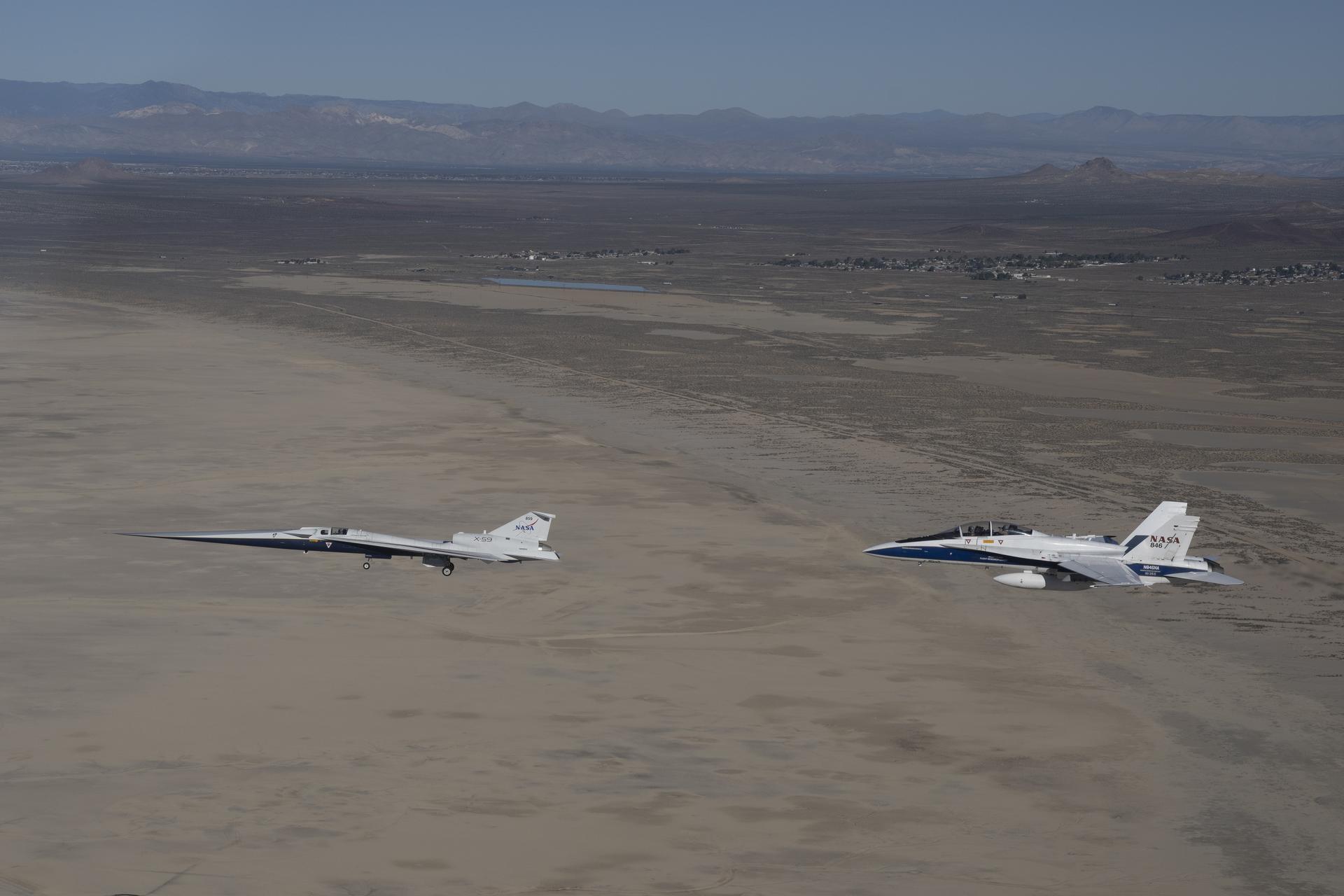
NASA and the outlets covering the announcement placed the X-70 in the long line of experimental aircraft. That line runs from the Bell X-1 in 1947 through the X-15 to the current X-59, as defence-industry.eu noted. AVweb points out that the X-59 has completed its first year of flight testing, so NASA is announcing its next X-plane while the current one is still flying.
"It's exciting to bring on another X-plane," said Laurie Grindle, director of the Aeronautics Division in NASA's Research and Technology Mission Directorate.
The setting looked chosen for effect. The unveiling came days before NASA's Max Power airshow at the same site, according to Migflug. A Kennedy Space Center stage, an industry summit audience and an airshow on the calendar all suit a reveal meant to build excitement about aeronautics as much as to brief engineers.
Why It Matters
X-planes are how NASA turns aerodynamic theory into flight data. Every crewed X-plane has to justify the cost and risk of putting a pilot in an experimental cockpit. The X-70's argument is versatility. One crewed aircraft with reconfigurable controls and 2,000 lb of payload capacity could in principle support many experiments that would otherwise each need their own dedicated vehicle or a long wait for time on a borrowed testbed.
The real test is execution. With no named builder, no engine count, no cost and no detailed schedule, the X-70 is so far a spec sheet, a quote about a first flight within two years, and an image labelled as generated. Those are reasonable starting points for a programme, not proof of one. Over the next year or so, look for who builds the aircraft, whether it is new or adapted from an existing airframe, and what NASA's first research campaign actually plans to fly. Those answers will show whether the X-70 is a lasting research platform or mainly something to show off at an airshow.
Sources
- NASA Announces X-70 Experimental Aircraft to Advance Flight Research (NASA)
- NASA Unveils X-70 Experimental Aircraft (AVweb)
- NASA X-70 Fractal: The New Crewed X-Plane Built to Rewire Its Controls (Migflug)
- NASA unveils X-70 Fractal, a crewed test aircraft with rapidly reconfigurable flight controls (defence-industry.eu)
