
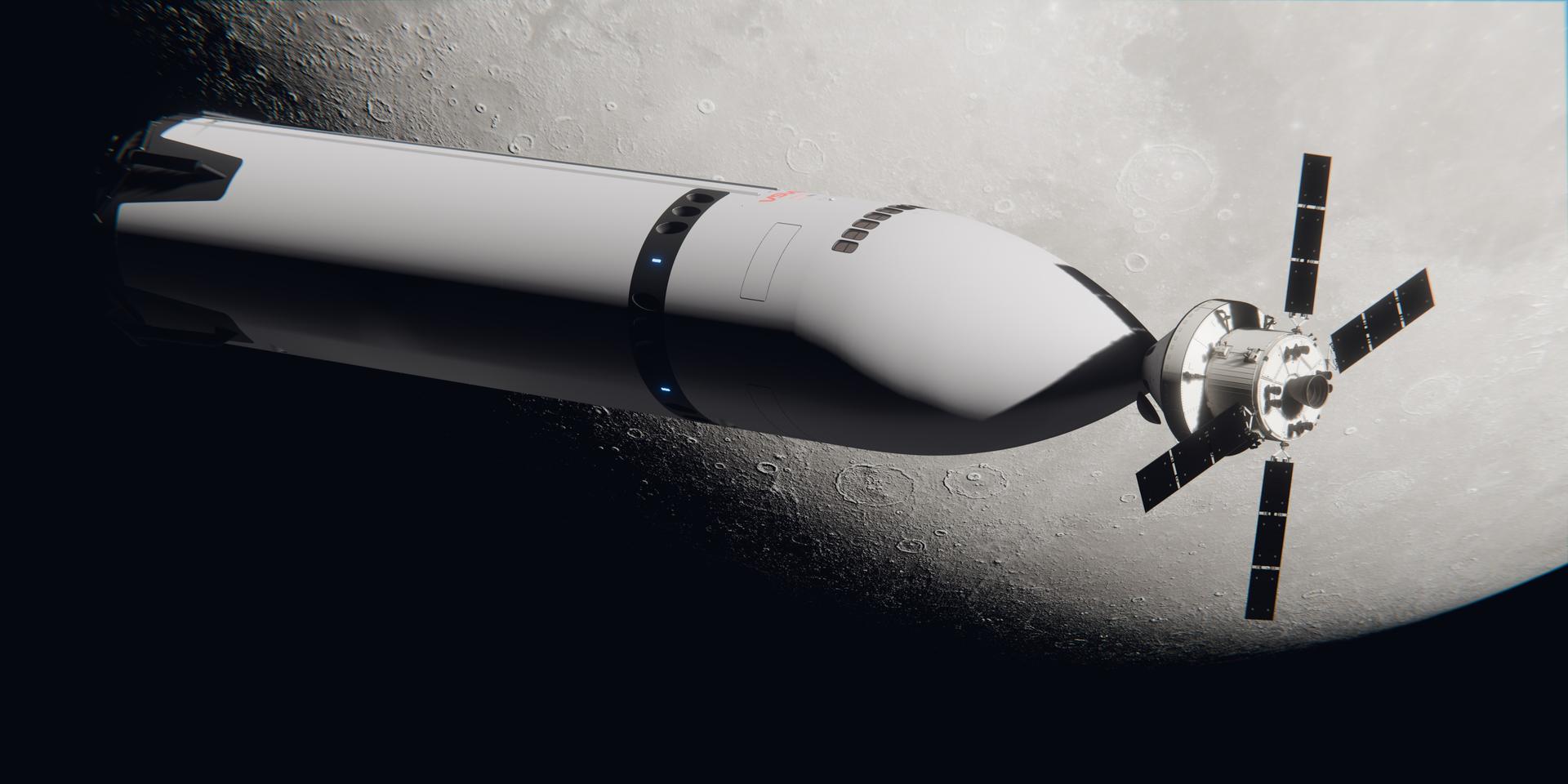
China's crewed lunar program has been visible for a while in pieces: a new rocket, a new crew ship, a lander with a poetic name, and a run of test firings. On October 31, at the opening of the 7th Manned Space Symposium in Beijing, the program put those pieces together in one public description of how they are supposed to work as a single mission.
The keynote came from Wang Xiang, deputy chief designer of China's crewed space program. According to CGTN's account of the talk, the plan is what Chinese engineers call "two launches, lunar orbit rendezvous." No single giant rocket carries everything. The lander and the crew vehicle fly to the Moon separately and meet there.
How the mission is meant to fly
The sequence Wang described goes like this:
- Two Long March 10 launches. One rocket carries the Lanyue lander (the name means "embracing the moon"). The other carries Mengzhou ("dream vessel"), the new crew spacecraft. Each is sent onto an Earth-moon transfer orbit.
- Rendezvous in lunar orbit. Lanyue and Mengzhou dock once both are around the Moon.
- Crew transfer and descent. Astronauts move from Mengzhou into Lanyue for the trip down. Universe Today reports that the crew will be three taikonauts, with two landing and the third presumably staying with the orbiting ship.
- Ascent and re-docking. The lander takes off from the surface and docks with Mengzhou again. Wang listed takeoff and re-docking among the steps the uncrewed rehearsal has to prove.
The rocket for the lunar mission is the three-stage Long March 10 variant with additional boosters, which Universe Today says has a payload capacity of 27 metric tons. CGTN says Wang described the two-launch approach as matching China's existing technical capabilities and infrastructure. In other words, China is splitting the job across two launches of an existing-class vehicle rather than waiting to build something far bigger first.
What has already been tested
The program's case that it is on schedule rests on hardware milestones, and CGTN lists several that are already done:
- A zero-height abort test of Mengzhou, which shows the escape system can pull the capsule away from a rocket on the pad.
- A max-q escape test of Mengzhou, covering an abort at the point of peak aerodynamic pressure during ascent.
- A landing and takeoff test of Lanyue.
- A low-altitude demonstration flight of the Long March 10, carried out on February 11, 2026, at the Wenchang launch site.
The China Manned Space Agency's own report on the symposium was more reserved. It said only that development work for the lunar-landing phase is "progressing steadily" and did not lay out the architecture itself. The detailed description comes from the coverage of Wang's keynote.
The road to a landing
China's stated target is a crewed landing before 2030. Astronauts will not be the first to fly the full sequence. Universe Today reports that an uncrewed Lanyue mission comes first, and Wang said that run will validate as many key technologies of the crewed process as possible: launch, orbiting the Moon, docking with Mengzhou, landing, takeoff and re-docking. Before that, the Tiangong space station will be used to check the rocket, lander and capsule in low Earth orbit.
Wang also framed the decision to develop the crew ship and lander as separate vehicles as more than a workaround. According to CGTN, developing them separately can help standardize production and support a long-term family of vehicles, not a single-use stack. He also credited the robotic Chang'e lunar program with results that support the crewed effort.
The longer-term plan reaches past the first landing. Universe Today notes that construction of the International Lunar Research Station is currently planned to begin in 2031, using the heavier Long March 9.
Why It Matters
A two-launch, lunar-orbit-rendezvous plan is a familiar trade in human spaceflight: launch two moderately sized rockets and accept a docking far from Earth, or build one very large rocket. China has picked the first option, which means its first landing will depend on a docking near the Moon, followed by a second docking after liftoff from the surface. Those are the steps Wang singled out for the uncrewed rehearsal, and for good reason. A failed docking at either end could end the mission.
Universe Today points out that NASA's Artemis III also depends on rendezvous operations, so both programs are now betting on docking reliability in deep space. The difference in China's case is that the public plan is now concrete: named vehicles, a rocket that has already flown a low-altitude demo, a list of completed abort and lander tests, and a defined uncrewed rehearsal that comes first. The test campaign still ahead is large. But by the program's own description, the pre-2030 target now rests on a specific sequence of flights that observers can watch happen, or not happen, over the next few years.
The symposium itself showed the scale of the effort. CMSE reports more than 800 experts attending the two-day meeting, which invited 11 academicians to give keynote reports, and drew 364 papers across 15 sub-forums. It was organized by the China Manned Space Engineering Office and co-hosted by Beihang University.
A note on dates: Universe Today's report gives the date of Wang's remarks as November 3. CGTN, which said he spoke on Saturday, and the official CMSE page, which dates the symposium's opening to October 31, point to the opening day, and this article uses that date.
