
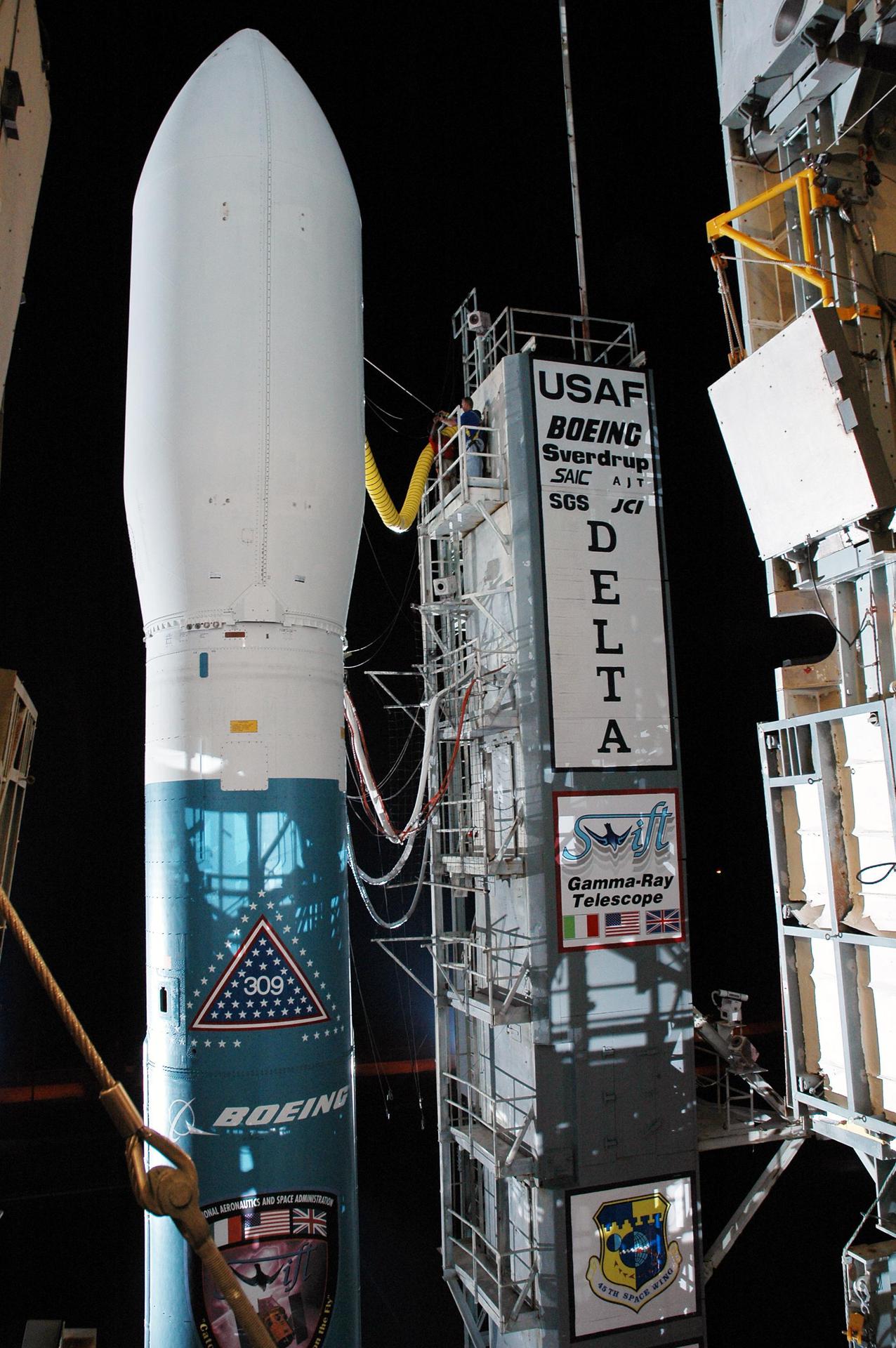
Swift launched in 2004 on a two-year prime mission. It is ending almost 22 years later, coming down in an uncontrolled fall through Earth's atmosphere. According to NASA's latest update, the gamma-ray observatory should reenter on Wednesday, Nov. 4. The U.S. Space Force's prediction puts it at about 3:30 a.m. EST, give or take 11 hours.
That error bar is nearly a full day wide, and that is normal for a spacecraft falling without control. The questions people ask are the obvious ones: when, where, and whether anyone should worry. Here is what the agencies and trackers have said.
How did Swift get here?
Swift's orbit had been decaying, and there was a plan to save it. The commercial rescue mission, Katalyst's LINK spacecraft, was meant to capture the observatory and boost it into a higher orbit. EarthSky reports that on Aug. 19 NASA and Katalyst announced LINK would not capture or boost Swift because of an attitude control problem on the commercial spacecraft. NASA's Oct. 23 update says the servicing mission ended in August without an attempt to boost the observatory.
After that, the team restarted science observations, which it had paused to minimize drag while the boost mission was pending. NASA says the return to observations increased drag on the spacecraft, and Swift again began to sink rapidly. On Oct. 20, Swift reached an altitude of 171 miles (275 km), could no longer compensate for the drag and went into safe mode. The operations team at Penn State then sent a command that, in NASA's words, effectively ended Swift operations to prepare it for reentry.
When exactly will it come down?
No one can say exactly. Predictions for uncontrolled reentries depend heavily on atmospheric drag, and drag depends on solar activity. A more active Sun heats and expands the upper atmosphere, so a satellite skimming through it slows down faster.
That is why the estimates differ. NASA, citing Space Force, gives about 3:30 a.m. EST on Nov. 4 (08:30 UTC), with an uncertainty of 11 hours. EarthSky reports an estimate that moved earlier because of recent active solar weather: 05:31 UTC on Nov. 4, plus or minus 12 hours. The two windows overlap almost completely, and NASA's figure, which comes from Space Force, is the one to treat as the agency position. The gap between them shows how much the forecast still depends on space weather in the final hours.
For readers in the Americas, EarthSky notes that the current timing would put reentry in the afternoon or evening of Tuesday, Nov. 3, or overnight into Wednesday, Nov. 4.
Where will it fall?
NASA says that, because of Swift's low inclination, any surviving fragments will land between 20.6 degrees south and 20.6 degrees north latitude. That keeps the debris away from most mid- and high-latitude regions. Inside the band, NASA says the location depends on when the spacecraft reenters. With a window measured in hours and the spacecraft circling the planet quickly, the spot stays uncertain until very late.
Aerospace engineer Dean Sladen told Space.com that the band is mostly ocean, though it also crosses populated parts of Africa, South and Southeast Asia and Latin America. That is a large part of why a strike on people is unlikely, though not impossible.
Will anything survive, and is anyone in danger?
NASA describes Swift as a spacecraft of roughly 3,200 pounds. Space.com puts it at about 3,300 pounds (1,500 kg). NASA expects most of it to burn up on the way down, but says some components are expected to survive reentry. Sladen named the six heavy reaction wheels and tougher telescope parts such as lenses and mirrors as the likeliest survivors, and said only a handful of small, scorched fragments are expected to reach the surface.
NASA puts the risk of harm coming to anyone on Earth at approximately 1 in 2,100, and calls it unlikely. That is the chance that anyone, anywhere, is hurt, not the risk to any single person, which is far smaller. LeoLabs' Darren McKnight told Space.com he expects Swift to disintegrate enough not to pose a ground casualty hazard, while noting that the internal workings of its X-ray and optical telescope might survive.
Can you see it?
Possibly, if you happen to be under the right part of the sky at the right moment. EarthSky points readers to the Swift Last Light website to check whether the fiery reentry might be visible from their location. Given the uncertainty in time and place, though, most people will learn about the reentry after it has already happened.
What was lost?
Swift carried three telescopes: the Burst Alert Telescope (BAT), the X-Ray Telescope (XRT) and the Ultraviolet/Optical Telescope (UVOT). NASA describes it as a multi-tool that could rapidly point at short-lived outbursts and send alerts to other facilities to help coordinate follow-up observations. It studied gamma-ray bursts, the most powerful explosions in the universe, and also contributed to work on active galaxies, supernovae, stellar X-ray flares, and comets and asteroids in our own solar system.
The mission was planned to last two years and ran for more than two decades, so the end came after a long stretch of extended operations rather than abruptly.
The disappointing part is how it ended. A commercial boost was a real option this year, and it did not fly. After the servicing mission ended, the team resumed observing, and NASA says Swift went on to observe hundreds of science targets, from stellar explosion remnants to active supermassive black holes and comets. The same return to observations increased drag and shortened the spacecraft's remaining time in orbit.
Why It Matters
Swift's reentry matters for three reasons. The first is the science gap: an observatory that ran far past its design life is gone, and the instruments it carried go with it. The second is that the rescue attempt was a real-world test of commercial on-orbit servicing for an aging government science satellite. It ended before any boost was tried, because of a problem on the servicer itself. NASA Administrator Jared Isaacman said the agency will put lessons from LINK's rendezvous attempt to work on the missions that follow, and the episode is a reminder that the approach is still unproven.
The third is the reentry itself. A 1-in-2,100 risk of harm to anyone on Earth is low, but it is not zero. The atmosphere will do most of the work on Wednesday, but not all of it, and NASA and Space Force will keep monitoring the descent and updating predictions as the final hours play out.
Sources
- NASA's Swift Observatory to Re-Enter Atmosphere (NASA Science, Nov. 2, 2026)
- NASA's Swift Mission Ends Ahead of Re-Entry (NASA Science, Oct. 23, 2026)
- Swift spacecraft fiery reentry will be in the next 2 days (EarthSky, Nov. 2, 2026)
- NASA's Swift space telescope is about to crash to Earth. Where will it fall? (Space.com, Nov. 1, 2026)
