
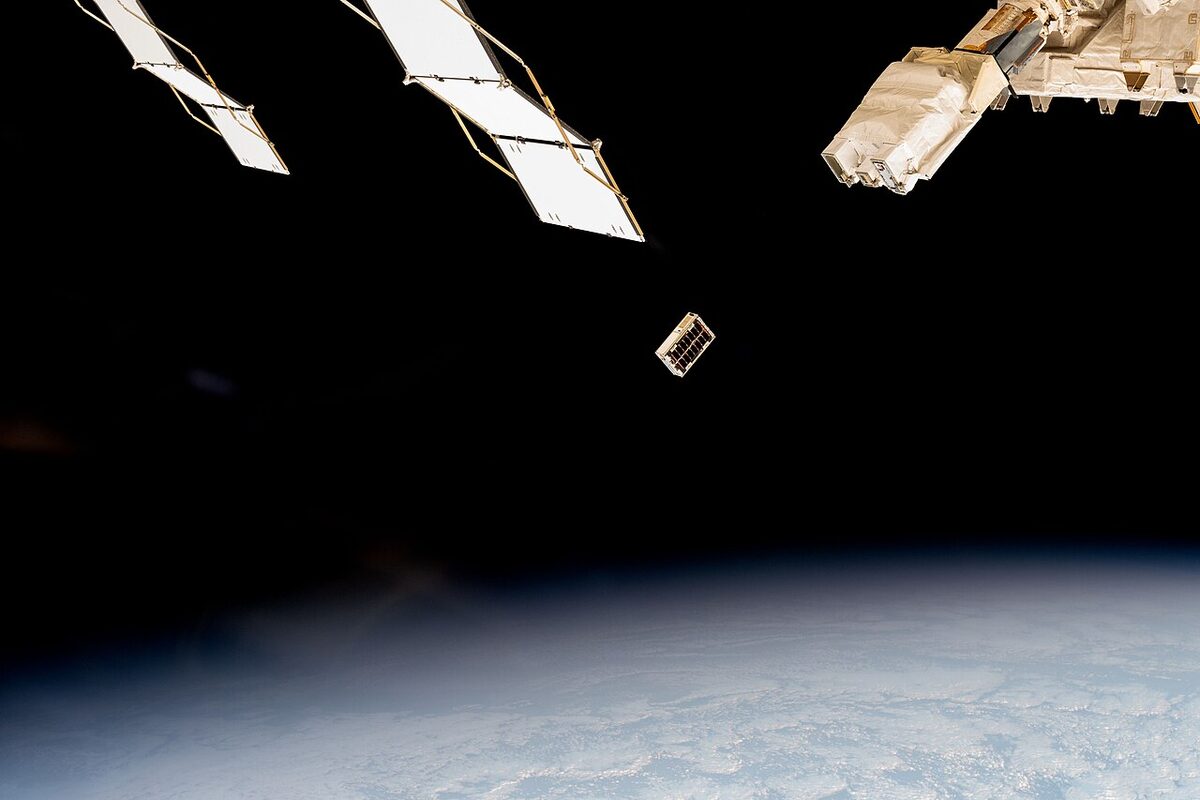
You cannot build a radio telescope ten kilometers across. You can, however, fly six small satellites far enough apart that, working together, they behave like one. That is the elegant premise behind NASA's SunRISE mission — the Sun Radio Interferometer Space Experiment — which is targeting a summer 2026 launch to study the Sun in a band of radio waves that never reaches the ground.
Each of SunRISE's six spacecraft is small, roughly the size of a toaster oven. Spread across about ten kilometers of empty space above Earth, they will record low-frequency radio emissions from the Sun and, crucially, the precise timing and position of each measurement. On the ground, scientists will combine those separate recordings into a single dataset using a technique called interferometry — the same principle that lets arrays of dishes on Earth mimic one enormous telescope. The result is a virtual radio telescope far larger than any single instrument could be.
Why go to space for radio
The reason SunRISE has to fly is that Earth's atmosphere blocks the long-wavelength radio waves it wants to study. The ionosphere — the charged upper layer of our atmosphere — reflects and absorbs these low frequencies, walling them off from ground-based observatories. To hear them at all, you have to get above the ionosphere. Only from space can SunRISE listen to this part of the Sun's radio output.
What it will hear are solar radio bursts: blasts of radio energy unleashed when the Sun's tangled magnetic field suddenly reconfigures and flings particles outward at tremendous speeds. These bursts accompany the eruptions — solar flares and coronal mass ejections — that drive space weather. SunRISE's special trick is that it can image roughly where a burst originates and which way the accelerated particles are streaming, tracing the Sun's magnetic structure from the outer corona out into interplanetary space.
A forecasting tool, not just a telescope
That directional information is the practical payoff. Space weather is not an abstraction. The same particle storms SunRISE will track can endanger astronauts beyond the protection of Earth's magnetic field, disrupt satellites, scramble navigation and communications, and in extreme cases stress electrical grids on the ground. As NASA pushes crews toward the Moon and eventually Mars — far from Earth's shielding — forecasting these storms shifts from a convenience to a safety requirement.
By pinpointing where a radio burst comes from and where its energetic particles are headed, SunRISE could help forecasters predict where a radiation event will strike and how severe it will be. The mission's data will travel home over NASA's Deep Space Network, the same antenna system that talks to probes across the Solar System.
The mission is a relatively lean one by NASA standards, led on the science side by a university team and managed by the agency's Jet Propulsion Laboratory, and it reflects a deliberate strategy of buying capability rather than building a flagship. SunRISE is launching as a rideshare — hitching to orbit alongside another payload rather than commanding a rocket of its own — which keeps costs down at the price of a more complex path to its operating position. Getting six spacecraft deployed and flying in the tight, well-measured formation that interferometry demands is itself part of what the mission has to prove. No one has operated a space-based radio interferometer of this kind before, so SunRISE is as much a technology demonstration as a solar observatory — a proof that the concept works at all.
SunRISE is also a demonstration of a broader trend: doing big science with swarms of small, relatively cheap spacecraft rather than a single expensive one. If six toaster-sized satellites flying in loose formation can reconstruct the Sun's radio storms in detail, the same formation-flying approach could be turned on other targets — a hint of how space telescopes might be built in an era of small satellites and shared, distributed instruments.
