
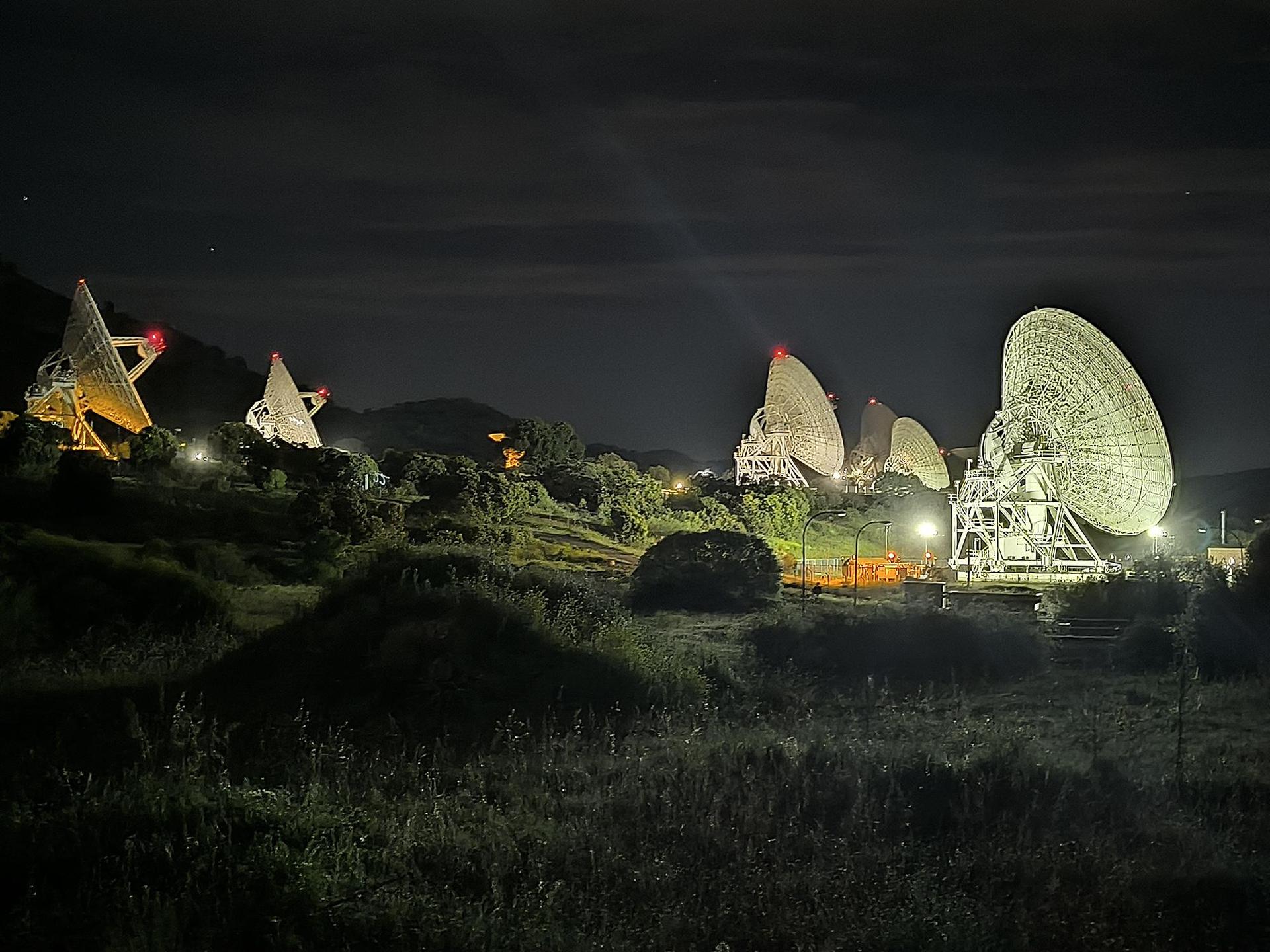
When you are trying to hold a phone call with a spacecraft billions of miles away, weather on Earth is not supposed to be the problem. But on Friday, July 24, 2026, it was. Wildfires sweeping across Spain forced NASA to evacuate the Madrid Deep Space Communications Complex (MDSCC) near Robledo de Chavela, roughly 37 miles west of the capital — one of just three ground stations on the planet that keep humanity in continuous contact with its interplanetary robots.
All 90 workers at the site were evacuated, and NASA reported everyone was safe. The wider emergency was far larger than one antenna field: more than 25,000 people were evacuated across Spain as major fires burned through the region. For NASA, though, the evacuation created a specific and unusual operational puzzle. What happens when one-third of the Deep Space Network suddenly goes dark?
A three-legged stool, and one leg just wobbled
The Deep Space Network, or DSN, is NASA's backbone for talking to everything beyond Earth orbit. It is not a single dish or a single site. It is three complexes — Goldstone in California's Mojave Desert, the Madrid facility in Spain, and a third outside Canberra, Australia — deliberately spaced far apart in longitude, roughly evenly around the globe. That geometry is the whole point. As the Earth rotates, a spacecraft that drops below the horizon at one site rises into view at the next, so at least one complex can always keep a lock on a distant mission. NASA describes the DSN as "the largest and most sensitive scientific telecommunications system in the world," and that is not marketing bluster: each complex fields a 70-meter dish, a 26-meter dish, and multiple 34-meter antennas to pull in signals that arrive as barely-there whispers.
The Madrid complex is a full peer in that trio, hosting the same class of hardware, including the enormous 230-foot (70-meter) antenna. Take one leg out of a three-legged stool and the remaining two have to carry the load. That is exactly what happened here.
The handoff worked
NASA said mission support was "seamlessly transitioned" to the Goldstone complex in California. In plain terms: the tracking passes that Madrid would have run got picked up by Goldstone instead, and the spacecraft on the other end of those links never lost their connection to Earth.
The most evocative example is Voyager 1. Now the most distant human-made object in existence, its signal has grown so faint over the decades that a single big dish is no longer enough to hear it clearly. Its downlink currently requires an array of five antennas working together — and eventually six — combining their collective sensitivity to reconstruct the trickle of data still arriving from interstellar space. Keeping that link alive through a ground-station evacuation is a genuine test of the network's redundancy, and by NASA's account the system passed it.
Worth underlining: this was not a graceful, scheduled handoff planned weeks in advance. It was a response to a fire bearing down on the facility in real time. The fact that it came off without an interruption to mission support is the strongest possible argument for why the DSN was designed with three sites in the first place.
Madrid — and its ESA neighbor — appear to have dodged the worst
As of the evacuation, NASA had not yet been able to assess damage to the Madrid antennas; that assessment was pending until it was safe for personnel to return. Early reporting, however, was cautiously encouraging. NASA's Madrid DSN complex and the European Space Agency's nearby Cebreros ground station both appeared to escape serious damage as the wildfires burned through the region. Cebreros is ESA's own deep-space tracking station, so the two agencies effectively had adjacent high-value assets in the fire's path — and both seem to have come through without major harm to the hardware.
That is a preliminary picture, not a final verdict. Fire behavior is unpredictable, and a full inspection of sensitive receiver electronics, cabling, and the antennas' mechanical systems is the kind of thing you do carefully and slowly once the danger has passed.
Why It Matters
It is easy to think of deep-space missions as self-contained — a probe out there, doing science on its own. They are not. Every image from Mars, every particle count from the edge of the solar system, every command uploaded to a distant spacecraft passes through one of these three ground complexes. The DSN supports far more than a couple of aging Voyagers: NASA lists deep-space probes, lunar missions, Mars relay traffic, spacecraft parked at Lagrange points, and highly elliptical orbit (HEO) missions among its customers. When one complex goes offline, the tracking schedule for dozens of missions has to be reshuffled onto the remaining two.
Friday's evacuation is a reminder that space infrastructure has a terrestrial soft underbelly. The antennas may point at the cosmos, but they sit on real ground, drawing real power, staffed by real people who can be threatened by a wildfire. Climate-driven fire seasons are lengthening and intensifying in many parts of the world, and two of the three DSN complexes — Goldstone in the Mojave and Madrid in the Spanish interior — sit in exactly the kind of hot, dry landscapes where that risk is rising. The network's built-in geographic redundancy absorbed this event cleanly. But redundancy has limits: it works precisely because the sites are far apart and unlikely to be hit at once. The real lesson is less "the system failed" and more "the system worked, and here is a concrete look at why its three-site design is worth the expense."
For now, the headline is a good one: no injuries, no lost missions, and a Voyager downlink that kept flowing across the Atlantic to California while a ground station on another continent was being evacuated. The damage assessment at Madrid will tell the rest of the story once crews can safely return.
