
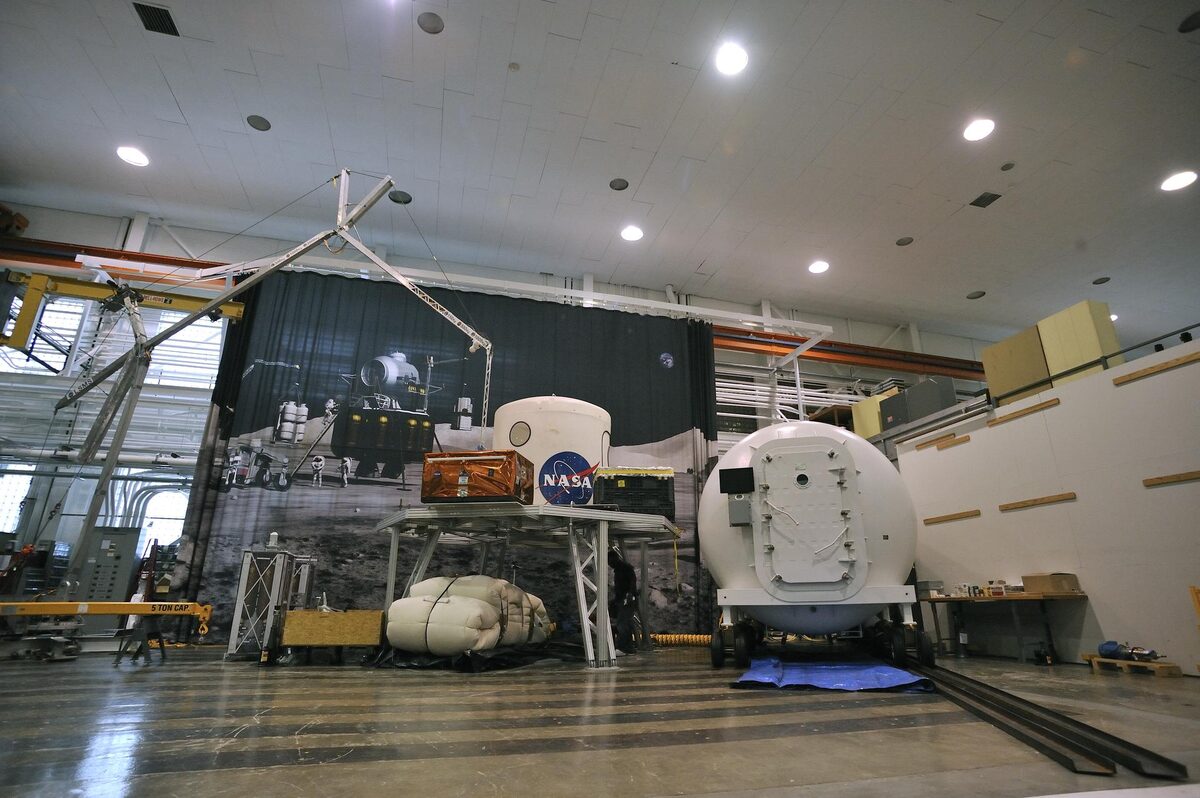
NASA announced its newest student competition at a rocket garden, in front of an audience of students, during a weekend when the agency's administrator had skydived into the event the day before. On Sunday, Nov. 8, Administrator Jared Isaacman stood among the vintage rockets at the Kennedy Space Center Visitor Complex and announced the Moon Base Student Challenge, a multiphase competition with $1 million in total prizes for teams that work on the engineering problems of living on the Moon.
"We're putting 1 million in prizes together," Isaacman told the crowd, according to Space.com. The formal details came in NASA Release 26-096. The challenge is open to student teams at US high schools and post-secondary schools, and registration runs through the NASA STEM Gateway until Jan. 25, 2027.
The setting: MAX POWER
The challenge was announced during MAX POWER, which NASA calls its inaugural aerospace expo. It was a multi-day event held in and around Kennedy Space Center to mark America's 250th anniversary. The event leaned into spectacle. Isaacman skydived in on Nov. 7, and Space.com reports he also flew a fighter jet during the weekend. NASA used the expo for several announcements at once: a new X-plane, recruitment for a new astronaut candidate class, the Moon Base challenge, and an update on its lunar plans.
Among those, the student challenge is the one most directly aimed at people who are not yet in the aerospace workforce. NASA's release says the challenge is meant to help participants build skills for careers in the space industry.
What the teams will actually work on
The competition does not ask for one complete "build a Moon base" entry. NASA has split the problem into six categories, each covering one of the basic systems a crewed surface outpost needs:
- Power generation and storage: producing electricity on the lunar surface and storing it.
- Construction: building the base's physical structures.
- Life-support systems: keeping crews alive inside it.
- Surface mobility: moving people and equipment across the terrain.
- Communications networks: linking surface assets with each other and with Earth.
- Astronaut safety: protecting the crew that works there.
According to Archyde's aggregated report, which draws on NASA's release, the concepts are meant for a habitat at the lunar south pole. NASA's own release describes the Moon Base as located in the lunar South Pole region.
The deliverables also say something about how NASA has set this up. NASA lists trade studies, concept proposals, and stakeholder briefings, which the release describes as industry skills, and says participants need no prior specialized engineering or technical experience. Those are the working documents of real systems engineering. A trade study makes a team compare alternatives against stated criteria and defend its choice. A stakeholder briefing makes a team explain that choice to people who did not design it and may not agree with it. Isaacman described the structure to the crowd as a "multi-phase competition that mirrors how ideas are developed actually in the aerospace industry": teams first submit concepts, then refine them, and finalists present their solutions directly to NASA leaders and stakeholders.
Who runs it
NASA's release quotes three people from the agency: Isaacman; Carlos García-Galán, manager of NASA's Moon Base Program; and Elaine Ho, associate administrator for the Office of STEM Engagement. According to the release, the Office of STEM Engagement designed the challenge in collaboration with the Moon Base Program. A challenge backed only by the education office could stay a pure outreach exercise. Having the Moon Base Program involved suggests the problem categories are tied to the program's real engineering questions and are not just generic STEM prompts, though NASA has not said so in those terms.
The Institute of Competition Sciences administers the challenge through a contract with the NASA Center of Excellence for Collaborative Innovation, which sits within the agency's Research and Technology Mission Directorate. Full rules and details are posted at moonbasechallenge.org.
What we don't know yet
The public materials leave several questions open. NASA describes the challenge as multiphase but has not explained in its announcement how the $1 million will be split among phases, categories, and divisions, or whether high school and post-secondary teams will compete against each other. Applicants should read the full rules on the challenge site rather than assume anything about prize sizes or judging. The announcement also does not say whether winning concepts will feed into NASA's own lunar surface planning, though Isaacman said the real opportunity is to work on problems NASA is actively trying to solve right now.
Why It Matters
Agencies run student competitions all the time, and many are mostly public relations. This one has a few features that make it more interesting.
First, the size. $1 million is a sizable prize pool for a competition open to high schoolers, and Isaacman himself framed the prize money as secondary to the chance to work on live NASA problems before graduation.
Second, the structure. Breaking a Moon base into power, construction, life support, mobility, communications, and safety matches how the engineering would plausibly be divided. A team that focuses on one area, such as storing power through the long lunar night or keeping a communications network running across uneven terrain, is working on a real, bounded problem instead of a vague dream.
Third, the timing and the audience. NASA made the announcement at an event built around the country's 250th anniversary, to a crowd of students, during the same event where it announced astronaut candidate recruitment. The message was clear: the agency wants the people who will eventually design, build, and staff a lunar outpost to start thinking about it now. Whether a high school trade study changes how NASA builds anything on the Moon is uncertain. A cohort of students who have argued over power budgets and life-support tradeoffs before they reach college is a more likely payoff, and possibly the more valuable one.
Teams have until Jan. 25, 2027 to register through the NASA STEM Gateway.
Sources
- NASA Announces $1 Million to Students for Moon Base Challenge (NASA Release 26-096, Nov. 8, 2026)
- NASA just launched a $1 million Moon Base Student Challenge (Space.com, Nov. 9, 2026)
- MAX POWER: NASA's Inaugural Aerospace Expo Ignites America's Future (NASA, Nov. 9, 2026)
- NASA Announces $1 Million Moon Base Student Challenge (Archyde, Nov. 8, 2026)
