
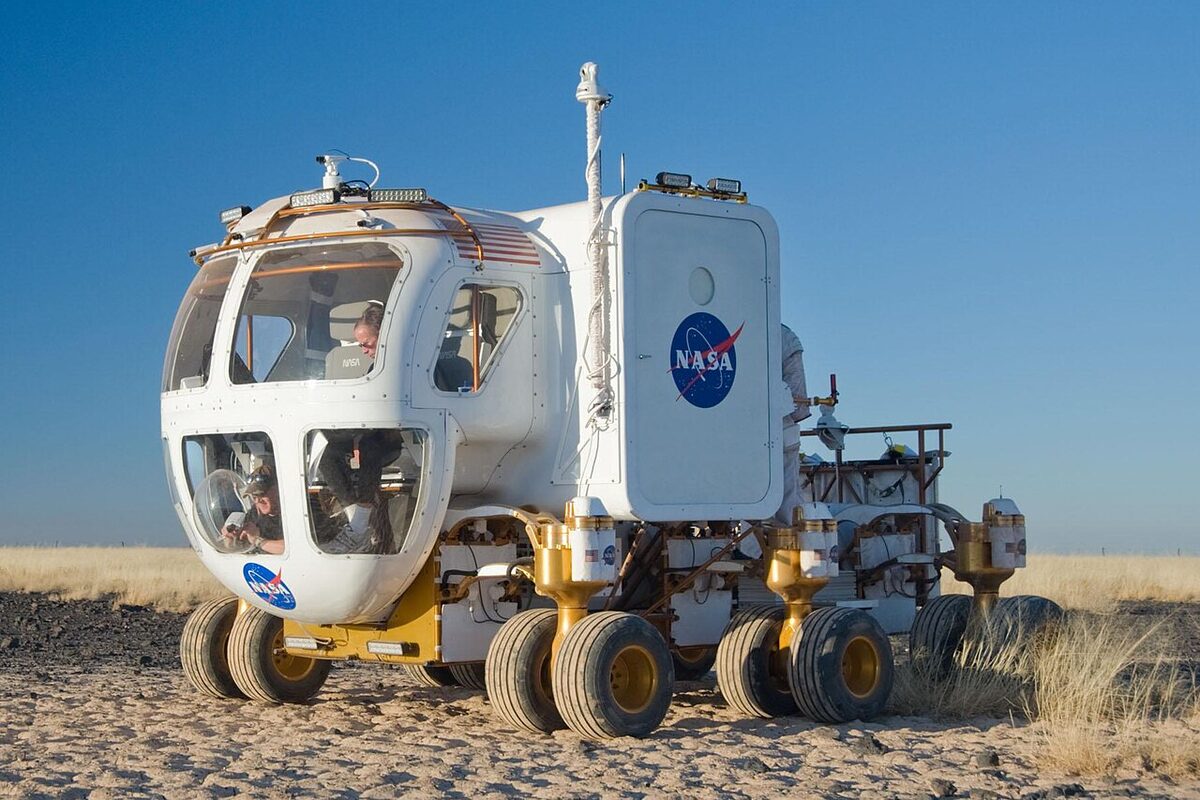
For most of the Artemis era, NASA's talk of a sustained presence on the Moon has been exactly that — talk, sketched in renderings and roadmaps. At a Moon Base event at the agency's Washington headquarters, that picture got noticeably more concrete. NASA used the gathering to lay out the commercial hardware meant to turn a string of one-off landings into something closer to infrastructure: rovers for astronauts to drive across the surface, and a line of uncrewed cargo landers to deliver the equipment a base would need.
The framing is a deliberate shift. Artemis has so far been organized around individual flights — get a crew around the Moon, then get a crew onto it. A "Moon base," by contrast, implies things that stay: power, mobility, science instruments, and the regular cargo runs to keep them supplied. NASA's update was an attempt to name the pieces and the partners that would make that permanence real.
Wheels and cargo
Two categories of hardware anchored the announcement. The first is crewed mobility — pressurized and unpressurized rovers that would dramatically extend how far astronauts can travel from a landing site, turning a few hundred meters of walking range into kilometers of driving range. Mobility is the difference between visiting a spot and exploring a region, and at the lunar south pole, where the science targets are scattered across rugged, permanently shadowed terrain, range matters enormously.
The second is cargo delivery. NASA outlined uncrewed landers designed to set down payloads — rovers, habitats, experiments, supplies — without a crew aboard. The agency's first Moon Base mission, Moon Base I, is targeted for launch as soon as this fall using Blue Origin's Blue Moon Mark 1 "Endurance" lander to carry NASA payloads to the surface. That would mark the transition from demonstrating that commercial landers can reach the Moon to actually using them to stock a site.
The mobility push builds on work already underway. NASA had previously brought commercial teams into its Lunar Terrain Vehicle program — a competition to develop an unpressurized, car-like rover for astronauts to drive at the south pole, which would also operate remotely as a robotic explorer between crewed visits. The pressurized rovers now being discussed are the larger, longer-range cousins of that effort: enclosed, shirtsleeve cabins that would let crews range far from a lander for days at a time. Together the two classes of vehicle sketch a surface program built around the ability to actually move around, rather than staying tethered to a single landing spot.
A crowded lunar manifest
The Moon Base hardware sits atop an unusually busy lunar calendar. The coming stretch is set to include a wave of robotic missions: Intuitive Machines' IM-3 aiming for the magnetic anomaly at Reiner Gamma, Astrobotic's Griffin Mission One headed for the south pole, and Firefly's Blue Ghost Mission 2 targeting the lunar far side later in the year. Each is a commercial flight carrying NASA and other payloads under the agency's strategy of buying rides rather than building everything itself.
That strategy is the throughline. Rather than develop landers and rovers in-house, NASA is contracting them from companies and committing to be a paying customer — the same model that reshaped low Earth orbit with cargo and crew flights to the space station. Applied to the Moon, the bet is that a steady stream of commercial deliveries can build up a surface presence faster and cheaper than a purely government program.
The caveats
Plenty could slow it down. Commercial lunar landings remain hard, with a mixed record of successes and failures on recent attempts. Schedules in this part of the program have a long history of slipping, and the broader Artemis architecture — including the crewed landings these robots are meant to support — faces its own budget and technical pressures. A signed contract is not a landed rover.
Still, the Moon Base event reflected a real change in posture: from describing a lunar base in the abstract to naming the vehicles, the missions, and the dates that would assemble one. The Moon, in NASA's telling, is no longer just a destination to reach but a place to outfit.
