
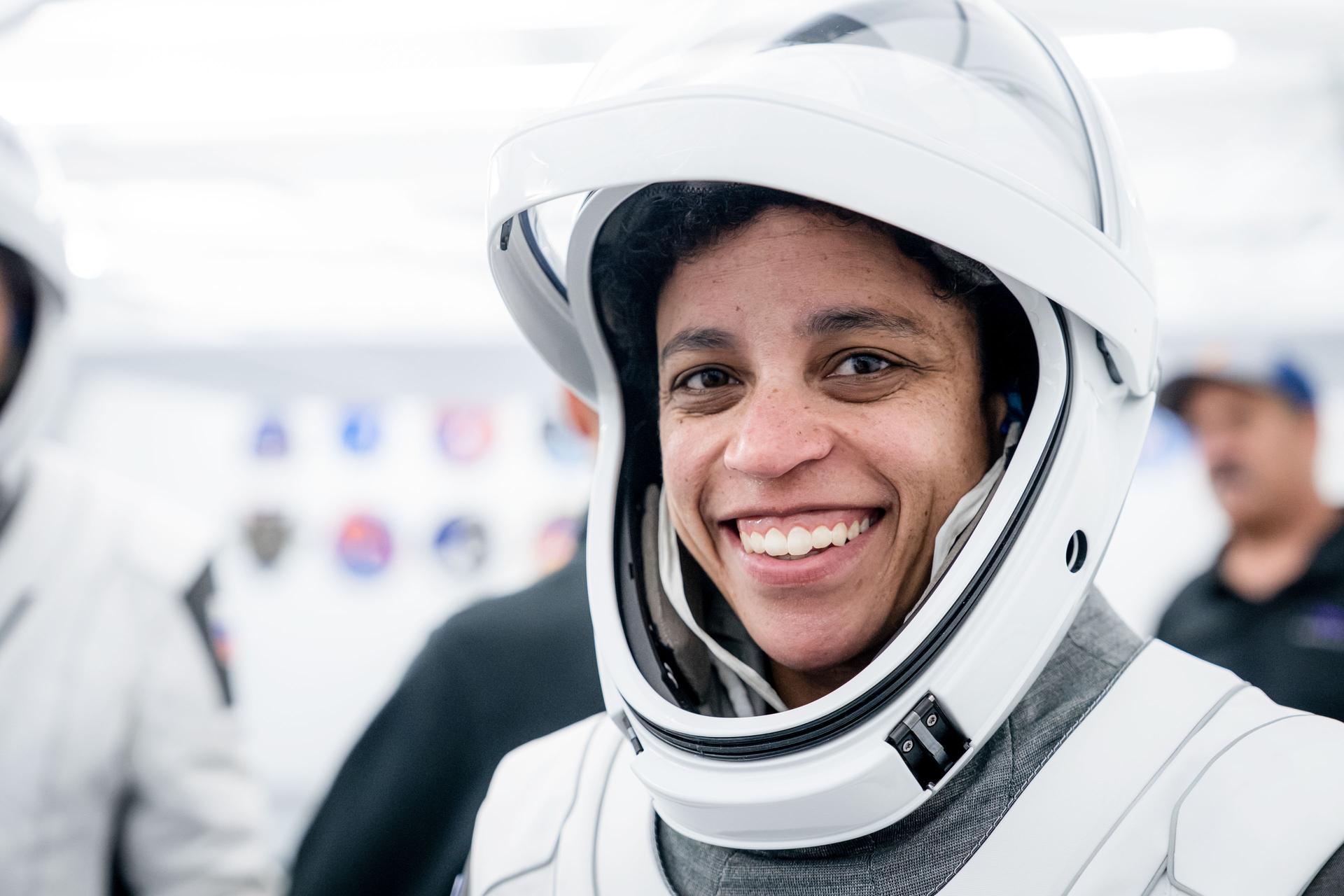
Four astronauts stood in front of cameras at Johnson Space Center in Houston on Monday, taking questions about a mission that won't leave the ground for another six weeks or so. That's standard practice for NASA, which likes to put a crew in front of the press well before launch day — partly for public engagement, partly because it's the last extended chance reporters get to talk to them before final launch preparations take over. Monday's back-to-back briefings did exactly that for SpaceX Crew-13, the next long-duration mission bound for the International Space Station.
The lineup: NASA's Jessica Watkins will command the mission, joined by fellow NASA astronaut Luke Delaney as pilot — his first trip to space. Rounding out the crew are Joshua Kutryk of the Canadian Space Agency and Sergey Teteryatnikov of Roscosmos, both serving as mission specialists. Three space agencies — NASA, CSA, and Roscosmos — are represented on a single Crew Dragon capsule, which has become the norm for these rotational missions since NASA and its partners started spreading seats across the international crew corps.
Two Briefings, One Message
NASA split Monday's press activity into two sessions. A mission-overview news conference ran at noon EDT, laying out the flight profile, launch vehicle, and station operations the crew will support. A separate crew news conference followed at 2 p.m. EDT, giving Watkins, Delaney, Kutryk, and Teteryatnikov the floor to talk about their individual roles and expectations. Both were held at Johnson Space Center, and NASA said this was Crew-13's final media availability before the crew heads to Kennedy Space Center in Florida for launch.
Crew-13 is targeting liftoff no earlier than mid-September 2026, riding a Falcon 9 rocket and Crew Dragon spacecraft from Cape Canaveral — the launch vehicle and spacecraft combination NASA has used for its commercial crew rotations to the station. NASA has not yet set an exact launch date, which is typical this far out; a firmer target usually emerges a few weeks before flight once station traffic and weather windows are locked in.
Meanwhile, Work Continues Aboard the Station
Crew-13 won't arrive at an idle station. The current residents, flying under Expedition 75, have a packed schedule in the days immediately following Monday's announcement. Chief among them: a spacewalk scheduled to begin at 8:35 a.m. EDT on Thursday, August 6, with NASA astronauts Jessica Meir and Anil Menon venturing outside to build a platform that will support installation of a roll-out solar array later this year. The platform work is a necessary staging step before the array itself goes up.
Beyond the spacewalk, Expedition 75 crew members are continuing a slate of research that NASA has flagged as part of the station's ongoing science output — including testing of exercise hardware such as the European Enhanced Exploration Exercise Device and the EasyMotion-2 electrical muscle stimulation suit, designed to help counteract the muscle and bone loss that comes with long-duration weightlessness; studies of astronauts' circulatory systems and hearing in microgravity; and evaluation of AI-based tools meant to help crews work more efficiently during their limited orbital hours. None of that pauses for a crew announcement; it's the daily grind that keeps the station's research mission moving between rotations.
Why It Matters
Crew-13 is another entry in NASA's ongoing cadence of SpaceX Dragon capsules ferrying astronauts to and from the ISS, keeping the station continuously staffed. Routine, though, doesn't mean unremarkable. The four-person crew represents three national space programs — NASA, CSA, and Roscosmos — riding together on commercial American hardware, an arrangement that would have seemed unlikely a decade ago when Soyuz was the only ride to orbit for many of NASA's partners. Luke Delaney's first flight also matters in a narrower sense: NASA's astronaut corps needs a steady pipeline of newly flown crew members to sustain operations as the agency's attention increasingly splits between the ISS and future commercial stations and Artemis lunar missions.
The August 6 spacewalk is worth watching too, even though it's a supporting task rather than a headline event. Roll-out solar arrays are the upgrade astronauts are now building toward, and keeping the station's power system modern is part of what allows NASA to keep extracting scientific value from the ISS. And the research NASA highlighted — exercise countermeasures, circulatory and hearing studies, AI-assisted crew scheduling — is the unglamorous but essential work that will inform how future crews stay healthy and productive on missions far longer than a six-month ISS rotation, including eventual trips to the Moon and Mars.
