
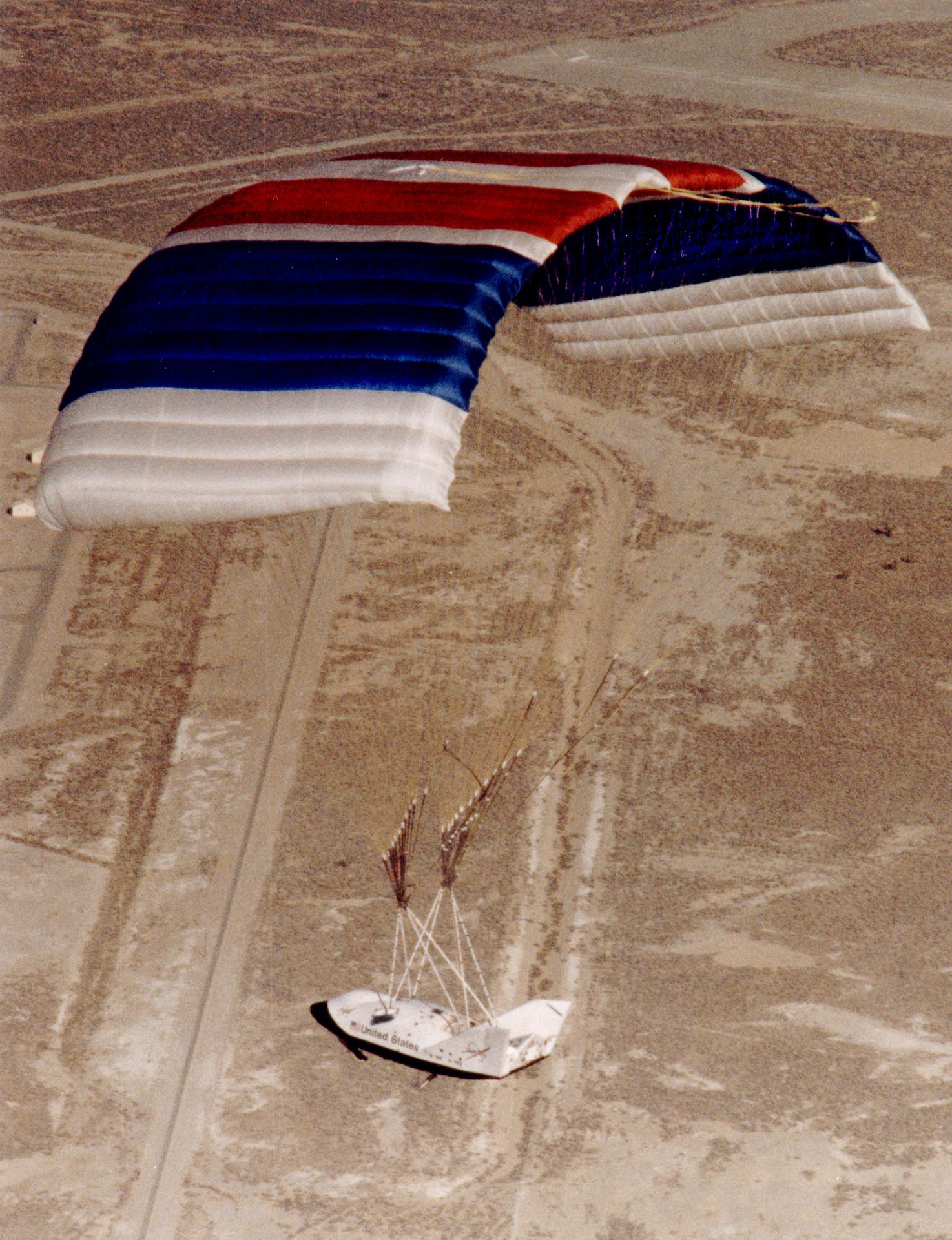
Landing is the hard part of building a reusable spacecraft, and on Oct. 6 the European Space Agency got a reminder of it. A full-scale mock-up of Space Rider, Europe's planned reusable uncrewed orbital vehicle, was dropped from a helicopter roughly 3 kilometers above a military test range in Sardinia. Its drogue chute opened as planned. Then the main parafoil, the large steerable wing meant to carry the vehicle down to the ground, came off during deployment. The test article fell freely and hit the ground.
An ESA spokesperson told Space.com that an anomaly happened during the parafoil deployment sequence and that an independent investigation is underway. According to L'Unione Sarda, ESA's statement said the final system-level release test, conducted in October, was not completed as planned because of an anomaly in the deployment of the parachute wing, and that the test model was lost.
What Space Rider is supposed to do
ESA describes Space Rider as Europe's first reusable space transportation system. It is an uncrewed robotic laboratory about the size of two minivans. It will launch on a Vega-C rocket, stay in low Earth orbit for about two months, and then bring its payloads back to Earth and land on a runway.
That last step is the one under test in Sardinia. Space Rider doesn't glide in on wings the way the Space Shuttle did. Space.com describes a wingless, lifting-body design that relies on a steerable parafoil to maneuver toward its landing area. A drogue parachute deploys first to slow the vehicle, then the larger parafoil unfurls. The Unione Sarda report gives the parafoil's size as 27 meters long and 10 meters wide. The vehicle dropped in these tests is a full-scale stand-in for the 4.6-meter reentry module.
Thales Alenia Space leads the development and Avio is co-contractor, according to the Italian paper. The drop-test campaign has been running since April at the Salto di Quirra range in collaboration with the Italian Air Force. Space.com notes the range is operated by Italy's Ministry of Defense.
A test campaign that was already behind
The October drop was not the first try at this final test. Space.com reports that an earlier attempt in May was aborted before release after a sensor flagged an issue during preparations, and the range was then unavailable from June through September. So the Oct. 6 drop was the first drop test since May, and it ended with the hardware destroyed.
Investigators do have some help. ESA recovered all of the components, Space.com reports. That gives the team physical evidence to examine alongside the flight data, which should help them identify which attachment, release or sequencing step failed.
Space Rider's thermal protection has had a better run. Space.com reports that heat-shield materials went through plasma wind tunnel tests at temperatures around 1,600 degrees Celsius earlier this year. That work covers the most intense part of returning from orbit. The Sardinia campaign covers what comes after it: getting a vehicle that has survived reentry down to the ground slowly enough to fly again.
Does this push back the launch?
ESA has not announced a schedule change. Géraldine Naja, ESA's director of space transportation, said at an ESA Council media briefing on Oct. 22 that the remaining qualification activities are not on the critical path of Space Rider's development, according to Space.com. She said she hopes the test will not force changes to the remaining schedule. That is a narrow statement. It says other qualification work is not what is holding the vehicle back, without saying how long the parafoil fix will take.
The Unione Sarda report puts the debut, in theory, in the second quarter of 2028. Whether that holds depends on what the independent investigation finds. A minor fault might be corrected with another drop, while a design problem in the parafoil system would likely take longer. Either way, the test model was lost, and the range was unavailable for four months earlier this year, so scheduling another full-scale drop is a real question.
Why It Matters
Space Rider is meant to give ESA its own reusable way to fly payloads in low orbit for about two months and return them intact. That is useful for microgravity experiments, technology demonstrations and anything that has to be examined on the ground after flight. The whole idea depends on landing gently and accurately enough to fly again. Space.com calls the steerable-parafoil landing a critical requirement for the vehicle's planned reuse, and a vehicle that can't reliably get its parafoil open can't meet it.
Losing a test article in development is not unusual. Naja herself described testing and validation as part of developing a space system, and drop tests use mock-ups so that failures like this happen over a test range and not during a real mission. Still, it's a setback in the one subsystem that makes Space Rider different from an ordinary capsule, and it comes in a test campaign that had already lost time to an aborted attempt and to range unavailability. The investigation's findings, and how quickly ESA can schedule another full-scale drop, will show whether the 2028 target is realistic.
