
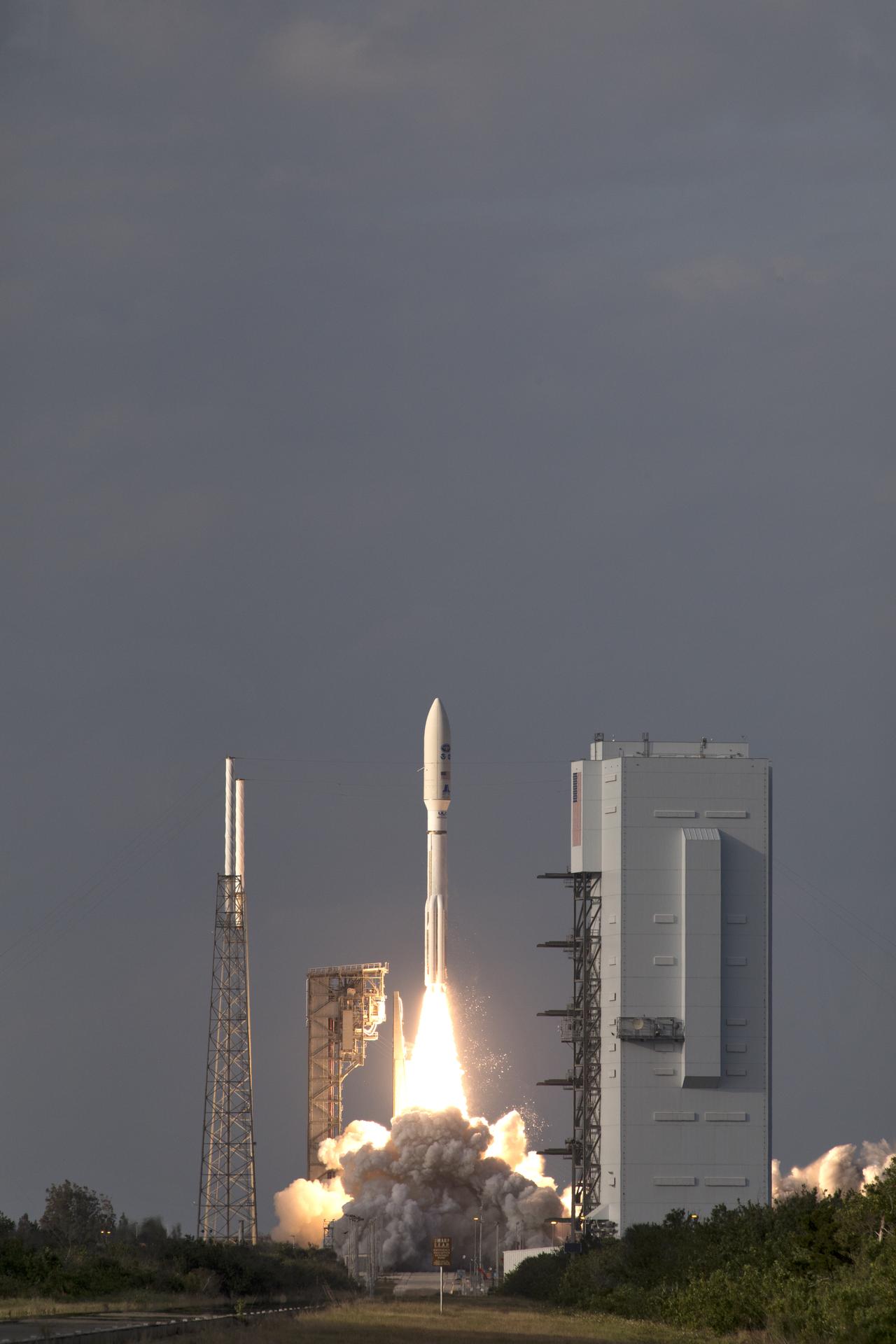
On July 2, 2026, the European Space Agency issued Press Release N°33-2026, a logistical-sounding document with a deceptively simple purpose: it's calling for journalists who want a seat at Europe's Spaceport in Kourou, French Guiana, to watch the launch of Meteosat Third Generation Imager-2. Accreditation closes July 16. The launch itself is targeted for no earlier than the last week of August 2026.
Buried in the administrative details of a press-credentialing announcement is a genuinely significant milestone for European meteorology and for the Ariane 6 rocket program. MTG-I2 will be Ariane 6's ninth flight overall — and its first to geostationary orbit, a 36,000-kilometer-high perch where a satellite's orbital period matches Earth's rotation, letting it stare at the same slice of the planet continuously. Every previous Ariane 6 mission has gone elsewhere. This one is different, and EUMETSAT and ESA both want it photographed.
What MTG-I2 Actually Does
MTG-I2 will complete a three-satellite Meteosat Third Generation constellation now in orbit, and according to EUMETSAT's own release, it is designed to serve as an in-orbit backup for Meteosat-12, the system's current primary imaging satellite. That backup role matters more than it might sound — geostationary weather satellites are the backbone of short-term forecasting and severe-storm warning across Europe and Africa, and having a ready spare in orbit means a hardware failure doesn't translate into a forecasting blackout.
The satellite carries two main instruments. The first is a Flexible Combined Imager, which delivers high-resolution imagery over Europe every 2.5 minutes — twice as fast, per EUMETSAT, as the rapid-scan service the outgoing Meteosat Second Generation satellites provided, fast enough to catch a thunderstorm cell developing in something close to real time. The second is the headline instrument: a Lightning Imager capable of monitoring more than 80% of Earth's surface from its geostationary vantage point.
Detecting lightning from geostationary orbit is a different problem than watching cloud tops. Optical lightning imagers stare down at the top of the atmosphere and pick out the brief flashes of light that leak upward from a strike, day or night, over ocean and continent alike, at electro-optical speeds satellites in lower orbits simply can't sustain because they're not parked over one spot. Combined with the Flexible Combined Imager's faster scan rate, ESA says the MTG system as a whole is generating at least 50 times more data than the previous-generation Meteosat Second Generation satellites did — a jump that reflects just how much more granular geostationary weather monitoring has become since MSG's design was frozen years ago.
The Rocket Doing the Lifting
The launch vehicle is Ariane 62 — the two-booster configuration of Ariane 6, as opposed to the four-booster Ariane 64 used for heavier payloads. EUMETSAT's release and independent trade-press coverage from Satellite Evolution both confirm the Ariane 62 assignment, along with EUMETSAT's role as the satellite's operator once it reaches orbit. An independent launch-tracking listing corroborates the Kourou (ELA-4) launch site, though it currently estimates the launch for September 2026 — a slightly later window than ESA's official "no earlier than the last week of August" target, a reminder that these dates remain preliminary outside ESA's own press materials.
For Ariane 6, a program still working through its early flight cadence, a geostationary mission is a meaningful test. Geostationary transfer orbit launches typically demand more from a rocket's upper stage — a longer coast phase, precise reignition, and a final burn that has to be accurate enough to leave the satellite's own thrusters with a manageable amount of orbit-raising left to do. Getting that right on flight nine, after eight missions to other destinations, is part of what European launch officials will be watching closely, even if the public narrative is about the weather satellite riding on top.
Why It Matters
Weather satellites rarely get the spotlight that planetary probes or crewed missions do, but MTG-I2 closes out a constellation that changes how fast Europe can see severe weather coming. A Lightning Imager watching 80% of the globe means forecasters get an early, continuous signal of storm intensification — lightning rates are a well-established proxy for how violently a storm is developing — well before radar or ground networks would catch the same signal in many regions, including over open ocean where ground-based detection barely exists at all. Paired with a Flexible Combined Imager that refreshes an image of Europe every 2.5 minutes — twice as fast as its predecessor's rapid-scan service — the practical effect is more lead time on severe weather warnings and a sharper picture for the numerical models that feed them.
It also matters as a milestone for Ariane 6. Europe's newest heavy launcher has spent its first eight flights building a track record; putting a flagship, EUMETSAT-operated satellite on flight nine — and doing it to geostationary orbit for the first time — is a vote of confidence from the agencies that depend on the rocket working exactly as advertised. If MTG-I2 gets to orbit cleanly, it both completes a next-generation weather system Europe has been assembling for years and gives Ariane 6 its first geostationary success to point to.
None of that guarantees a smooth countdown. Launch dates measured in "no earlier than" terms are exactly that, and geostationary missions leave less room for error than most. But the accreditation deadline is set, the rocket and payload are assigned, and barring a slip, late August or September 2026 will be the moment Europe's weather-watching constellation gets its backup eye — and its Lightning Imager starts watching four-fifths of the planet for the first flicker of a storm.
Sources
- Call for interest: MTG-I2 launch media programme at Europe's Spaceport — ESA
- Meteosat Third Generation Imager 2 to be launched by Arianespace on Ariane 62 rocket — EUMETSAT
- Meteosat Third Generation Imager 2 to be launched by Arianespace on Ariane 62 rocket — Satellite Evolution
- MTG-I2 Mission (Ariane 6) — RocketLaunch.Live
