
Every June 30, a slightly unusual entry appears on the world's calendar of observances. There is no parade, no fixed mascot, and no guaranteed astronomical event to mark it. Instead, International Asteroid Day exists to make people think, for one day, about a category of natural disaster that is both extraordinarily rare and uniquely preventable: an asteroid hitting Earth. In 2026 the observance falls on a Tuesday, and it was designated by the United Nations in 2016 as a global day of education about asteroids, planetary defense, and space science.
The timing is not incidental. Asteroid Day 2026 lands in the narrow window between two of the most consequential planetary-defense milestones humanity has ever attempted. Behind us is NASA's DART mission, which in 2022 became the first real-world demonstration that we can deliberately change an asteroid's path. Ahead of us is the European Space Agency's Hera spacecraft, ESA's follow-up asteroid mission, which is built to turn DART's one-shot result into something closer to repeatable science.
What actually happened at Dimorphos
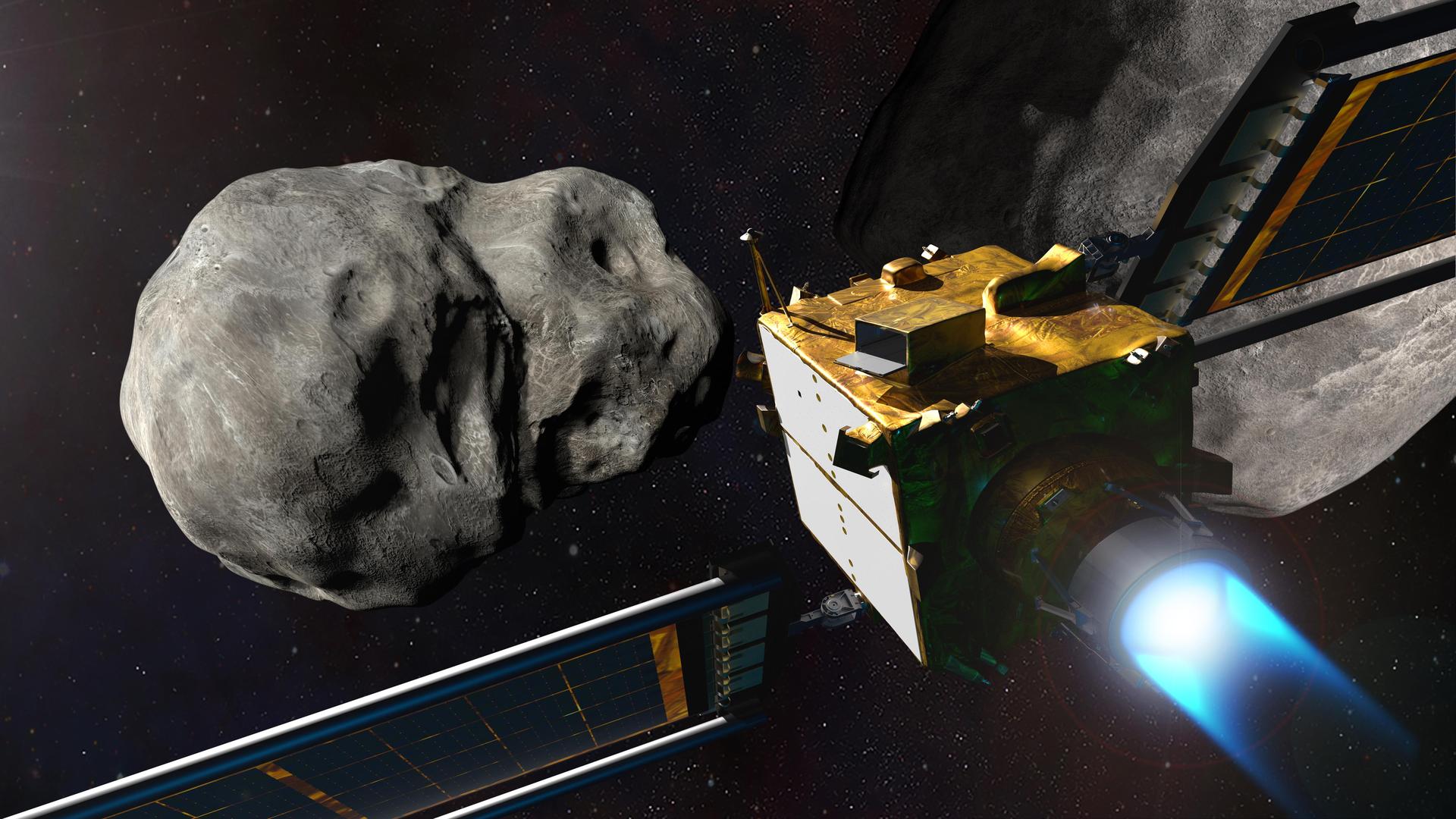
To understand why 2026 matters, you have to go back to the experiment that started it. DART, the Double Asteroid Redirection Test, was built and operated by the Johns Hopkins University Applied Physics Laboratory for NASA's Planetary Defense Coordination Office. Its target was deliberately chosen for measurability rather than menace: Dimorphos, a small moonlet orbiting the larger asteroid Didymos. Neither object posed any threat to Earth. The point was not to save the planet but to find out whether ramming a spacecraft into an asteroid would move it in a way we could detect from the ground.
It did. NASA confirmed that the September 26, 2022 impact shortened Dimorphos's orbit around Didymos by 32 minutes, cutting the moonlet's circuit from 11 hours and 55 minutes down to 11 hours and 23 minutes. For a technique whose entire premise rests on the idea that a tiny nudge applied years in advance can translate into a wide miss later, that is an enormous result — NASA noted it exceeded the mission's minimum success threshold by more than 25 times.
That single number — 32 minutes — is now the baseline against which the next phase of planetary defense will be measured.
Why Hera is the other half of the experiment
DART proved the asteroid moved. What it could not fully answer is why it moved as much as it did. When a spacecraft slams into a rubble-pile asteroid, the deflection comes from two things: the momentum of the impactor itself, and the recoil from the plume of debris blasted off the surface. NASA found that this recoil substantially enhanced DART's push against Dimorphos — a little like air streaming out of a balloon sends the balloon the other way. But the exact size of that effect depends on details we still don't know well: the asteroid's mass, its internal structure, how loosely it's bound together, and the shape and depth of the crater the impact left behind.
That is the job ESA built Hera for. Hera is ESA's own asteroid mission, and it is designed to study the aftermath of the deflection in close, deliberate detail. Where DART hit the asteroid and died on impact, Hera will linger, mapping Dimorphos and characterizing exactly what DART did to it.
The distinction matters enormously for anyone who wants to use this technique for real. A kinetic impactor is only useful as a defense if engineers can predict, in advance, how much a given asteroid will move when struck. Turning DART's success into an engineering tool — something you could aim at a genuinely threatening object with confidence — requires the ground-truth measurements that only a spacecraft on the scene can collect. That is precisely why the follow-up matters as much as the original test: it is the moment the deflection experiment finally gets its close-up.
An awareness day with an agenda
Asteroid Day itself is the public-facing arm of all this. It is structured less as a celebration than as a recurring reminder, backed by the UN, that impact hazards are a solvable problem if they are taken seriously while there is still time to act. The 2026 programming reflects that practical bent. The official organization ran its Luxembourg public program on June 26 and 27, ahead of the June 30 observance, and events worldwide bring scientists, educators, and the public together to explore asteroid science, the role of space missions, and risk-mitigation strategies.
Those efforts span what amounts to a pipeline rather than a single capability — detection, deflection, and crisis preparedness. Detection means finding hazardous objects early enough, through sky surveys and tracking, to do anything about them at all. Deflection is the part DART and Hera are validating: actually changing an object's trajectory. Crisis preparedness is the unglamorous remainder: what governments and emergency agencies do in the scenario where an impact can't be prevented and a region has to be warned, evacuated, or hardened. Asteroid Day's value is that it puts all three in front of the public on the same day, rather than letting planetary defense live only in mission press releases.
Why It Matters
For most of human history, an asteroid impact belonged to the same mental category as a supervolcano or a nearby supernova: a catastrophe you could name but never prevent. DART changed that. For the first time, there is hard evidence — a measured 32-minute orbital shift — that a deliberate human action can alter the path of a celestial body. But a single successful test is not yet a reliable defense. The gap between "it worked once on a harmless target" and "we can aim this at a real threat and know the outcome" is exactly the gap Hera is built to close when it reaches Dimorphos. That is what makes this particular Asteroid Day more than a symbolic date on the calendar. It falls in the interval between proof-of-concept and validation, when the question has shifted from "can we move an asteroid?" to "how precisely can we predict the move?" The answer will determine whether kinetic deflection becomes a dependable tool or remains a promising one-off — and the public-education push around June 30 is the mechanism that keeps the political and financial will alive long enough to find out.
