
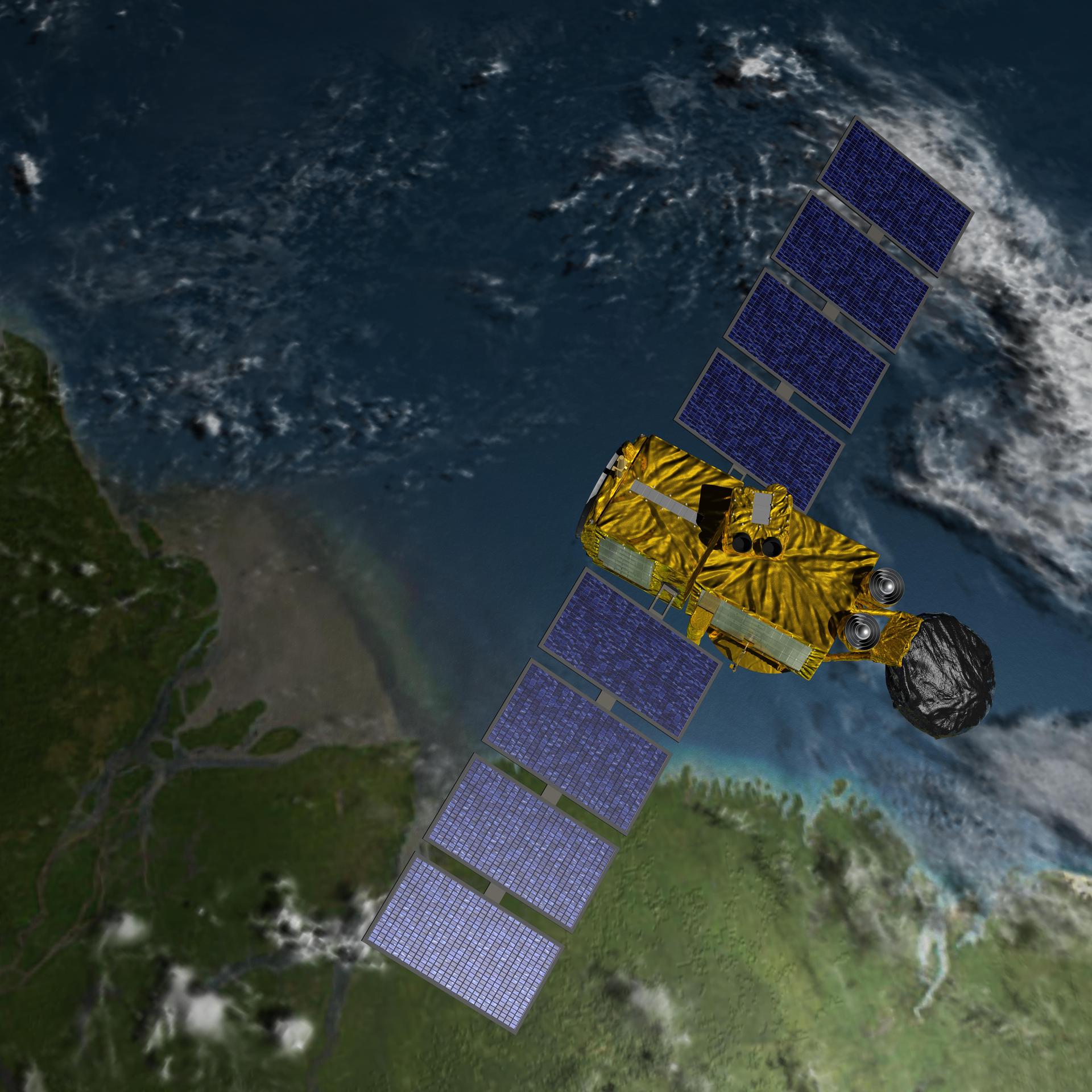
In the pre-dawn dark of the Gobi Desert, a Long March 4B lifted off from the Jiuquan Satellite Launch Center at 07:46 China Standard Time on July 2 (23:46 UTC on July 1), carrying a satellite whose job is not to look up at the stars but down at the sea. The payload was Haiyang-2E, the newest member of China's HY-2 marine-environment monitoring program, and its arrival in orbit does something quietly important: it restores and expands a constellation that had been leaning on aging hardware.
The China National Space Administration confirmed the launch and a successful orbital insertion, describing Haiyang-2E as a new satellite dedicated to monitoring the ocean environment. Behind that terse official language is a spacecraft built to keep a persistent, all-weather watch over the surface of the world's oceans.
What Haiyang-2E Actually Does
Haiyang-2E is a roughly 1,500-kilogram satellite built by the China Academy of Space Technology (CAST) for the National Satellite Ocean Application Service, which operates under the State Oceanic Administration. In other words, this is an operational workhorse commissioned by the users who need the data, not a one-off science demonstrator.
The satellite carries three microwave instruments, each doing a distinct job:
- Microwave Radiometer Imager (MWRI) — captures sea-surface heat and temperature by measuring the ocean's thermal microwave emission.
- Radar Altimeter (RA) — bounces radar pulses off the sea surface to measure its height, the raw input for tracking sea state, waves, and ocean circulation.
- Ku-band Rotational Fan-beam Scatterometer (SCAT) — reads the roughness of the sea surface to derive the marine wind vector, meaning both wind speed and direction.
Microwave instruments are the deliberate choice here. Unlike optical cameras, they see through cloud cover and work regardless of daylight, which is exactly what you want if your goal is uninterrupted coverage of wind, temperature, and sea state across an entire planet's oceans.
Replacing the Old Guard, Completing the Network
Haiyang-2E is a replacement for Haiyang-2B. Satellites age, instruments degrade, and an operational service cannot afford gaps, so bringing a fresh spacecraft online is less a headline achievement than a maintenance imperative done well.
The more interesting part is the networking. Haiyang-2E is the first of a new trio — to be joined by Haiyang-2F and Haiyang-2G over this year and next — that is set to progressively replace the current HY-2B, HY-2C, and HY-2D satellites. A single spacecraft can only revisit a given patch of ocean so often; a constellation of them, properly spaced, shortens the revisit time and tightens the temporal resolution of the data. For applications like tracking a developing storm's wind field or watching sea-surface temperature shift over days rather than weeks, that cadence is the whole game.
With HY-2B handing off to HY-2E and two more replacement satellites planned, China's operational ocean-monitoring backbone is set to be steadily refreshed.
The Rocket and the Running Tally
The launch vehicle was a Long March 4B, a three-stage liquid-fueled rocket and a natural fit for the sun-synchronous, repeating-ground-track orbits that Earth-observation missions favor. It delivered Haiyang-2E into sun-synchronous orbit from Jiuquan, one of China's oldest and busiest spaceports.
This flight also nudged several counters forward. It was the 57th launch of the Long March 4B specifically, the 118th of the broader Long March 4 series, and — the number that tends to draw attention — the 654th launch of the Long March family overall. That cumulative tally is a useful shorthand for the sheer operational tempo China's flagship rocket line now sustains.
Why It Matters
Ocean-observation satellites rarely make front pages, but the data they produce is load-bearing for a lot of things people do care about. Sea-surface wind vectors feed weather and typhoon forecasting. Sea-surface temperature and height data underpin climate monitoring, ocean-current modeling, and fisheries and shipping decisions. A gap in that stream degrades all of it.
By replacing an aging satellite and rolling out a fresh trio of ocean observers, China is doing the unglamorous work of keeping an operational Earth-observation service continuous and improving its revisit cadence at the same time. It is also a reminder of the pace behind the numbers: a 654th Long March launch is not a milestone so much as a heartbeat. For readers who track spaceflight as a barometer of national capability, the steady drumbeat of routine, purpose-built missions like Haiyang-2E often says more than any single spectacular flight.
Sources
- China launches new satellite to monitor ocean environment — China National Space Administration
- Replacement Haiyang-2 Ocean Spacecraft Delivered Into Orbit — China in Space
- CASC Haiyang 2E Long March 4B Rocket Launch — Space Launch Schedule
- China launches oceanographic satellite for enhanced marine monitoring — China Daily
