
The full Moon of Oct. 26 has started to wane. Over the next week it will cross some of the best-known stars of the autumn sky, and it will still be bright enough to wash out faint targets around it. It passes the Pleiades and Aldebaran first. Then it moves through the gap between Capella and Aldebaran, and by the end of the week it reaches the twin stars of Gemini. Before dawn, Mars and Jupiter are slowly moving closer together ahead of a conjunction in mid-November.
Here is the schedule, night by night, with notes on what you can actually expect to see.
Monday night, Oct. 27: The Moon meets the Seven Sisters
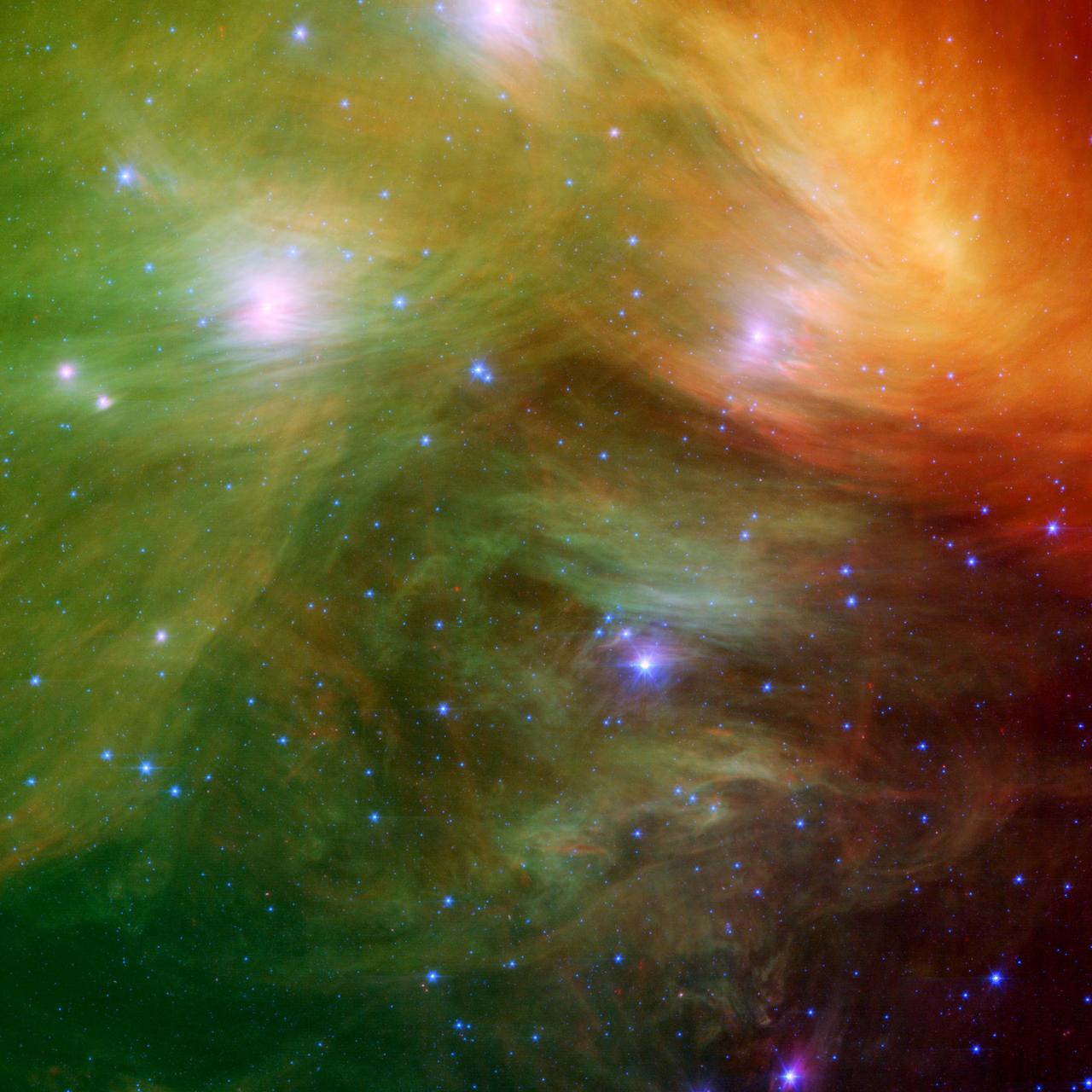
The main event of the week comes first. On the evening of Oct. 27, the bright waning gibbous Moon rises in the east close to the Pleiades and the orange star Aldebaran. EarthSky puts the closest approach at 2:00 UTC on Oct. 28, which is 9 p.m. CDT on the evening of Oct. 27 in North America. NASA's October skywatching guide picked out the Oct. 27-28 pairing as one of the month's highlights. Its sky chart shows the Moon right next to the cluster around 11 p.m. on Oct. 27, looking east, with both climbing higher as the night goes on.
The Pleiades, also called the Seven Sisters, look like a small, fuzzy group of six or seven stars to the naked eye. Binoculars or a small telescope show many more, NASA notes. The problem this week is moonlight. With a Moon this bright right next to it, the cluster's fainter members will be hard to pick out. Binoculars are the best tool here, because they can separate the cluster's sharp blue-white points from the glare. If the Moon swamps the view, try again later in the night, when the Moon has moved on and both objects are higher.
If you are not sure where to look, Space.com offers a simple star-hop. Start at Orion's Belt and follow its line upward to Aldebaran. The Pleiades sit less than 15 degrees above that star. This week the Moon is close enough to both that it does most of the work for you.
Tuesday night, Oct. 28: Between Capella and Aldebaran
The Moon moves eastward against the stars by roughly its own width every hour, so one day later it is in a different spot. By late evening on Oct. 28, EarthSky says, it sits between bright Capella in Auriga and Aldebaran in Taurus, with the Pleiades still nearby. It is less striking than Monday's close pass, but it is a good night to learn where these winter stars sit in relation to each other before they take over the evening sky in the coming months.
Thursday and Friday mornings, Oct. 30-31: Castor and Pollux
Before dawn on Oct. 30 the Moon, nearing its third-quarter phase, approaches Castor and Pollux, the twin stars of Gemini. On Halloween morning it shines by the two stars. Pollux is the brighter of the pair. Late on Nov. 1, EarthSky notes, the twins rise ahead of the third-quarter Moon. That phase arrives at 20:28 UTC on Nov. 1, and EarthSky says the Moon then rises in the middle of the night and sets around midday. After that, the evenings stay darker.
Halloween extras: Medusa's eye and Samhain lore
Space.com's list of seasonal targets includes Algol, the star traditionally called "Medusa's eye," whose brightness drops on a regular schedule. Anyone hoping to see it dim on Halloween night will be disappointed. Citing Sky & Telescope, Space.com reports that the minima fall on Oct. 29 and Nov. 1, not Oct. 31. While you are in that part of the sky, the circlet of stars marking the head of the sprawling constellation Cetus lies to the right of the Pleiades for viewers in the U.S.
The Pleiades also have a link to the holiday itself. Space.com notes that the Celtic festival of Samhain, an ancestor of Halloween, was tied to the time of year when the cluster reaches its highest point at midnight. So the Moon is passing the cluster during the very season that made it part of Halloween's origins.
If you want to look at the Moon itself, the full Moon of Oct. 26 showed bright ray systems spreading from the craters Tycho, Copernicus and Kepler, Space.com says. As the Moon wanes, the dividing line between its lit and dark sides moves across the surface, and features flattened by full-Moon lighting regain their shadows.
The planets: Mars closes in on Jupiter
The most interesting slow change of the season is happening in the morning sky. Jupiter stands high in the east at dawn and is easy to find. Mars is much fainter. EarthSky's tip is to picture a line from the sunrise point up through Jupiter and keep following it. Mars lies along that line.
Night by night the gap between the two planets is shrinking. On Nov. 15, Mars passes 1.2 degrees north of Jupiter. That is a little more than twice the apparent width of the full Moon, close enough for both planets to fit easily in one binocular view. It is worth checking every few mornings between now and then to watch the gap close. Each planet moves along its own orbit, and from Earth that shows up as a slow change in where they appear against the stars.
Saturn is the evening planet. It reached opposition on Oct. 4, when it was opposite the Sun in our sky; EarthSky notes that Saturn is generally at its closest and brightest for the year around opposition. It is still well placed. EarthSky says it is visible in the east at nightfall and is no longer visible before dawn. NASA's guide also pointed out a recent Hubble finding: a ten-sided wave pattern around Saturn's south pole. No backyard telescope will show it, but it is a reminder that the planet is still changing in ways we can measure.
The Orionid meteor shower peaked on Oct. 21-22, NASA notes, so it is already well past its best, and this week's moonlight would wash out any stragglers anyway.
Why It Matters
Moon-and-star pairings like this week's are not rare. For beginners, though, they are one of the most reliable ways to learn the sky. A bright Moon next to a recognizable cluster is easy to find without a chart. Once you have found the Pleiades, Aldebaran, Capella, Castor and Pollux with the Moon's help, you can find them again on your own for the rest of the season. The Mars-Jupiter approach teaches something different. Over a few weeks you can watch the planets move against the background stars, the same motion that gave planets their name: "wanderers."
It is also a fair warning about moonlight. A waning gibbous Moon brightens most of the night sky, which makes this a week for bright targets such as clusters, planets and first-magnitude stars, and a poor week for faint galaxies. Plan for that and the week offers plenty. Expect deep, dark-sky views and you will be disappointed until after the Nov. 1 third quarter.
