
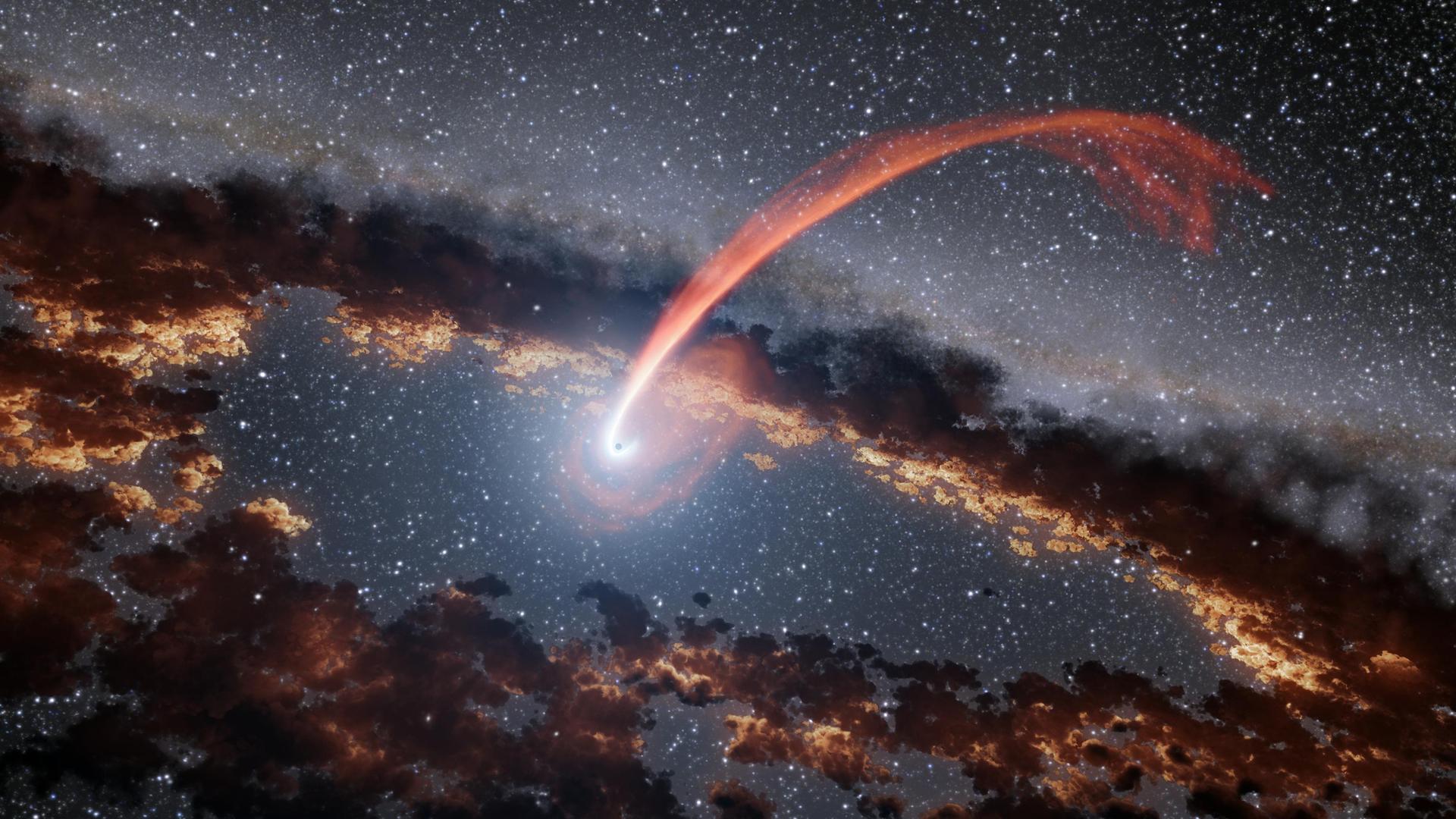
Dark matter makes up most of the matter in the universe, and nobody knows what it is. One old candidate is the primordial black hole, or PBH: a hypothetical black hole formed in the Big Bang itself rather than from a collapsing star. If PBHs exist in large enough numbers to account for dark matter, a few of them should end up inside stars. A new study asks what happens next, and whether we could see it.
The work, led by MIT assistant professor Ore Gottlieb and published in The Astrophysical Journal, describes what the authors call "Hawking stars," named after a proposal Stephen Hawking made in the 1970s. According to the team's models, such a star does not simply carry an invisible passenger forever. The black hole eats it from the inside, and depending on the details, the star either dies quietly or blows apart in a flash that current telescopes should be able to detect. MIT News reported the result on November 19.
The obvious caveat comes first: this is purely theoretical. No Hawking star has been seen. What the paper offers is a prediction of what one would look like, which is the necessary first step toward finding one or ruling the idea out.
A narrow, stubborn mass window
The smallest primordial black holes would have evaporated by now through Hawking radiation, but heavier ones should still be around. In the preprint, "The Life and Death of Stars That Capture Primordial Black Holes", Gottlieb and co-authors Matteo Cantiello, Norton, Van Tilburg and Kleban point out that PBHs in the so-called asteroid mass window, roughly 1017 to 1023 grams, are still viable dark matter candidates.
A star that swallows one, though, could turn a hypothetical relic into an event that might be visible to telescopes.
Getting a black hole into a star
The first problem is capture. A tiny black hole moving through the galaxy will usually just pass through or past a star. As Universe Today explains, a single star on its own is unlikely to trap a PBH. A companion changes that.
The paper finds that capture is dominated by three-body interactions, in which the gravity of a planetary or stellar companion helps strip the black hole of enough energy to bind it to the host star. Once bound, the PBH has to sink to the star's center, and how long that takes depends strongly on its mass. For a Sun-like star with a Jupiter-like planet, the authors calculate that the black hole needs a mass of about 1022 grams or more to spiral inward within the star's main-sequence lifetime. Lighter PBHs generally require tighter companions.
The researchers call their approach the first global framework for the problem. It combines analytic calculations, stellar evolution models, 3D general-relativistic magnetohydrodynamic (GRMHD) simulations of the black hole feeding, and Monte Carlo population synthesis to estimate how often these captures happen across a population of stars.
Two ways to die
Once the black hole reaches the core, things move quickly by stellar standards. Per Universe Today, it takes only a few million years for the PBH to consume about 1 percent of the star's mass. From there, the star's fate splits in two.
The loud ending. If the star spins fast enough, the infalling gas cannot fall straight in. It settles into an accretion disk around the black hole, and that disk launches jets. In the simulations, the jets drive an explosive disruption of the star. MIT News describes the resulting flash, concentrated in blue and ultraviolet light along with X-rays and gamma rays, as bright enough for current telescopes to pick up.
The quiet ending. If the black hole arrives late in the star's life, or grows too slowly, no disk forms. The PBH just keeps feeding and consumes the star quietly, with little or no bright disk-powered emission.
The paper describes this split as a bifurcation: disk-forming PBHs produce explosions, while late or slow-growing ones eat their hosts quietly. The difference matters for observers, because only the first branch produces an obvious signal.
Why It Matters
A model that links asteroid-mass primordial black holes to a specific, bright, short-lived event gives astronomers something to look for.
Observations could work in both directions. If surveys turn up blue and ultraviolet flares that match the predicted explosions, that would be a candidate signal. Gottlieb notes that other astrophysical phenomena could produce a similar flash, so astronomers would need other clues to confirm a PBH. The paper says the absence of such transients could constrain the fraction of dark matter in PBHs. The population synthesis in the paper is meant to provide exactly that kind of rate estimate, so absence of a signal would mean something.
Much remains uncertain. The rates depend on how common PBHs really are, on how often stars have companions that make capture possible, and on the mass of the black holes involved. The quiet branch, by design, leaves little to see, so some fraction of Hawking stars could die without anyone noticing. Still, the idea turns a hypothetical relic of the early universe into a prediction about stars, and stars are something astronomers watch very closely.
