
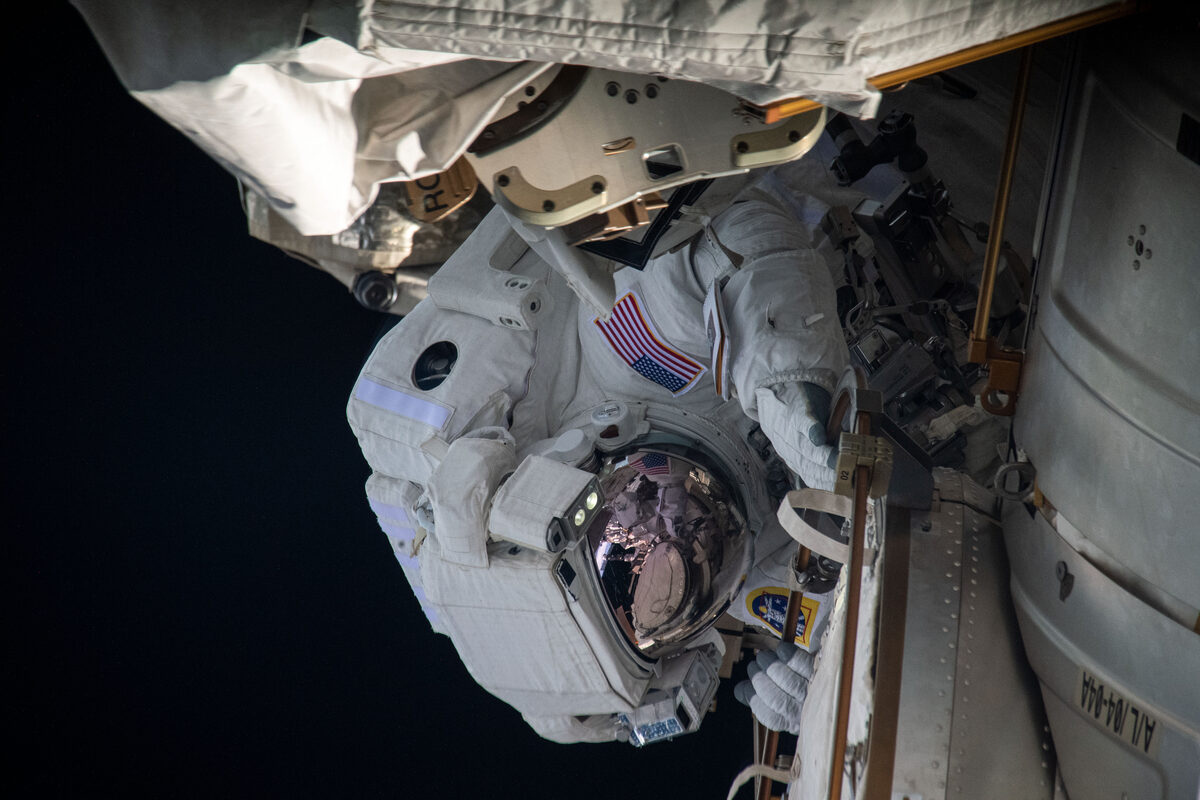
At 8:35 a.m. ET on August 6, 2026, NASA astronauts Jessica Meir and Anil Menon floated out of the International Space Station's Quest airlock and got to work on a job that won't pay off for months: rewiring part of the station's power grid so a solar array that hasn't launched yet will have somewhere to plug in.
The spacewalk, designated U.S. Spacewalk 96, ran roughly six and a half hours and focused on the station's 3B power channel, one of the power channels that collectively keep the ISS's systems, experiments, and life support running. Meir and Menon installed hardware that modifies the channel to prepare it for a future International Space Station Roll-Out Solar Array, or IROSA, one of the compact, roll-up panels NASA has been adding to the station's original solar wings over the past several years.
It was a milestone outing for both crew members, though for very different reasons. For Meir, this was her sixth career spacewalk, a return to familiar territory. For Menon, it was his first time outside the station — the kind of debut that tends to stick with an astronaut regardless of how routine the underlying task might sound from the ground.
Why It Matters
The ISS's power system is showing its age. NASA has spent recent years threading in IROSA panels onto the station's original solar arrays to shore up capacity without a full array replacement. But the roll-out arrays can't just be bolted onto the outside of the station and switched on — the power channels they'll feed into need to be reconfigured first, with new hardware and wiring routed and verified by spacewalking astronauts before a single new panel arrives.
That makes Spacewalk 96 a plumbing job in the most literal sense: unglamorous, done ahead of the headline-grabbing installation, and essential to whether the eventual IROSA deployment goes smoothly. Prepping channels like 3B in advance is how NASA avoids scrambling to fix wiring in the middle of an actual array swap.
Three Spacewalks, One August
Spacewalk 96 is the first of three spacewalks NASA has scheduled for August, each addressing a different piece of station upkeep.
- Spacewalk 97 (August 13): A crew will replace a Space-to-Ground antenna, hardware that is critical for communications between the station and Mission Control. According to reporting from FoxWeather, the antenna swap will be handled with help from the station's robotic arm.
- Spacewalk 98 (August 25): The final outing of the month is the most varied of the three. NASA says astronauts will connect power and data cables and replace a docking aid. FoxWeather's account adds that the spacewalk will also include a camera swap and bioprinting experiments aimed at treating cartilage injuries, tucking research work in around the maintenance tasks.
Stringing three spacewalks across a single month is a heavy cadence by ISS standards, and it reflects how much unglamorous infrastructure work — antennas, cabling, power routing — needs to get done in parallel with the station's ongoing science mission.
What Actually Happened Outside
NASA's coverage of Spacewalk 96 began at 7 a.m. ET, ahead of the 8:35 a.m. start, and was carried on Amazon Prime, X, YouTube, and NASA+, according to a preview posted by SpacePolicyOnline. The roughly 6.5-hour duration is fairly typical for a station EVA — long enough to complete a substantial hardware task, short enough to stay within the limits of the astronauts' suits and consumables.
The specifics of the 3B channel work were kept fairly high-level in NASA's own release: the agency describes it as installing hardware that modifies the channel "to prepare for a future" IROSA installation, without naming a target date for when that array will actually go up. That's consistent with how NASA has approached prior IROSA prep work — the wiring and structural changes tend to happen well ahead of the array itself arriving on a cargo flight.
The Crew
Jessica Meir has now completed six spacewalks over her NASA career, giving her the kind of EVA experience that makes her a natural lead for a complex power-system task. Anil Menon, by contrast, was making his first excursion outside the station, a rite of passage for any new station crew member that typically comes after extensive pool training on Earth.
Pairing a veteran with a first-timer is standard practice for station EVAs. NASA has not yet detailed which astronauts will suit up for Spacewalks 97 and 98 later this month.
