
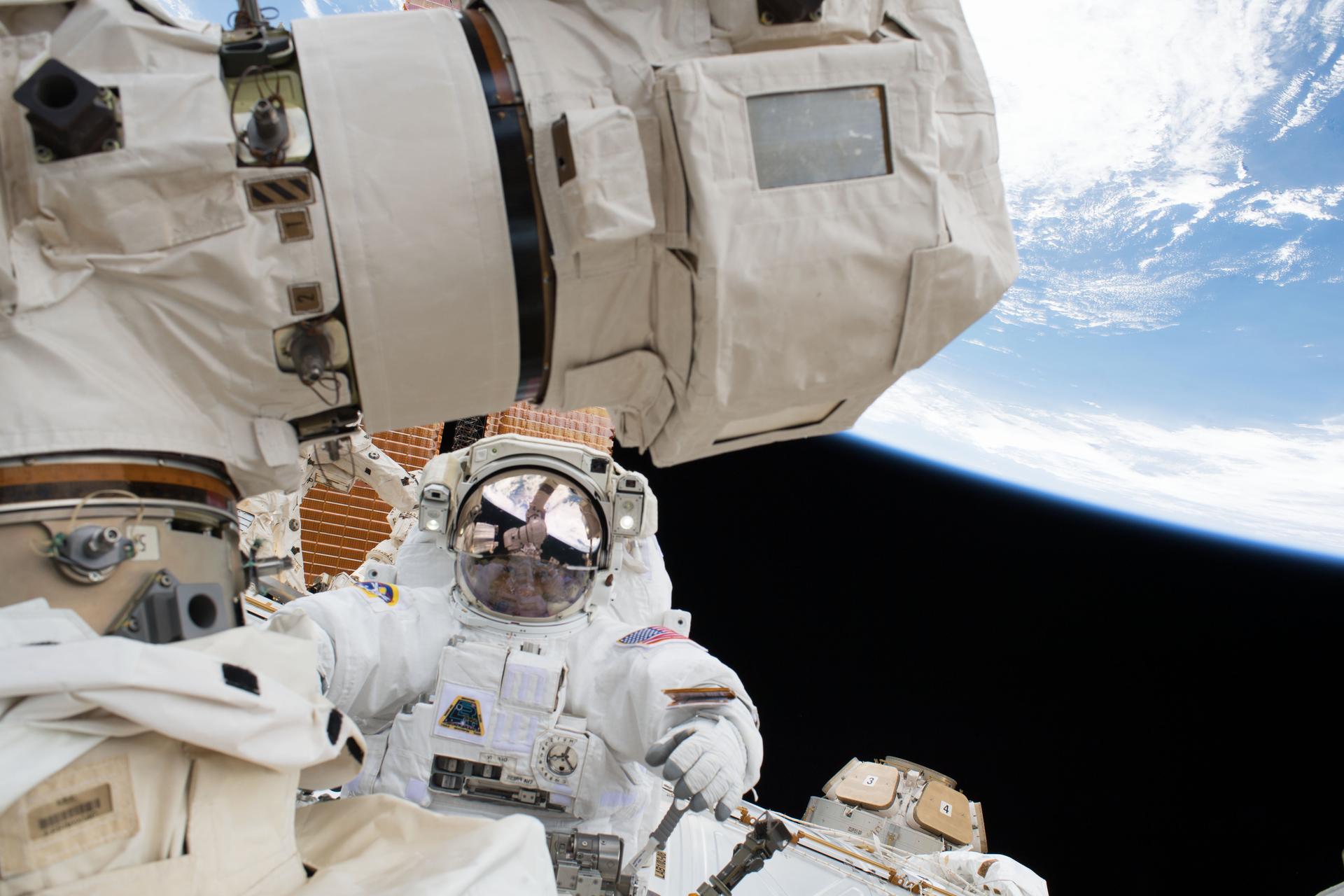
Two astronauts floated out of the International Space Station's airlock on Tuesday morning to run what amounted to a maintenance punch list in orbit — but the pairing doing the work made this outing more than routine. NASA's Jessica Meir and ESA's Sophie Adenot conducted U.S. Spacewalk 99 on Sept. 1, 2026, marking only the sixth time in spaceflight history that a spacewalk crew has consisted entirely of women.
NASA television coverage began at 7 a.m. EDT, with the pair — Meir in an unmarked suit, Adenot in one marked with red stripes — venturing outside roughly 90 minutes later, around 8:30 a.m. EDT. ESA's own broadcast pegged the same event to European time: 13:00 CEST for coverage, with the excursion itself starting near 14:30 CEST. Both agencies agree on the duration: about six and a half hours of work in vacuum before the astronauts repressurized and came back inside.
What They Did Out There
The task list read like a station superintendent's to-do sheet, not a single dramatic repair. Meir and Adenot replaced a retroreflector on the forward port of the Harmony module — a small but essential piece of hardware that visiting spacecraft use for docking navigation, reflecting laser or radar signals back to an approaching vehicle so it can gauge range and closing rate precisely. They also installed data-relay jumper cables, routine but necessary plumbing for the station's communications backbone.
From there, the pair moved to preparatory work on the radiator for the Alpha Magnetic Spectrometer, the cosmic-ray detector mounted on the station's truss, getting it ready for a future servicing task rather than completing repairs on this walk. Rounding out the job list, they swapped a high-definition camera mounted on the truss — the kind of unglamorous hardware refresh that keeps the station's external eyes working but rarely makes headlines on its own.
Why It Matters
Spacewalk 99 matters on two levels that don't often coincide. Operationally, it's exactly the kind of unglamorous upkeep that keeps a quarter-century-old space station functioning: navigation aids need replacing, cables need running, cameras wear out, and instruments need prepping before bigger jobs. NASA logged this as the 284th spacewalk conducted in support of station assembly and operations — a number that underscores how much of human spaceflight is maintenance, not moonshots.
But the crew composition is its own milestone. All-female spacewalks remain rare enough that this was only the sixth ever conducted, a reminder of how recently NASA and its partner agencies began regularly flying women in numbers sufficient to pair them on EVAs — the first all-female spacewalk didn't happen until October 2019, also with Meir, alongside Christina Koch. Seven years and five more such walks later, the milestone is edging toward normal without yet being routine, and each additional instance chips away at how remarkable it should have to be.
The Astronauts, By the Numbers
For Meir, this was her seventh career spacewalk, a tally that moves her into third place among female NASA spacewalkers — behind only Peggy Whitson, who has logged 10, and Suni Williams, with nine. It's a list that reflects not just individual achievement but the accumulating flight time NASA has now banked with women in long-duration and repeat station assignments.
Adenot's ledger tells a different but equally notable story: this was her third spacewalk, and it came barely a week after her second. Two EVAs in roughly seven days is a demanding cadence for any astronaut, let alone one still relatively early in an EVA career, and it points to how tightly ESA and NASA have had to sequence maintenance work against the station's operational calendar this cycle.
A Numbers Game That's Slowly Changing
It's worth sitting with the arithmetic here. Six all-female spacewalks against 284 total station EVAs is a ratio that tells its own story about the decades it took for women to reach parity in the astronaut corps, let alone in the EVA-qualified subset of it. Spacewalking remains one of the more physically demanding and schedule-constrained activities in human spaceflight — suits have to be sized and available, training has to be current, and crew rotations don't always line up two EVA-qualified women on the same increment at the same time. That Meir has now flown four of the six all-female walks — the first three, back in 2019 and 2020 with Christina Koch, and now this one with Adenot — spanning nearly seven years, says as much about the slow churn of station crew scheduling as it does about any individual astronaut's résumé.
Neither NASA's nor ESA's releases framed Tuesday's walk as a statement — the task list was maintenance, full stop, and both agencies presented it primarily as such. But statements don't require agencies to make them explicitly; the numbers do that on their own. As station operations continue and more international partners rotate through six-month increments, milestones like this one will likely keep recurring — and, if the pace of the astronaut corps' diversification continues, keep getting less remarkable, which is rather the point.
