
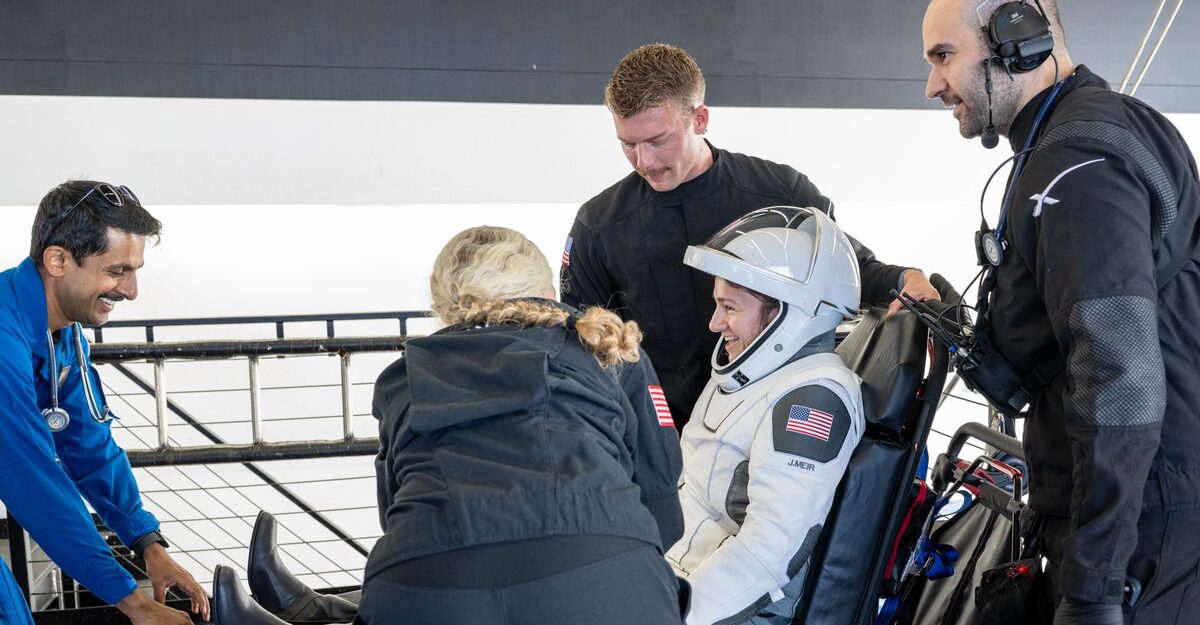
For the four people aboard SpaceX's Crew Dragon Freedom, the trip home began with a splashdown in the Pacific. For Sophie Adenot it went on for two more days. The ESA astronaut splashed down off Los Angeles with her Crew-12 crewmates on Oct. 8, then flew to Houston and crossed the Atlantic on a French military tanker. She touched down in Cologne, Germany, at 04:21 GMT on Oct. 10.
When she landed she had spent 237 days, 5 hours and 18 minutes on her mission. According to ESA, that is a new European record for the longest single spaceflight. It beats the previous mark, held by Italian astronaut Luca Parmitano, by more than 35 days. It was also her first flight.
The descent, by the clock
Crew-12 undocked from the International Space Station at 12:05 GMT on Oct. 7. ESA puts the return journey at 27 hours and 29 minutes, and Space.com describes it as a roughly 27-hour trip. NASA reported splashdown at 11:34 a.m. EDT (8:34 a.m. PDT, 15:34 GMT) off the coast of Los Angeles.
Four people were aboard: NASA astronauts Jessica Meir and Jack Hathaway, Adenot, and Roscosmos cosmonaut Andrey Fedyaev. NASA spells his name Andrey; ESA's release uses Andrei. For Hathaway, as for Adenot, this was a first spaceflight. Fedyaev was on his second.
Meir's flight moves her higher on NASA's endurance list. NASA says she now has 440 total days in space, which puts her in the agency's top 10. Space.com reports that Meir performed four spacewalks on the mission, and ESA says Adenot completed three, spending 19 hours and 42 minutes outside the station.
NASA's Bill Spetch summarized the mission's length this way, as quoted by Space.com: "It's great to have them back after 237 days in space, 235 of those on the space station." The crew launched on Feb. 13, 2026, and the two-day gap presumably covers the flights to and from the station, though the sources do not break it down.
The long way to Cologne
The splashdown was the end of the flight but not of Adenot's journey. ESA says the crew went ashore by helicopter, then flew together on a NASA plane to Ellington Field in Houston. On Oct. 9 she boarded an A330 MRTT of the French Air and Space Force, a tanker-transport aircraft, bound for Cologne.
In Cologne she starts a readaptation program of two to three weeks at :envihab, the aerospace medicine facility run by the German Aerospace Center (DLR). ESA describes the period as adjusting to Earth's gravity and undergoing data collections. Space.com reports a 45-day postflight conditioning period for the returning crew.
A mission stretched by its neighbors
Crew-12 was not originally meant to set a record. Its length owed much to a delay in the mission that followed it.
Before it, Crew-11 came home about a month early on Jan. 15 because of a medical issue involving NASA astronaut Mike Fincke, Space.com reports. Crew-12 launched on Feb. 13 and brought the station back up to a normal seven-person crew.
The crew after it was late. Crew-13 was supposed to launch on Sept. 12 but was held back by a Dragon propulsion issue, Space.com reports, which gave Crew-12 a few extra weeks in orbit. When Crew-13 did fly, it reached the station on Oct. 1 in under eight hours, which Space.com says is the quickest trip to the ISS ever made on a U.S. vehicle. After a short handover, Crew-12 undocked six days later.
Under the station's rotation system, a slip at either end of a mission tends to lengthen the crew already in orbit. That happened here, and a European astronaut was aboard when it did.
Why It Matters
The record matters because Europe has no crew vehicle of its own. ESA astronauts reach orbit on partner spacecraft, as Adenot did on a SpaceX Dragon. A European endurance record therefore depends partly on how partner crew rotations play out. Readaptation tracked at a European facility such as :envihab adds to Europe's own human spaceflight research.
ESA is also making a policy point. Its release on Adenot's return includes a statement from Director General Josef Aschbacher and mentions the Intermediate Ministerial Council Meeting in Rome in December. Aschbacher says Europe must secure a role in exploration commensurate with its political and economic weight. A record-setting astronaut returning just before that meeting is, at the least, good timing for the agency.
The mission also shows how much the station's crew schedule depends on hardware. One crew left early for medical reasons, and a later launch slipped because of a propulsion problem that gave Crew-12 a few extra weeks in orbit. The crew set a record along the way. A rotation system with little slack means such delays land on whoever is already aboard.
Sources
- ESA astronaut Sophie Adenot returns from her first mission to the International Space Station (ESA Press Release, Oct. 10, 2026)
- NASA's SpaceX Crew-12 Dragon Splashes Down at 11:34 a.m. EDT (NASA Space Station Blog, Oct. 8, 2026)
- Splashdown! Crew-12 astronauts return to Earth after nearly 8 months in space (Space.com)
