
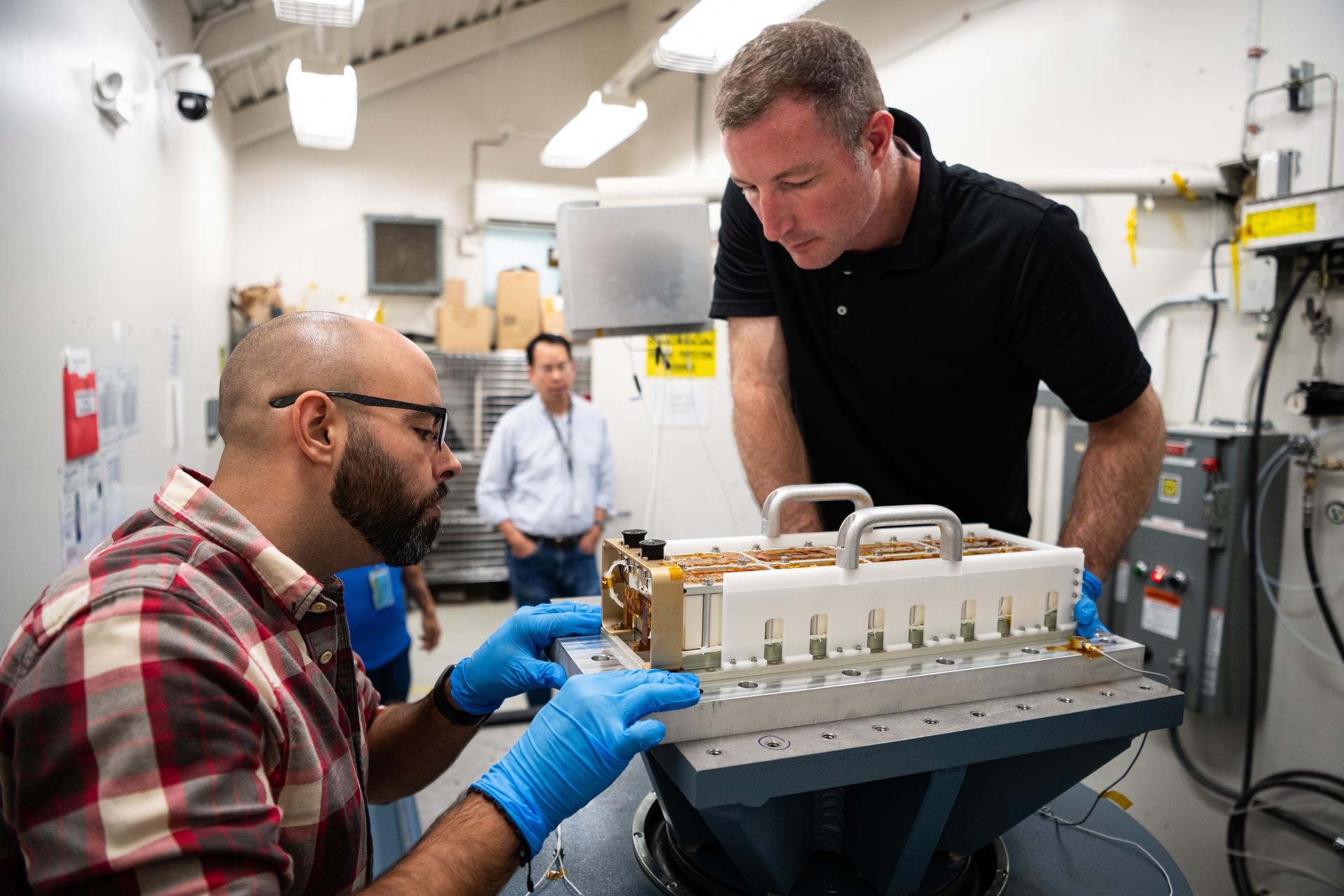
Batteries do not like the cold, and the Moon has a lot of it. During the lunar night at the south pole, the region Artemis is aiming for, temperatures fall to about minus 200 degrees Celsius (minus 328 F). That is far colder than anything a phone or laptop battery is built to handle. NASA engineers have now published early results from a project that tries to close some of that gap. Their prototype cells survived temperatures much lower than most batteries could, but they are not yet down to lunar-night conditions.
The work comes from a NASA effort called Solid Power for Extreme Environment Adaptability and Resilience in Space, or SPEARS. NASA's Glenn Research Center leads the project, and testing happens at NASA's Langley Research Center. According to a NASA Langley release dated October 14, 2026, Donald Dornbusch at Glenn is the principal investigator. Yi Lin leads testing and research at Langley, and Ji Su, a polymer materials scientist, is the task lead at Langley.
What the tests showed
The headline numbers break into two groups. Each one answers a different question.
The first group covers operation, meaning whether the cells can deliver power at a given temperature. NASA reports that during thermal vacuum testing at Langley, the small prototype cells "operated well" up to 80 C (176 F) and down to minus 60 C (minus 76 F). They kept working, with what NASA describes as slightly reduced performance, down to minus 80 C (minus 112 F).
"We proved for the first time that these cells can work down to minus 80 degrees Celsius," Lin said in the agency's release. NASA adds that Lin is confident performance can be improved and the range perhaps expanded in coming years.
The second group covers survival, meaning whether the cells are damaged by temperatures they are not expected to operate in. NASA says the cells took exposure from 100 C (212 F) down to minus 170 C (minus 274 F) without damage. That lower figure is the one in Interesting Engineering's headline. It is also easy to misread. Surviving minus 170 C is not the same as producing power at minus 170 C. NASA states that not even solid-state batteries will function at that temperature, and the cells must be warmed back to operating temperature afterward.
The difference between those two groups matters for any hardware headed to the lunar surface. A battery that can sit out a deep freeze unharmed and then work once it is warmed up is still useful. It just needs some help along the way.
Why solid electrolytes
Conventional lithium-ion cells move ions through a liquid electrolyte. NASA says that liquid could freeze at lunar night temperatures, potentially damaging the battery, and would evaporate when exposed to the vacuum of space. SPEARS swaps it for a solid electrolyte made of ceramic or polymer material. NASA also notes the design avoids the fire hazard that comes with liquid electrolytes.
The design does not get rid of heating. It reduces how much is needed. NASA says small heaters warm the cells to their operating temperature, and that the batteries would not need to be kept warm all the time. Since solid electrolytes do not freeze the way a liquid does, NASA says this approach could reduce the need for heavy thermal management systems in spacecraft and lunar habitats, allowing lighter designs, lower costs and longer missions. On a lunar lander or rover, every kilogram spent on heaters, insulation and related power is a kilogram not spent on science instruments or other payload.
Reading the fine print
A few caveats are worth stating plainly.
These are coin cells in a lab. NASA's release describes the tested batteries as small coin-cell batteries, and Interesting Engineering, reporting on the same results, calls them small laboratory prototypes that have not yet been demonstrated in space. Going from a coin cell to a flight-qualified battery pack is a long process. It brings new problems with packaging, cycle life, vibration and integration, none of which the reported results cover. NASA says its Ames Research Center is developing flight hardware such as test boards and electronics to help prepare the batteries for spaceflight and test them in space environments, and Interesting Engineering notes that further development and testing are required before operational use.
The lunar night is still colder. The best operating result reported is minus 80 C, and the survival floor is minus 170 C. The south pole night reaches about minus 200 C. That leaves a gap on both counts. The reported approach relies on small heaters to bring the cells back to operating temperature, so these cells would not be running unaided in the coldest conditions.
The detailed data is not public yet. NASA's Technical Reports Server lists a presentation from the American Chemical Society Fall Meeting, held in Chicago in August 2026, titled "Challenges in Solid-State Batteries toward Applications in Extreme Space Environment." Lin and Su are among its authors. The record lists the authors and meeting details, but we did not find an abstract or full text on that page, so readers looking for discharge curves, capacity retention figures or cycle counts will have to wait for a fuller publication.
Why It Matters
Power is one of the quiet constraints on lunar surface operations. NASA frames the problem this way: a battery for the Moon's south pole has to work immediately when warmed up, power everything from an astronaut's emergency kit to a rover exploring dark craters, and do so without posing a fire hazard. Today that usually means spending mass and energy on keeping batteries warm. A battery chemistry that tolerates much wider temperature swings changes that trade-off. It would not eliminate thermal management, but it could shrink it.
Interesting Engineering reports that potential uses under Artemis include rovers, scientific instruments and emergency equipment. NASA's release also lists small tools such as drills for shadowed lunar craters and long-duration scientific instruments. It adds that the technology could spin off into Earth-based uses, since the project grew out of an earlier battery project for aeronautics applications.
The SPEARS results are a useful step, not a finished product. They show that a solid-electrolyte cell can run at minus 80 C and survive minus 170 C, which is a real improvement for space batteries. Getting the rest of the way to the lunar south pole night, and from a lab bench to a spacecraft, is the next challenge. NASA says the project, which began in 2026, will focus on technology development in its first stages before potentially shifting toward commercial collaboration.
