
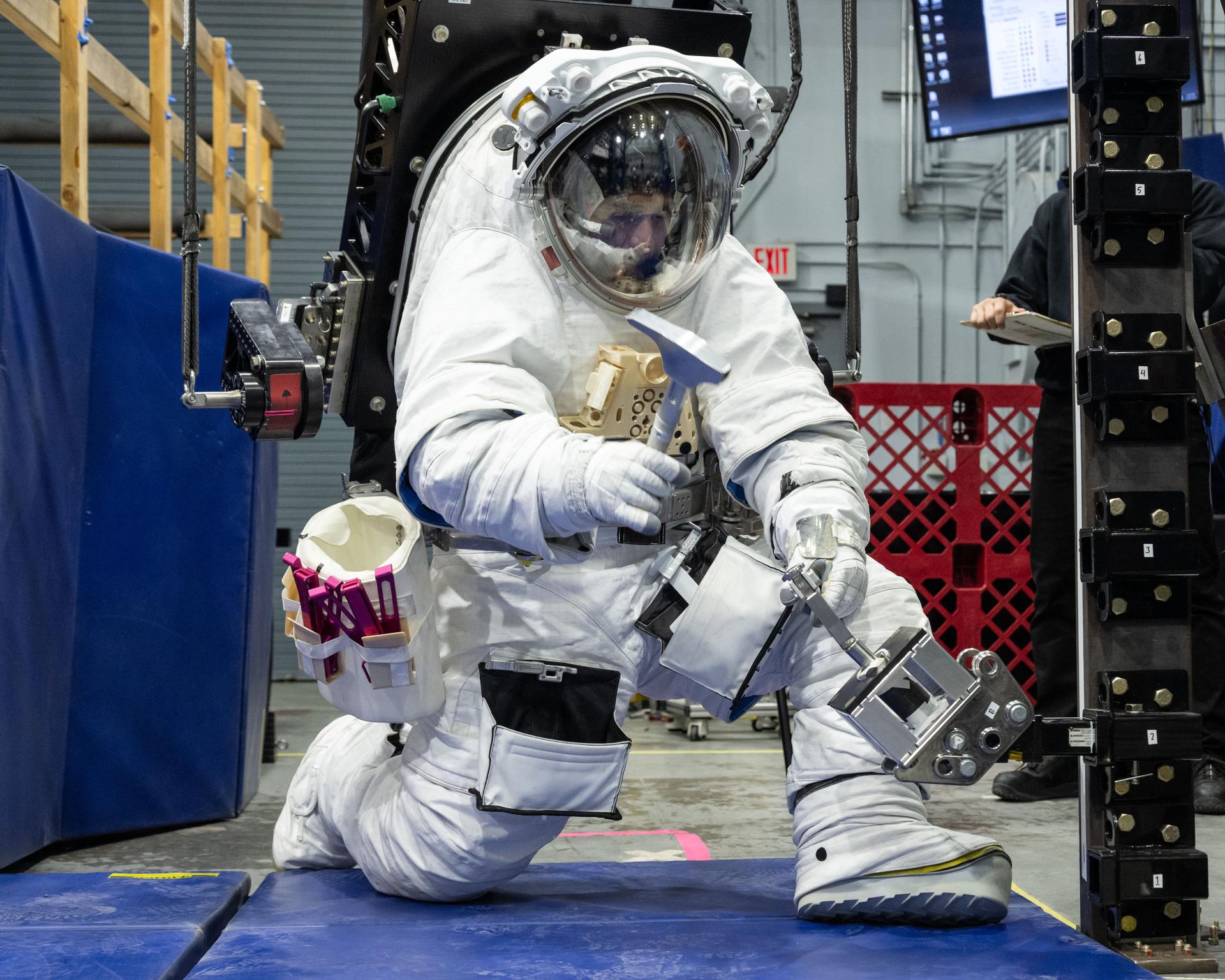
Anyone who has touched a doorknob after shuffling across a carpet knows the basic problem. Now picture that shock at the lunar south pole, with a spacesuit full of oxygen on one side and a lander full of electronics on the other. NASA wants outside help to keep that from happening. The agency opened its Lunar Grounding Challenge on Oct. 5, 2026, and announced it the following day. Up to $150,000 is on offer for concepts that can safely discharge a suited astronaut before they make contact with their spacecraft. Submissions are due Jan. 15, 2027, according to New Space Economy.
The phrase NASA uses to describe the risk is a memorable one. Because the lunar surface has no natural way to bleed charge away, the agency says an astronaut may become "a walking, high voltage capacitor."
Where the charge comes from
NASA's challenge page names two charging mechanisms. The first is tribocharging, the same friction-driven charge transfer behind the carpet shock. In this case it comes from walking on the lunar surface. The second is plasma charging, from the ambient plasma around the lunar south pole.
The south pole makes both worse. NASA says the problem is compounded in permanently shadowed regions, the dark areas that never see direct sunlight. In those regions a suit can build up a substantial negative potential, because two things that would otherwise balance the charge are missing: an ambient flux of ions, and photoelectron emission.
The lander has the opposite problem. Sitting stationary in sunlight, it holds a slightly positive potential. So an astronaut coming back from a shadowed crater is heavily negative and is walking toward a slightly positive vehicle. NASA says the extreme voltage differential can trigger electrostatic discharge, an instantaneous electrical arc, when the two make physical contact.
Dust adds another complication. As Space.com reported, quoting NASA's challenge description, suspended lunar dust and heavy dust buildup on a suit significantly increase arcing lengths. In other words, a spark could jump across larger gaps than it would between clean surfaces.
What goes wrong when it sparks
NASA lists several consequences of an uncontrolled discharge at the lander. It could degrade the layers of the suit, damage electronics, threaten the oxygen-rich environment inside the suit, and shock the crew. Space.com's summary of the hazards is similar: arcs that damage suits, sparks that could start fires in an oxygen atmosphere, and electrical shocks.
The challenge asks for ESD (electrostatic discharge) mitigation concepts that neutralize the astronaut in a safe and timely manner before they interact with the lander, so that touching the lander is not the moment the charge gets released.
The numbers NASA wants designers to hit
The challenge comes with a specific design envelope, summarized by New Space Economy:
- Voltage difference: a design case of about -100 kV on the astronaut and +100 V on the lander.
- Current limit: no more than 1.0 mA at the suit interface, with a target of 0.2 mA or less.
- Mass: under 20 kg.
- Discharge time: a worst-case discharge of 30 seconds.
- Durability: up to four excursions over 10 days.
- Suit model: a suited-astronaut capacitance of 200 pF.
The current limit is the interesting constraint. The point is not just to remove the charge but to do it under a cap: no more than a milliamp at the suit interface, and ideally a fifth of that, 0.2 mA or less. That is the difference between a controlled bleed and a spark. Handling a 100-kilovolt difference within that current limit and a 30-second worst case is the engineering problem the specification sets.
Space.com adds that the solution has to be small in mass, volume and power, and has to keep working through the Moon's extreme temperature swings across as many as four EVAs over as long as 10 days.
New Space Economy also adds a caveat worth repeating: these figures are requirements and modeling assumptions, not measurements. Nobody has walked a modern suit out of a permanently shadowed crater and recorded -100 kV. The numbers set a design target, not an observed value.
How the competition works
The first phase is deliberately low-barrier. According to New Space Economy, it requires no fabrication or physical prototype testing, so entrants submit concepts rather than hardware. Up to five finalists may then move on to a concept refinement stage, where reviewer feedback informs revised submissions. Space.com describes multiple phases: a concept design, a refinement after talking with reviewers, and then a final selection.
New Space Economy is blunt about what that means. The competition asks for concepts rather than a flight-ready protection system, and a winning entry would not by itself certify a device for astronaut use. The goal is to cast a wide net for ideas early and spend serious engineering effort only on the most promising ones.
Why It Matters
Space.com places the relevant landing during Artemis 4 or 5, at the lunar south pole, in 2028. That would be the first landing mission since Apollo 17 in 1972. The south pole is not the Apollo-era Moon. Its permanently shadowed regions are exactly where NASA says charging is at its worst.
Once astronauts are working in and around shadowed terrain across several EVAs, every return to the lander is a chance for the kind of contact discharge NASA describes. A reliable, lightweight way to bring the astronaut and the vehicle toward a safe electrical relationship first would be a small piece of hardware with outsized consequences. It would address the suit, the electronics and the crew in a single step.
It is also a reminder that much of the risk in returning to the Moon sits in unglamorous details like static electricity rather than in rockets. NASA is putting $150,000 and a January deadline behind this one.
