
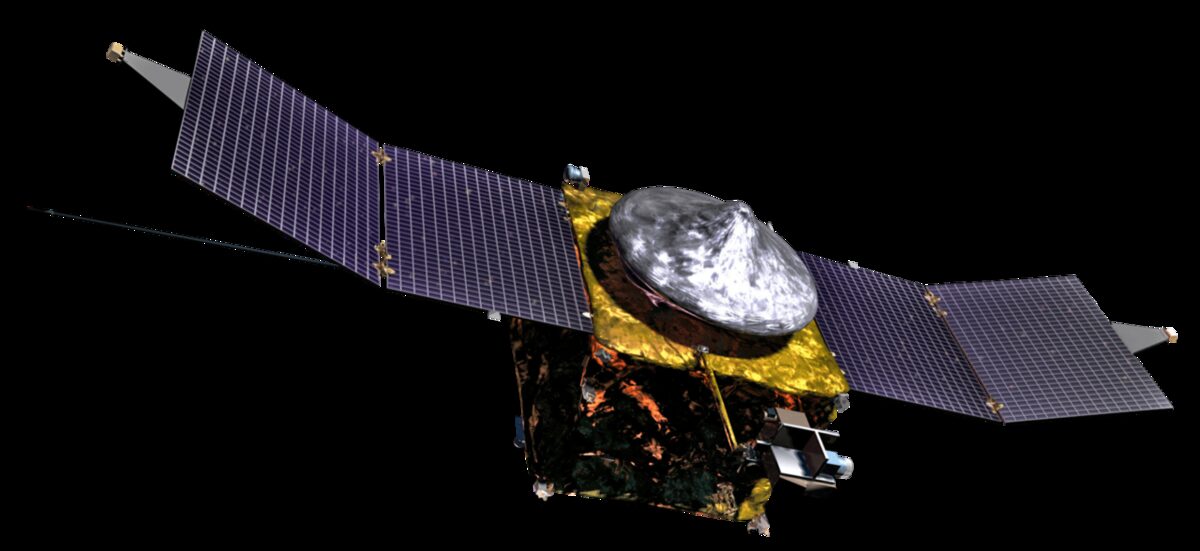
NASA has formally ended the MAVEN mission, closing out more than eleven years of observations that reshaped how scientists understand the death of a planet's atmosphere. The orbiter — its full name is the Mars Atmosphere and Volatile Evolution mission — arrived at Mars in September 2014 on a one-year assignment and kept working for a decade beyond it. The spacecraft was the first ever built specifically to study the thin, escaping upper atmosphere of Mars, and the questions it set out to answer were among the oldest in planetary science: where did the Martian air go, and where did the water go with it?
The evidence that Mars was once warmer and wetter is written all over its surface — dry river valleys, lakebeds, minerals that only form in liquid water. For that water to have flowed, the planet needed a thicker atmosphere and a stronger greenhouse than the cold, near-vacuum it has today. Something stripped that atmosphere away over billions of years. MAVEN was sent to catch the process in the act.
How a planet loses its air
What MAVEN found was a planet being slowly scoured by its own star. Unlike Earth, Mars has no global magnetic field to deflect the solar wind — the constant stream of charged particles flowing out from the Sun. MAVEN measured, in detail, how that solar wind reaches down into the Martian upper atmosphere, charges up gas molecules, and accelerates them off into space. During solar storms, the loss rate spikes. By watching both quiet periods and violent ones, the mission was able to build a budget for atmospheric escape and extrapolate it backward across geological time.
The conclusion was that the Sun did most of the work. Early in the Solar System's history, when the young Sun was far more active, the same stripping mechanisms MAVEN measured would have run much faster, peeling away the bulk of the Martian atmosphere and dooming any standing water to freeze or boil away. It was not a single catastrophe but a steady bleed — a planet exhaling into space over eons.
The auroras nobody expected
MAVEN also turned up phenomena that were not on the original science plan. The mission discovered new kinds of auroras at Mars, including diffuse auroras that paint the entire night side of the planet during solar storms and "proton auroras" produced when fast protons from the solar wind slam into the upper atmosphere and glow. On Earth, auroras cluster near the poles because our magnetic field funnels particles there. Mars, with no such field, lights up differently — a reminder that the same basic physics produces strikingly different results depending on a world's magnetic shield.
Those discoveries matter beyond Mars. Understanding how unmagnetized planets lose their atmospheres feeds directly into the study of exoplanets, where the question of which rocky worlds can hold onto air — and therefore water, and therefore the possibility of life — is now central. MAVEN effectively turned Mars into a natural laboratory for atmospheric escape, the closest worked example we have.
Why the mission is ending now
MAVEN's end came unexpectedly. On December 6, 2025, the spacecraft fell silent after an onboard anomaly placed it in safe mode with uncontrolled rotation, draining its batteries. Despite months of recovery attempts, NASA was unable to reestablish contact and formally decommissioned the mission in June 2026. The spacecraft had long outlived its design life and delivered far more than it promised, serving in its later years as a vital relay for data from NASA's surface rovers as well as a science platform in its own right.
Its legacy is a before-and-after line in Mars science. Before MAVEN, the loss of the Martian atmosphere was a plausible story told mostly through surface clues. After MAVEN, it is a measured, quantified process with rates, mechanisms, and a clear leading culprit. The orbiter answered the question it was built to ask, and in doing so it gave planetary scientists a template for reading the atmospheres of worlds we cannot yet visit.
