
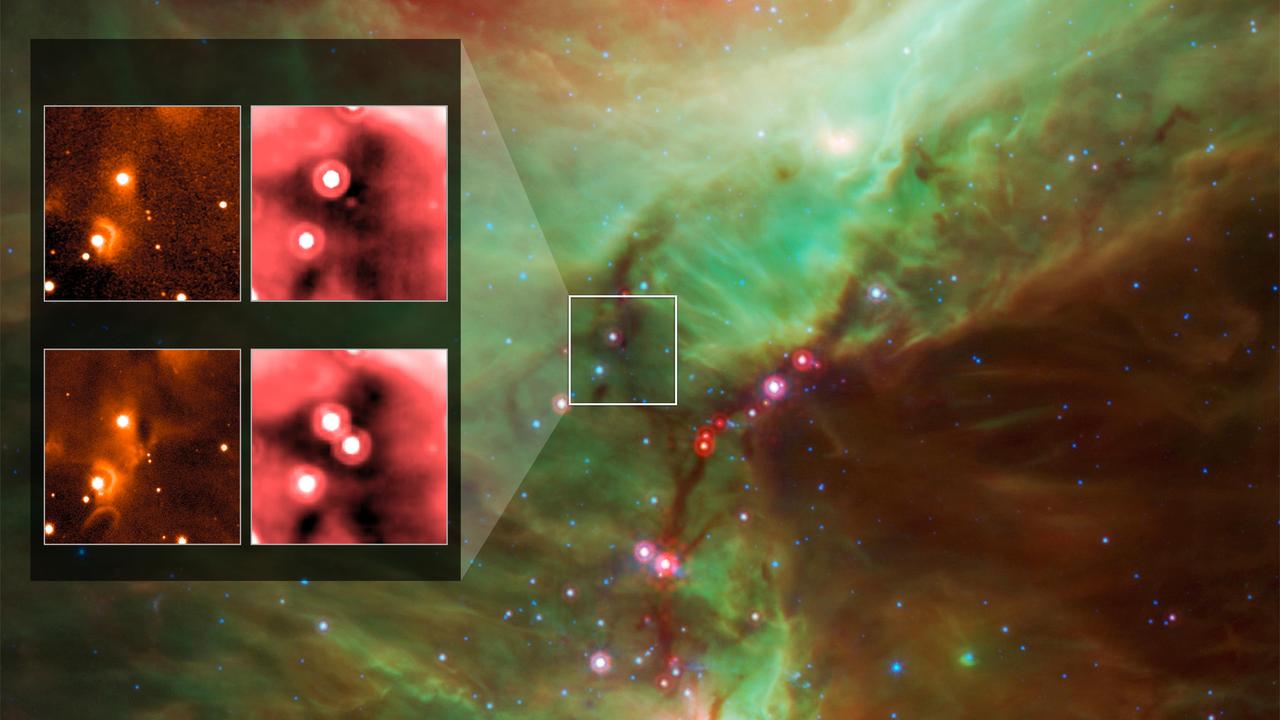
Most massive stars don't fly solo. Roughly 90 percent of them have at least one stellar companion, compared to about half of sun-like stars such as our own. The standard explanation is that these binaries are born together: a single rotating cloud of gas and dust collapses, its disk fragments under its own gravity, and two (or more) protostars condense out of the pieces, orbiting each other from birth. It's a tidy story, and it's been the working assumption for decades.
An international team led by Yichen Zhang of Shanghai Jiao Tong University has now caught a massive binary in the act of forming a different way entirely — one where the two stars didn't start out together at all.
Watching two stars orbit while they're still being born
The system in question, IRAS 07299−1651, sits about 5,300 light-years from Earth and contains two protostars still deeply embedded in the gas and dust of their birth environment — young enough that they're actively pulling in material and building mass. Zhang's team first pointed the Atacama Large Millimeter/submillimeter Array (ALMA) at the system in 2019, then kept coming back. Over nearly eight years, they combined ALMA data with observations from the Very Large Array (VLA), the James Webb Space Telescope (JWST), and the European Southern Observatory's Very Large Telescope (VLT), tracking the subtle positional shifts of the two protostars against each other with enough precision to reconstruct their three-dimensional orbit.
"For the first time, we were able to watch two massive stars move around one another while they were still being born," Zhang said in a statement accompanying the paper, which appears in Nature Astronomy.
What they found didn't look like a disk-fragmentation binary. The orbit is highly eccentric — nearly parabolic, meaning the two stars trace paths that are barely bound to each other rather than settling into the closer-to-circular orbits typical of stars that condensed together in a shared, rotating disk. Just as tellingly, the disks of gas and dust feeding each individual protostar are strongly misaligned — both with each other and with the plane of the binary orbit itself. If the two stars had fragmented out of one collapsing structure, their disks and their orbit would be expected to share a common orientation, inherited from the rotation of the original cloud. Instead, everything about this system points in different directions, as if two independent objects had simply been thrown together.
That's essentially what the researchers concluded happened. Running the reconstructed orbit backward, they determined the two protostars — each of which had already been developing on its own, with its own disk — swept close enough to gravitationally capture one another only about 60 years before the observations. On the timescale over which stars form, which runs to hundreds of thousands or millions of years, 60 years is effectively instantaneous — a single frame grabbed in the middle of an ongoing process.
A core merger, not a shared birth
The paper's authors — Yao Wang, Zhang, Rubén Fedriani of the Instituto de Astrofísica de Andalucía in Spain, Jonathan Tan of the University of Virginia, and collaborators — describe the event as a "core-merger parabolic encounter." In plain terms: two dense clumps of collapsing gas, each already in the process of forming its own star, wandered into each other's gravitational reach and locked together into a bound pair, rather than being siblings that split from a single womb.
Untangling that story required stitching together capabilities that no single telescope has on its own. "Each telescope revealed a different piece of the puzzle," Fedriani said, calling the combined dataset "the most exquisite detail on the formation of this massive protobinary system." ALMA's millimeter-wavelength sensitivity mapped the cold dust and gas in the disks and traced the protostars' positions over time, the VLA added radio-wavelength data, and infrared images from JWST and the VLT traced the jets of material streaming away from the young stars. No single epoch of observation from any one instrument could have revealed the orbit's shape — it took the accumulated positional drift across nearly eight years of monitoring to pin it down.
"The early lives of stars can be quite chaotic," Tan said of the result — a reminder that the environments where massive stars form are crowded, gravitationally messy places, not the clean, isolated collapse scenarios often used in simplified models.
Why It Matters
Binary and multiple-star systems are the rule, not the exception, among massive stars, and that companionship has consequences that ripple far beyond the stars' formation. Massive binaries are the progenitors of some of the most energetic events in the universe: when they eventually die, close massive pairs can produce the neutron star and black hole mergers that gravitational-wave observatories like LIGO and Virgo detect as ripples in spacetime. How those binaries assemble in the first place — whether by fragmenting from a shared disk or by capturing each other after forming separately — shapes the orbital properties, spins, and separations they carry into old age, which in turn shapes what kind of merger, if any, they eventually produce.
Until now, capture-formed massive binaries were largely a theoretical possibility, invoked to explain oddities in orbital geometry after the fact. IRAS 07299−1651 gives astronomers a system caught mid-assembly, with the misaligned disks and the eccentric, near-parabolic orbit serving as physical evidence rather than inference. It suggests that at least some massive binaries don't inherit their orbital architecture from a single birth cloud's rotation — they build it from scratch, through a dynamical encounter, and that difference in origin story could help explain why real binary populations show more variety in orbital eccentricity and disk alignment than simple fragmentation models predict.
