
For decades, the textbook version of Mars has been a planet that quit early. It cooled, lost its dynamo, and settled into geological retirement — a rusty, inert world where the only drama left was dust storms. A new study mining the quakes recorded by NASA's InSight lander complicates that obituary considerably. Beneath the surface of Mars, researchers report, sits the fossil plumbing of a magmatic engine on a scale previously thought unique to Earth — assembled by a planet that never had plate tectonics at all.
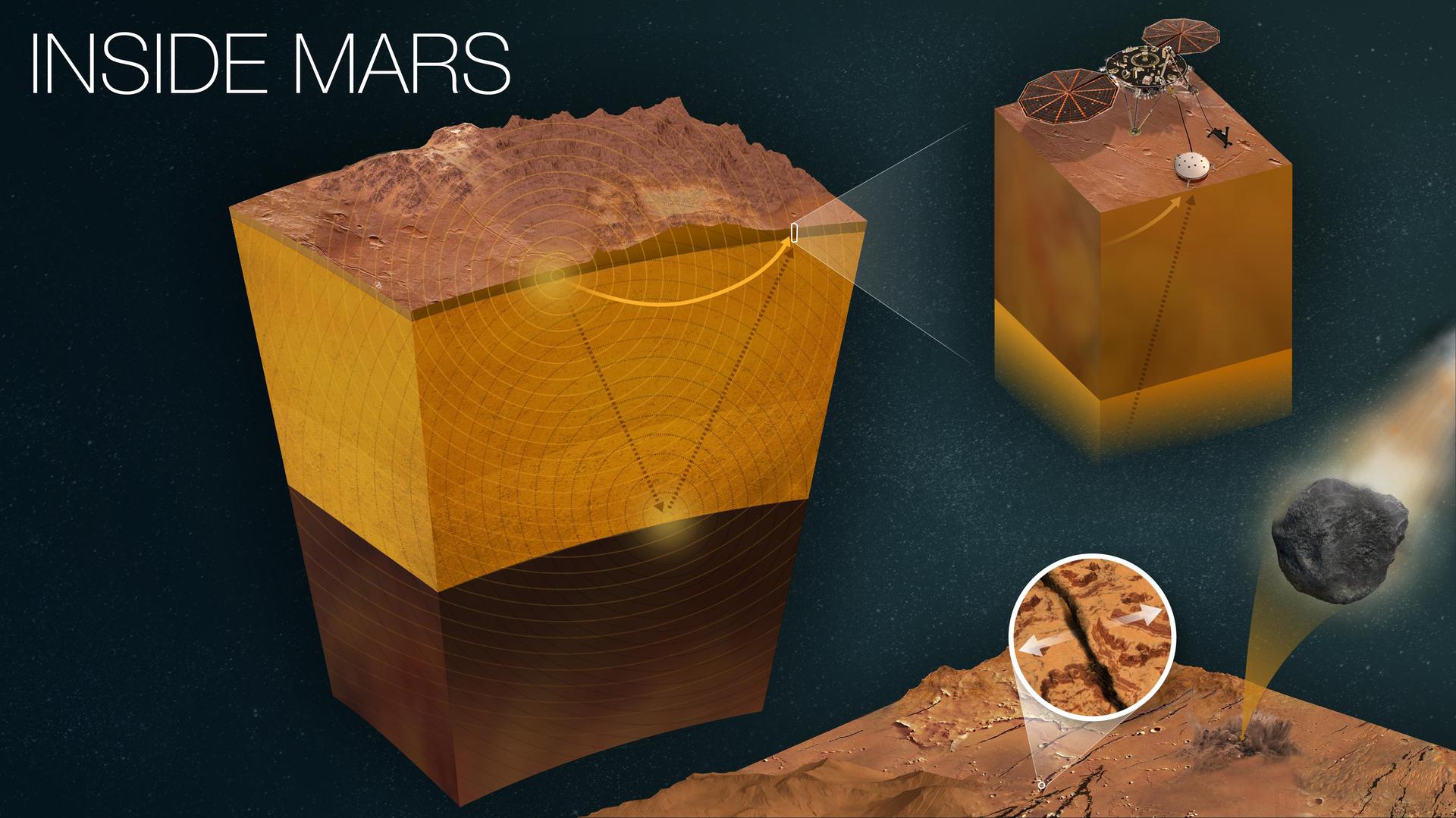
The work, titled "Seismic evidence for a melt-depleted lower crust and transcrustal magmatism on Mars," was published in Nature Astronomy on June 26, 2026. The University of Oxford-led team did not drill into Mars or sample its rocks. Instead, they listened. InSight, which operated on the Elysium Planitia plains before NASA retired the mission, carried an exquisitely sensitive seismometer — the first ever placed on Mars, in 2018 — that logged marsquakes and the sharp pings of meteoroid impacts. Those waves carry information about everything they pass through on their way to the detector — and embedded in them was a puzzle about 24 kilometers down.
The boundary nobody could explain
Seismologists had already spotted a discontinuity at roughly that depth: a boundary where seismic waves abruptly change speed, signaling a shift in the rock they are traveling through. The obvious question was what kind of rock could produce such a change. The Oxford group attacked it by brute comparison, testing candidate rock compositions against the seismic measurements using statistical analysis — drawing on collaborators in Oxford's Department of Statistics — to see which ones could actually reproduce the observed wave behavior.
Only one family survived the filter. Below the 24-kilometer mark, the seismic properties match ultramafic rocks — compositions heavy in iron and magnesium and poor in silica — sitting beneath more mafic, silica-richer rock above. That signature is diagnostic. Ultramafic rock is what you get when magma has had much of its silica-rich melt extracted from it over time. In other words, the lower crust of Mars looks melt-depleted: it is the residue left behind after enormous volumes of molten material were processed through it and drained away.
That single inference cascades into a much bigger picture. To leave behind a melt-depleted lower crust on this scale, Mars had to have run magma through its crust again and again over long stretches of geological time — storing it, letting it differentiate, mixing fresh batches with old, and assimilating surrounding rock. Geologists call this a transcrustal magmatic system, a process previously thought to be unique to Earth. The InSight data say Mars had one too.
Earth's trick without Earth's tectonics
Here is the part that should make planetary scientists sit up. On Earth, the construction of complex, chemically differentiated crust is tightly bound up with plate tectonics — the conveyor belt of subduction and spreading that recycles material and concentrates the lighter, silica-rich rock into continents. Mars has no plates. It is a one-plate, "stagnant lid" planet, its surface a single rigid shell.
And yet, the study argues, Mars achieved a comparable degree of magmatic complexity anyway. As the team put it, planets may not need Earth-style tectonics to build complex crusts and sustain conditions supporting life. That challenges a fairly deep assumption about how rocky planets assemble their outer layers — the idea that you need tectonics to manufacture sophisticated crust. Mars appears to be a counterexample sitting right next door.
A buried layer on a continental scale
The researchers also put rough dimensions on how widespread this hidden plumbing may be. Rather than a scatter of isolated magma chambers, the buried, melt-depleted layer may extend sideways for hundreds or even thousands of kilometers around Mars's northern hemisphere — the signature of enormous, interconnected magmatic systems rather than one-off volcanoes. Lead author Dr. Tobermory Mackay-Champion, now at the University of Bristol, carried out the work with Oxford's Professor Jon Wade and Professor Mike Kendall, alongside collaborators at the University of Bristol and in Oxford's Department of Earth Sciences and Department of Statistics. Together they turned a single instrument's record of trembling ground into a map of structure buried kilometers below.
Why It Matters
The finding bears on one of the central questions in comparative planetology: what does it actually take to build a planet's crust? If Mars manufactured Earth-like, differentiated crust without plate tectonics, then the recipe for crustal complexity is more flexible than assumed — which matters for interpreting rocky exoplanets we will never visit and can only model. It also feeds directly into the habitability conversation, since the team explicitly ties this kind of internal magmatic processing to a planet's ability to sustain conditions supporting life. And it is a vivid demonstration of what a single, well-placed seismometer can do: InSight has been retired for years, yet its archived quakes are still rewriting the geology of another planet. The next leap will likely require a seismic network — multiple stations spread across Mars — to map this hidden plumbing in three dimensions rather than inferring it from one listening post.
