
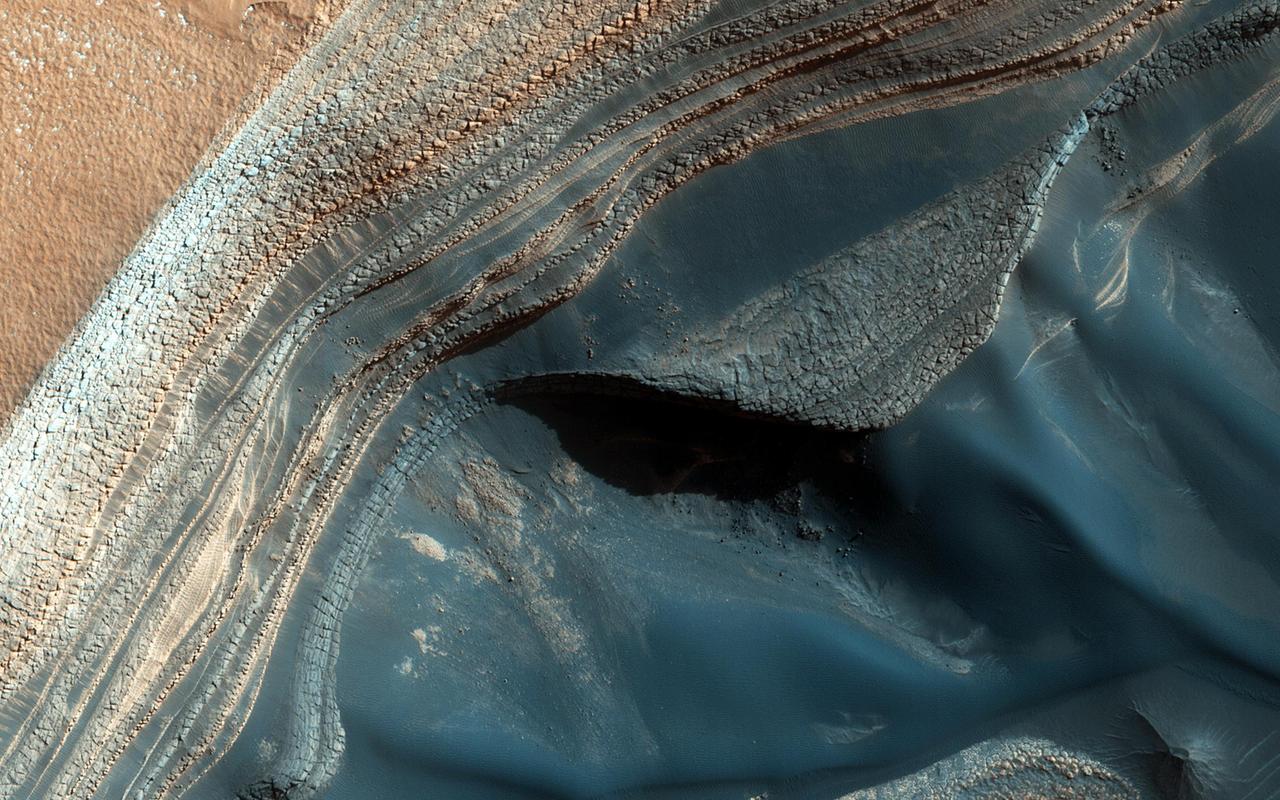
For years, the bright cap at Mars' north pole has had a contradiction built into it. Measurements of how the ice reflects sunlight suggested it was fairly dirty, with dust making up as much as about 25% of its mass by some estimates. Radar, which sees down into the 1.5-kilometer-thick stack of ice called the north polar layered deposits, pointed to far fewer impurities. Both can't be right.
A study published Sept. 8 in npj Space Exploration concludes the radar was closer to the truth. According to the paper's abstract, the exposed north-polar ice generally contains less than 3% dust by mass. The problem was never the ice. It was how the reflectance data had been read.
Redoing the math
The work comes from Aditya Khuller, a senior research scientist at the University of Washington's Applied Physics Laboratory, and Pari Mohan. As the UW News release describes it, the pair redid the calculations with a method for modeling snow and ice developed by Steve Warren, adapting techniques that had been used on Earth for decades to Mars. The release says the leading earlier approach was developed for studying soil on the Moon, and that it seemed off when Khuller checked its accuracy on Earth.
The data came from orbit and from the surface. Universe Today reports the team drew on the OMEGA and CRISM instruments, plus the Surface Stereo Imager on NASA's Phoenix lander, which sampled ice near the Martian north pole in 2008. UW's release says the study combined Phoenix data with observations from orbiting satellites.
The headline result is a big revision. The roughly 25% dust figure drops to about 3%, and the paper treats 3% as an upper bound for exposed ice in general.
An ice-cream sandwich, not a dirty snowball
A cleaner average turns out to be only part of the story. The study finds that the ice is not uniformly mixed. It is layered, and the layers differ sharply.
The abstract describes clean ice layers holding just 0.05% to 0.5% dust, interbedded with "marker beds" that are 25% to 75% dust. The UW release calls the arrangement an ice-cream sandwich: layers of dustier ice between slabs of cleaner ice.
Dust darkens ice, so how dusty the ice is changes how much sunlight it reflects, which is why the reflectance-based estimates mattered so much.
The seasonal disguise
The surface coating matters too. The polar cap's albedo, meaning how much light it reflects, changes over the Martian year. The new analysis attributes those changes to thin, dusty frost lying on top of coarse-grained firn, the compacted, granular ice that sits between fresh snow and solid glacier ice.
In the UW account, the dusty frost forms in winter and disappears in summer. So part of what looked like dirt in the ice itself is a temporary veneer that comes and goes with the seasons, sitting on top of much cleaner material.
With dust levels this low, the authors say, the reflectance observations and the radar-derived impurity estimates for the north polar layered deposits finally agree. Two independent ways of probing the same ice now tell the same story.
Why It Matters
One reason is practical. Universe Today notes that the north polar cap holds potential as a source of water for future human missions. A cap that is cleaner than assumed is, on its face, a better prospect than one where a quarter of the mass is dust, though neither source addresses extraction.
The other reason is scientific. The north polar layered deposits are a stack of material laid down over time, and the layering holds a record of Mars' past climate. Universe Today notes that the ice helps researchers piece together past climates on Mars, and the UW release says the layers hold details about the climate of thousands of years ago. A record of nearly pure ice broken up by dust-rich marker beds is very different from one of uniformly dirty ice. The contrast between clean layers and dusty bands is itself information about how conditions changed while the deposits built up.
There is a methodological lesson as well. What changed was the physical model used to interpret the data, borrowed from the study of snow and ice. A discrepancy between instruments that had been treated as a puzzle about Mars appears to have been at least partly a puzzle about analysis.
What to keep in mind
The study is about the exposed north-polar ice, and its main figure is described as a general upper limit, not a single value for every spot. The dusty marker beds are real and can be very dirty, so local dust content depends on which layer you are looking at. The paper's main claim is about overall composition and about reconciling two conflicting kinds of measurement, not about mapping every layer in detail.
UW announced the work in a release dated Sept. 29, about three weeks after the paper appeared, and Universe Today covered it Oct. 1. The paper itself is the primary source for the figures quoted here.