
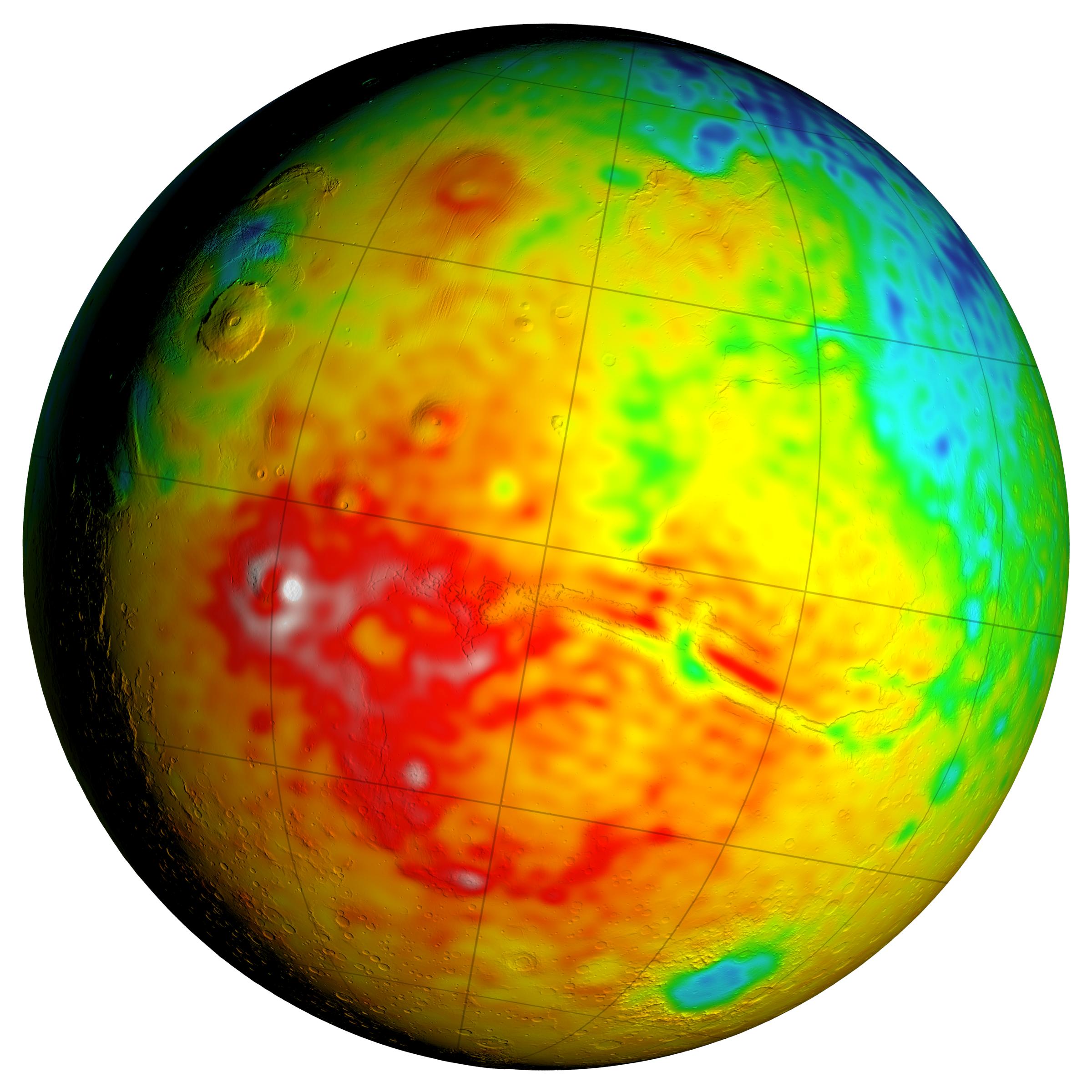
Mars has a small fleet of orbiters that have been circling it for years, and it turns out their radio signals carry a surprising amount of information about what lies deep inside the planet. A new study in Nature uses that information to argue that a region of the Martian mantle beneath the southern highlands is markedly hotter than the rest, and that it has stayed that way for a very long time.
The work is led by Alexander Byrne of the University of Arizona. Harriet Lau and Nick Wagner of Brown University, who are co-authors, adapted a technique called tidal tomography, which was developed at Brown, for use on Mars. The team infers a preserved thermal anomaly of 200 to 400 degrees Celsius in the present-day mantle below the southern highlands.
How you weigh a planet with a wobble
The starting point is a simple bit of orbital mechanics. Mars follows an eccentric orbit and has an axial tilt, so the tidal forcing it feels from the Sun changes with the seasons. Wagner explains that the Sun's gravity stretches and squeezes Mars because its orbit is not circular. That flexing produces a tidal bulge, and the bulge produces tiny changes in the speed of spacecraft orbiting the planet.
Those changes are measurable. The team drew on about 16 years of tracking data from three spacecraft: Mars Global Surveyor, Mars Odyssey and Mars Reconnaissance Orbiter. From that record they examined the time-variable gravity field of the planet, and in particular its degree-3 components. According to the Nature abstract, those components differ by as much as 300 percent from what a spherically symmetric Mars would predict.
A planet that responds identically everywhere would not do that. The mismatch implies that the interior is not uniform, and that different regions flex by different amounts under the same tidal squeeze. Warmer rock is softer, so mapping how stiff the mantle appears to be in different places is, in effect, a way of mapping temperature.
What the pattern looks like
The abstract reports that the effective shear modulus of the mantle varies by more than 20 percent, in a roughly north-south pattern that is aligned with the crustal dichotomy, the long-known split between Mars's low northern plains and its elevated, heavily cratered southern highlands. Brown's release puts the same result in plainer terms: the southern hemisphere would need to be about 20 percent less rigid than the northern part to explain the data.
The authors read that softness as heat. Their inferred anomaly is 200 to 400 degrees Celsius warmer than the rest of the mantle, per the Brown release. The abstract says the anomaly correlates with the crustal dichotomy and that the temperature variation has persisted over several billion years, which suggests the heat is not a recent fluke.
Where the heat comes from is still open
The abstract offers two possible explanations and does not pick between them. The anomaly could reflect regional mantle convection. Alternatively, it could result from insulation by the thick southern crust, which would have kept heat trapped beneath it and allowed the warm region to persist over several billion years. Either way, the study describes the anomaly as preserved, meaning it has survived to the present day.
Universe Today's coverage, published Sept. 28, draws out some consequences. A warm region of this kind may induce partial melting that is stalled by the overlying crust. It could also thicken the crust and enhance the magnetization of the southern highlands. The northern mantle, by contrast, is described as thinner and cooler. These are framed as possibilities that follow from the finding rather than as results of the study itself.
Why It Matters
Brown's release frames the result as a way to understand how the planet has evolved over the past 4 billion years. Wagner says the open question is whether Mars formed with this asymmetry already in place or whether something early in its history, such as a large impact on the northern hemisphere, caused it. He calls disentangling those theories the next big step after this study. The southern crust may also have insulated the mantle beneath it and kept it warmer, and Wagner says both theories are possible.
Universe Today reports that, in their paper, the authors noted that future studies could help researchers understand the thermal models of Mars and the influence of deep-seated volcanic activity there. The method may also travel. Universe Today notes that the Jupiter Icy Moons Explorer (JUICE) will use a radio science experiment to map the gravitational field of Ganymede, and that its tidal deformation should help determine whether an interior ocean exists and how deep it lies. The outlet adds that Mercury and Enceladus could also benefit from such studies. Any body whose orbit or companions produce a time-varying tide, and which has spacecraft tracking it, is a plausible candidate.
There are limits worth keeping in mind. The temperature figure is an inference from an effective shear modulus, not a direct measurement, and the abstract itself leaves the cause of the anomaly unresolved. Wagner also suggests the anomaly may have a compositional component in addition to a temperature difference, though he says a follow-up study would be needed to test that. The result rests on three things: a departure of up to 300 percent from the spherical prediction, a north-south stiffness pattern of more than 20 percent, and its alignment with the dichotomy.
