
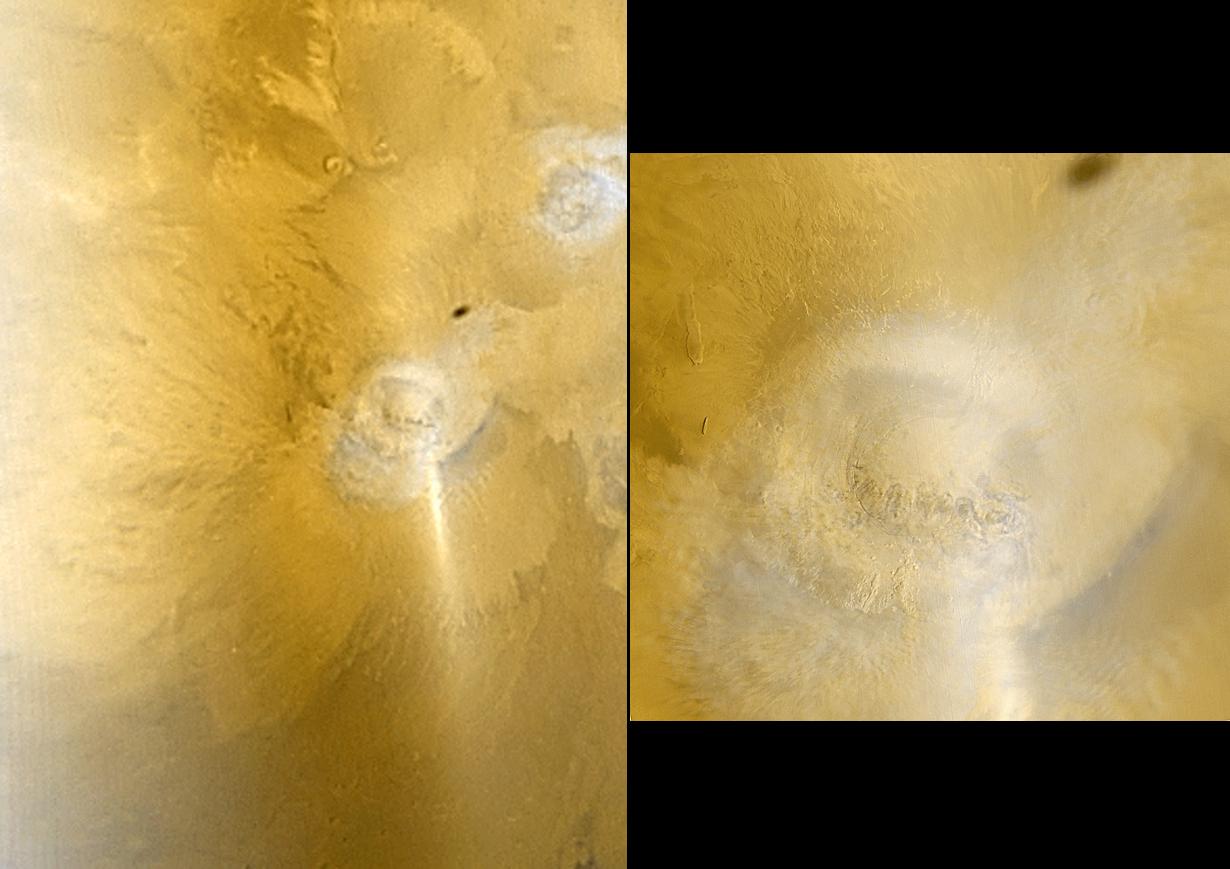
On spring and summer mornings in Mars's southern dusty season, a long, thin cloud forms downwind of Arsia Mons, a volcano about 20 km tall. It grows fast and stretches up to 1,800 km across the Martian surface, nearly twice the length of the United Kingdom. Planetary scientists call it the Arsia Mons Elongated Cloud, or AMEC. ESA's Mars Express spacecraft first brought it to wide attention in 2018, and it has been a puzzle ever since.
A study published in Nature Geoscience now suggests the cloud is stranger than anyone thought. The authors argue that the AMEC can only be explained if water vapour freezes directly into ice particles without any dust grain to start the process. That mechanism, called homogeneous nucleation, has been predicted in theory for some planetary atmospheres but has never been observed in nature.
How clouds usually get started
To see why the result is surprising, you need to know how ice clouds normally form. Below the triple point of water (the temperature and pressure at which ice, liquid and vapour can coexist), the accepted view is that ice cloud particles form by heterogeneous nucleation. Water molecules collect on something that is already there, such as a speck of dust, and freeze onto it. The seed gives the ice a surface to build on, so freezing can begin at fairly modest levels of supersaturation.
Homogeneous nucleation leaves out the seed. Water molecules have to come together and lock into a stable ice crystal by themselves, which takes far more extreme conditions. The paper's abstract says this route had been considered theoretically possible for mesospheric clouds on Earth and Venus, but it had never been seen in nature.
On Mars, the seed is thought to be dust, according to ESA. The AMEC appears during the dusty season, which makes a dust-free origin all the more surprising. The authors say the conditions are rare: the process needs exceptional circumstances, with relative humidity more than 100,000 times that of everyday life on Earth.
What the team did
The study was led by Jorge Hernandez-Bernal of LMD/CNRS/Sorbonne Université. The team combined observations from three Mars Express instruments, VMC, HRSC and OMEGA, with a Mars meteorological model. When they added a homogeneous nucleation scheme to the model, it reproduced the unusual characteristics of the AMEC. The authors write that this "strongly suggests" homogeneous nucleation is happening on Mars.
Hernandez-Bernal told ESA that reproducing the cloud required "exotic physics" and called the dust-free freezing "wholly unexpected."
The paper builds on earlier work by the same group. A 2021 observational analysis described the cloud's structure, and a mesoscale modelling study posted to arXiv in October 2024 followed it up. The arXiv paper describes observations that show a compact "head" about 120 km across sitting on the western slope of the volcano, with a tail extending west for more than 1,000 km. Any explanation has to account for that shape: a small, intense source region feeding a very long, narrow plume.
The recipe for a cloud that shouldn't exist
According to ESA's summary of the work, the mechanism goes like this. A powerful atmospheric wave lifts moist air several kilometres upward within a few minutes. As the air rises it cools sharply, dropping by 30 degrees in about 10 minutes. The rapid cooling makes relative humidity spike to more than 100,000 times the values typical in daily life on Earth.
At that level, the water vapour freezes directly into cloud particles without dust grains, forming the AMEC.
ESA says the AMEC sits in a unique position where Mars's thin atmosphere and the towering height of Arsia Mons combine to create these conditions. The 2024 arXiv paper had found that its model, without this extra physics, did not reproduce the cloud: the optical depth was too low and the tail did not expand. Adding homogeneous nucleation is what changed that.
Why It Matters
The first reason is basic physics. Homogeneous ice nucleation from vapour has been a theoretical possibility in planetary atmospheres, including mesospheric clouds on Earth and Venus, without any direct confirmation from nature. If the interpretation holds, Mars has provided the first natural case where the process seems to be required to explain what we see.
The second reason concerns Mars itself. Cloud formation affects where water ends up in the Martian atmosphere and how it moves. A process that can build a cloud on a scale of 1,800 km without dust seeds is something Mars atmospheric models may need to take into account where strong, rapid uplift happens, though the sources do not spell out that consequence.
The third reason is the value of long-running missions. Mars Express first revealed the AMEC in 2018. Years of repeated observations with several instruments, together with steadily improving modelling, were needed to turn an odd-looking cloud into evidence for new physics. ESA Mars Express Project Scientist Colin Wilson called the result "a true accomplishment for the mission and its scientists," noting that Mars Express discovered the AMEC and has monitored it for years.
A note of caution belongs here too. The authors frame the result as strong evidence from modelling, not a direct observation of individual ice crystals forming. The case rests on the fact that a model with homogeneous nucleation reproduces the cloud's distinctive features. ESA also notes that some aspects of the modelled cloud do not exactly match the observations, though Hernandez-Bernal called the result "remarkable." It is a strong argument, but it is an interpretation built on a model.
