
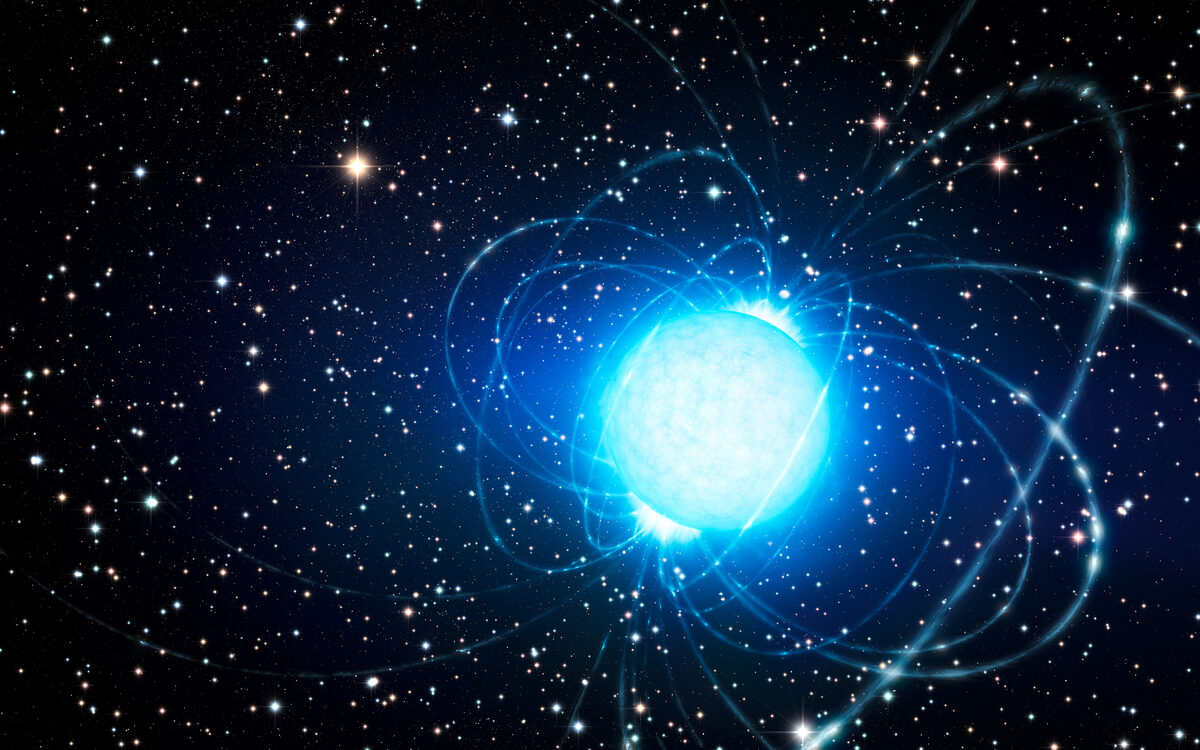
Earth's magnetic field is roughly half a gauss at the surface — enough to deflect a compass needle. The strongest continuous magnetic field ever produced in a laboratory is about 45 tesla, or 450,000 gauss. The magnetic field of a magnetar is approximately 10^15 gauss. At that strength, the magnetic field energy density exceeds the energy density of nuclear matter, quantum electrodynamics is no longer a small perturbation on classical electromagnetism, and atomic hydrogen as we normally understand it cannot exist — the electron orbitals are deformed from spheres into thin cylinders aligned with the field. This is not the physics of any classroom, and magnetars are the only places in the universe where it occurs on macroscopic scales.
A magnetar is a neutron star — the compressed core left after a massive star collapses in a supernova. In that collapse, roughly a solar mass of material is compressed into a sphere perhaps 20 kilometers in diameter. The density inside is two to three times the density of an atomic nucleus; the neutrons (and some protons, and possibly more exotic phases of quark matter) are packed so tightly that the entire object is, in a sense, a single quantum system. Most neutron stars are born spinning rapidly and have magnetic fields around 10^12 gauss, which is already extraordinary. Magnetars are the subset — perhaps 10 percent of all neutron stars — that emerge from the collapse with fields 1,000 times stronger.
How the field is amplified
The mechanism for producing magnetar-strength fields is still actively studied, but the leading model invokes a convective dynamo operating in the first few seconds after the collapse. As the proto-neutron star cools by radiating neutrinos, convective instabilities drive fluid motions at scales of kilometers, and if the initial rotation rate is fast enough, these convective flows can amplify a seed magnetic field exponentially — the same magneto-rotational instability that operates in accretion disks, but running in an extreme environment. Simulations can produce fields approaching 10^15 gauss through this mechanism, and the observed spin periods of known magnetars (ranging from 2 to 12 seconds, slow for neutron stars) are consistent with an initial rapid spin that has braked against the strong magnetic field over centuries.
The 30 or so confirmed magnetars in the Milky Way are detected primarily as Soft Gamma Repeaters (SGRs) and Anomalous X-ray Pulsars (AXPs). SGRs flare unpredictably in X-ray and soft gamma rays, occasionally producing giant flares — the most energetic events in the galaxy outside of supernovae. The December 27, 2004 giant flare from SGR 1806-20 briefly saturated X-ray detectors on the far side of Earth, was detectable as an ionospheric disturbance in the Earth's own upper atmosphere, and released more energy in 0.2 seconds than the Sun will emit in a quarter million years. It was, for that fraction of a second, as bright as a full Moon in radio frequencies — from a source 50,000 light-years away.
The fast radio burst connection
In April 2020, SGR 1935+2154, a magnetar in the Milky Way about 30,000 light-years away, produced a radio burst that was detected simultaneously by the CHIME telescope in Canada and the STARE2 array in the United States. The burst lasted a millisecond and had a brightness temperature and time structure essentially identical to fast radio bursts — the class of extragalactic millisecond radio transients whose origin had been unknown since their discovery in 2007. This single detection linked magnetars to at least some FRBs and established the physical viability of the mechanism: when the magnetar's crust fractures under magnetic stress (a "starquake"), it launches charged particles along field lines that coherently radiate at radio frequencies. The same geometry that produces X-ray flares during crustal failures can produce FRB-like emission under the right conditions.
What this means for the broader FRB population remains contested. The FRB from SGR 1935+2154 was many orders of magnitude fainter than the most energetic extragalactic FRBs. Either magnetars occasionally produce events far outside the range yet observed in the Milky Way, or the extragalactic FRB population includes progenitors that are not magnetars in the conventional sense — perhaps millisecond magnetars freshly formed in neutron star mergers, or magnetars in unusually dense environments that amplify the radio emission.
What is certain is that magnetars are operating at the intersection of general relativity, nuclear physics, quantum electrodynamics, and plasma physics in ways that cannot be reproduced anywhere else. They are, in the technical sense, experiments that nature runs and we can only observe — and each burst, each flare, each precise timing measurement of their decelerating spins is a data point in the physics of matter under conditions no human laboratory will ever achieve.
