
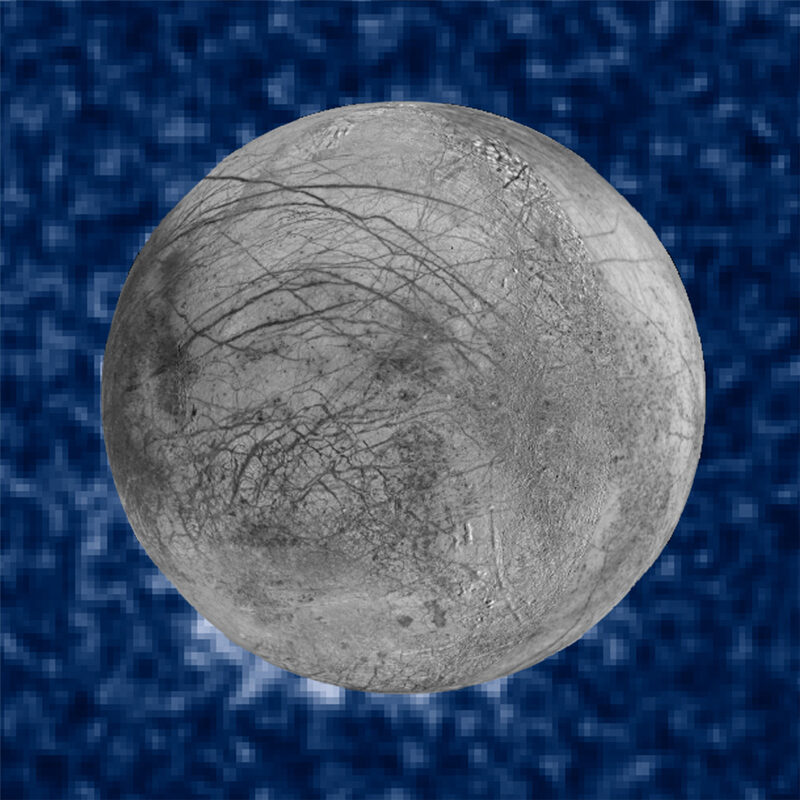
For decades, the appeal of Jupiter's moon Europa has rested on a simple picture: a global ocean of liquid water, buried beneath an icy crust, occasionally leaking toward the surface where a spacecraft might one day sample it. A new study argues that the plumbing is far less cooperative than that picture suggests. Water trying to rise from Europa's deep ocean, the model finds, tends to freeze itself into a plug long before it ever reaches daylight.
The paper, published July 24, 2026 in Nature Astronomy and led by planetary scientist Lujendra Ojha of Rutgers University's Department of Earth and Planetary Sciences, simulates how water moves through fractures in Europa's ice shell. The conclusion is blunt: the narrow cracks that might carry ocean water upward are also the cracks most likely to seal themselves shut.
The self-sealing crack
The mechanism hinges on a detail that is easy to overlook - how the water actually flows. When liquid is forced up through a narrow dike in the ice, the flow turns turbulent. Turbulence drives the water into vigorous contact with the frigid fracture walls, and heat bleeds out fast. The water doesn't just cool; it supercools, dropping below its freezing point while still liquid.
Supercooled water is unstable. In these conditions it begins spawning tiny suspended ice crystals - frazil ice - that grow and accumulate inside the pathway. The crystals clog the dike, choking off the very channel that was supposed to deliver water to the surface. The simulations show that narrow cracks could freeze shut within hours. On a body where geological features play out over thousands to millions of years, hours is effectively instantaneous.
The result is a kind of geological catch-22. To reach the surface, ocean water needs a fracture. But a fracture narrow enough to form readily in the ice is also narrow enough to lose its heat and freeze closed almost immediately. The plumbing seals itself before anything gets through.
So where does the surface water come from?
Europa's surface is not a featureless sheet of ice. It is scarred with ridges, chaotic terrain, and reddish deposits that have long tempted researchers to imagine ocean material welling up from below. If the new model is right, most of those features would not be direct fingerprints of the deep ocean at all.
Instead, the study argues that any shallow pockets of liquid water on Europa most likely form from localized melting within the ice shell itself - heat concentrated in a particular spot melts nearby ice - rather than from ocean water rising through cracks. It's a subtle but consequential distinction. A shallow lake fed by local melting is chemically a product of the ice shell. A shallow lake fed by the ocean is a messenger from the deep. They are not the same target, and they would not tell you the same things.
Why It Matters
This is not an abstract quarrel about ice physics. It lands squarely on the two flagship missions now en route to the Jupiter system.
NASA's Europa Clipper launched on October 14, 2024 and, after a 1.8-billion-mile cruise, is due to arrive at Jupiter in April 2030. It will make 49 close flybys of Europa carrying nine instruments plus a gravity experiment, all aimed at the central question of whether the moon has the ingredients and conditions for life. Europa's subsurface ocean is thought to hold more than twice the water of all Earth's oceans combined - an enormous potential habitat, if it can be reached or read. The European Space Agency's JUICE mission, launched in April 2023, is set to reach Jupiter in July 2031.
Both missions are, in part, hunts for accessible water - places where the ocean's chemistry might be exposed to remote sensing. Ojha's model doesn't diminish the ocean; it complicates the shortcut. If ocean water rarely makes it to the surface intact, then the shiniest-looking surface features may be poor proxies for what's happening kilometers below. The mission teams may need to weigh their observations differently: a shallow melt pocket is worth studying on its own terms, but reading it as a direct sample of the ocean could be a mistake. Knowing which is which, before the flybys begin, shapes where these spacecraft should point their instruments and how the data should be interpreted once it comes back.
The bigger picture
There is a long history in planetary science of surfaces that turn out to be misleading. Ice shells are dynamic, and the temptation to read every ridge and stain as a plume of ocean water has always run ahead of the physics. What this study contributes is a specific, testable reason to be cautious: the thermodynamics of turbulent flow in a very cold crack conspire against clean delivery from below.
None of this makes Europa less interesting. A moon with more than twice Earth's ocean water, tucked under an ice shell warmed from within, remains one of the best places in the solar system to ask whether life could arise somewhere other than here. But if the ocean is more sealed off than hoped, the search for habitable niches may have to shift - away from chasing surface hints of upwelling, and toward understanding the ice shell itself as a place where liquid water, and perhaps the conditions for life, could persist in isolated pockets of its own making.
Europa Clipper still has years of cruise ahead before it can put any of this to the test. When it arrives in 2030, one of the questions waiting for it will be exactly the one this model raises: when you find liquid water near Europa's surface, where did it actually come from?
