
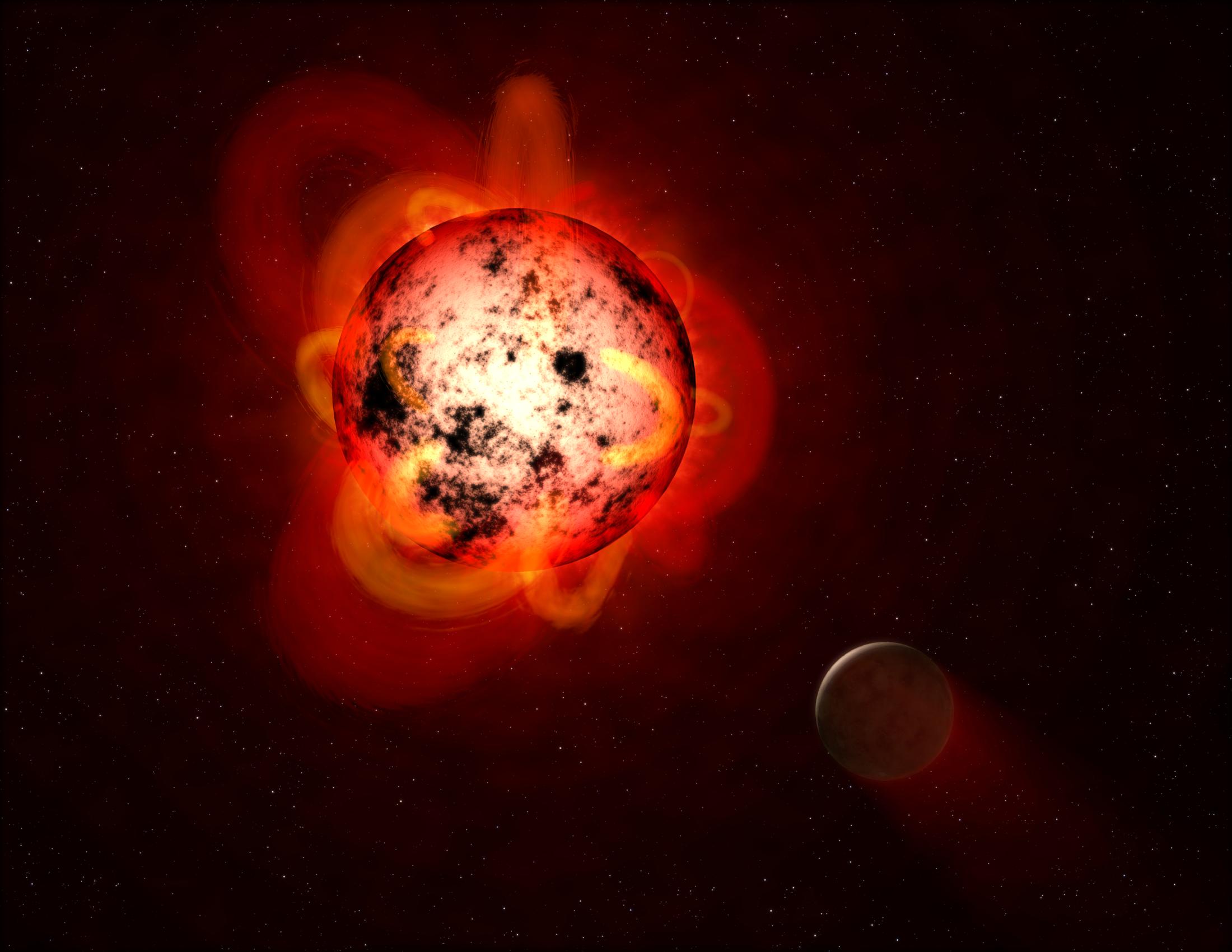
For as long as astronomers have modeled the freckled surfaces of stars, one rule seemed safe to assume: faculae — the bright magnetic patches that dot the Sun alongside its darker sunspots — are brighter than the quiet surface around them. That assumption is baked into decades of solar physics and, more recently, into the models researchers use to correct exoplanet measurements for stellar activity. A new study says the rule breaks down entirely once you leave Sun-like stars behind.
The paper, led by Alexander Shapiro of the Max Planck Institute for Solar System Research along with Sara Seager, Sami K. Solanki, and colleagues, was formally published in The Astrophysical Journal on August 21, 2026, and got a spotlight writeup from AAS Nova on September 9. Using 3D radiative-magnetohydrodynamic simulations, the team modeled how faculae behave across a range of stellar types — and found that the textbook "always bright" picture holds only near the Sun's end of the spectrum.
From Bright to Dark, Star by Star
The researchers ran their simulations using the MURaM radiative-MHD code paired with the MPS-ATLAS radiative-transfer code, tracking how magnetic flux tubes at a star's surface affect the light emerging from facular regions compared to the surrounding quiet photosphere. The results trace a clear progression:
- On G2 stars like the Sun, faculae are bright, as expected.
- On K2 stars, they're still bright — but progressively fainter.
- On M0 dwarfs, the brightness edge keeps shrinking.
- On M4 dwarfs, faculae flip sign entirely, appearing darker than the surrounding non-magnetic surface.
The paper's findings state it plainly: on M4 dwarf stars, facular regions are darker than the surrounding quiet, nonmagnetic stellar surface — directly contradicting assumptions commonly used in exoplanet transmission-spectra studies.
Why Would a Bright Spot Go Dark?
What makes faculae bright on the Sun in the first place? Magnetic flux tubes at the solar surface act like windows into hotter, deeper layers of the star. Reduced opacity in the magnetized gas lets astronomers see down further, where temperatures are higher — that's the effect that produces brightening.
So what changes on a cooler star? According to the AAS Nova writeup, two competing effects are at play in every star's faculae: strong magnetic fields suppress the inflow of hot material into the magnetic region (a darkening effect), while lower opacity in that same magnetized gas reveals deeper, hotter layers (a brightening effect). On the Sun, the brightening effect wins. Shapiro and colleagues attribute the shift on cooler stars to shallower magnetic flux tubes and reduced vertical temperature gradients at M-dwarf surfaces relative to the Sun — conditions under which surface gas pressure increasingly favors the darkening side of that balance. By M4, darkening wins outright.
Why It Matters
This isn't just a curiosity about stellar surfaces — it has direct consequences for how astronomers measure exoplanets, and M dwarfs are exactly the stars getting the most attention right now. Their small size and close-in habitable zones make them prime targets for transit surveys and for JWST transmission spectroscopy of rocky, potentially habitable worlds.
Transit depth — how much starlight a planet blocks as it crosses its star — is the basic measurement used to derive a planet's radius. But that measurement assumes a clean, well-characterized stellar surface. According to the AAS Nova coverage, dark faculae increase the apparent planetary radius derived from transit depth, while bright faculae decrease it. Get the sign of that correction wrong — as models built on the Sun's bright-faculae assumption would for an M dwarf — and a planet's inferred size shifts in the wrong direction.
The arXiv preprint underlying the paper goes further, noting that stellar spots and faculae contaminate exoplanet transmission spectra in a wavelength-dependent way that can mimic planetary atmospheric features. That's a serious concern for JWST observations of small planets around M dwarfs, where astronomers are hunting for faint spectral fingerprints of atmospheric gases. A wavelength-dependent stellar contamination signal sitting on top of — or masquerading as — a genuine atmospheric absorption feature is exactly the kind of systematic error that's hard to catch after the fact and easy to misinterpret as a discovery.
M dwarfs are also known for strong magnetic activity, and many of the small, temperate planets currently being targeted for atmospheric characterization orbit these stars. If facular contamination has been running backward in models built on solar assumptions, some of the radius and spectral measurements already in the literature for M-dwarf planets may need a second look.
What Comes Next
The study, published as Volume 1008, Article 24 in The Astrophysical Journal (DOI 10.3847/1538-4357/ae7105), doesn't claim every existing exoplanet measurement is wrong — it demonstrates a mechanism that current stellar-contamination models likely don't account for correctly when applied to cool stars. The practical fix is straightforward in principle: build stellar activity corrections around the actual physics of each spectral type rather than extrapolating from Sun-like assumptions. Given how central M dwarfs have become to the search for potentially habitable worlds, that recalibration is likely to matter for a wide swath of ongoing and upcoming JWST programs.
