
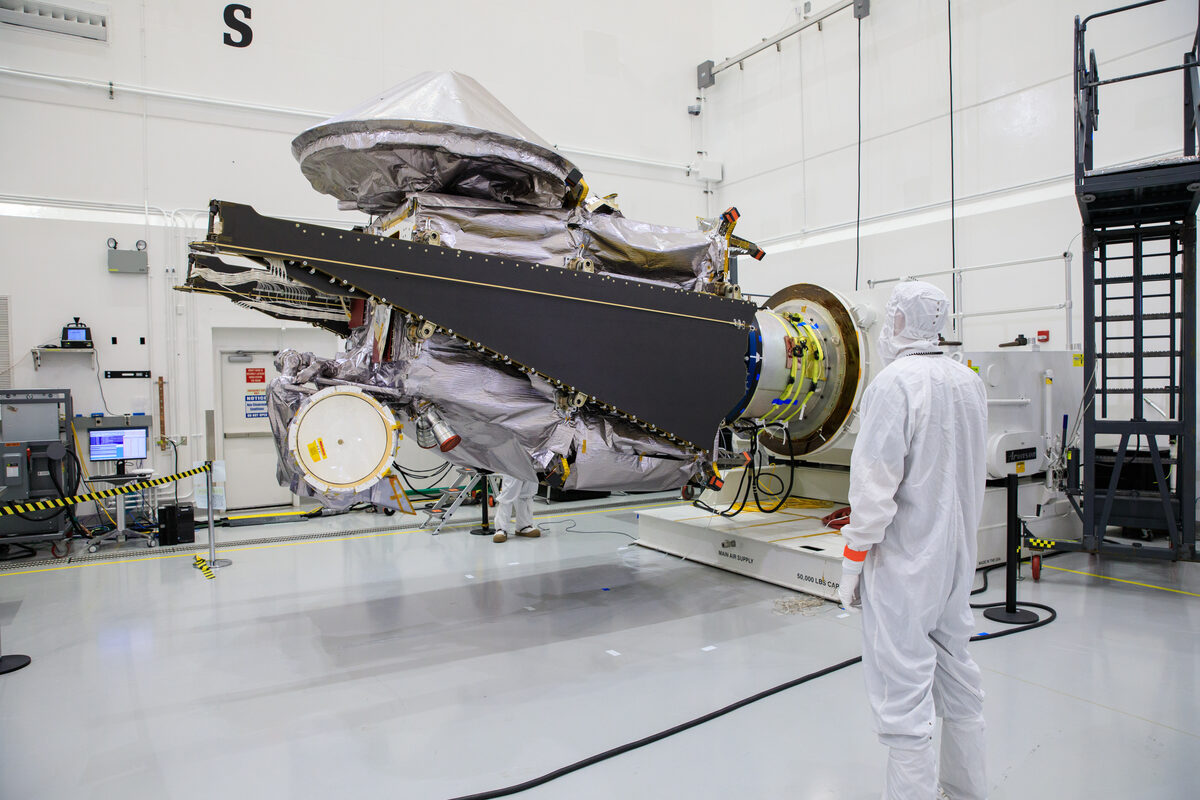
The Trojan asteroids are fossils. They occupy two gravitational sweet spots in Jupiter's orbit — called the L4 and L5 Lagrange points, leading and trailing the planet by 60 degrees — where the combined gravitational pull of the Sun and Jupiter holds objects stably for billions of years. The Trojans have been there since the early solar system, when giant planet migration scattered small bodies across the system and some were captured into these stable reservoirs. Unlike the main asteroid belt, which has been geologically processed by collisions and heating, the Trojans are thought to preserve the original composition of outer solar system material — ices and organics that formed beyond the snowline of the proto-solar disk. A spacecraft that can sample their diversity is sampling the raw ingredients of the planets.
Lucy launched from Cape Canaveral on October 16, 2021, on a twelve-year mission that will visit eight Trojan asteroids — the most any mission has ever targeted in a single flight. Its path is an elaborate sequence of gravity assists, swinging around Earth three times to build up speed for the outer solar system, and its target list includes the first binary Trojan ever directly observed from close range. But what Lucy found on the way to the Trojans has already reshaped the mission's scientific expectations.
Dinkinesh: a surprise inside a surprise
On November 1, 2023, Lucy flew past Dinkinesh — a 790-meter main-belt asteroid chosen as an engineering test of the spacecraft's terminal tracking system, which needed to practice locking onto and following a small, rapidly moving target. The team expected a routine flyby of an unremarkable rock. What they found was a binary: Dinkinesh had a 220-meter companion, Selam, in a roughly 52-hour mutual orbit. And Selam itself turned out to be a contact binary — two lobes touching, held together by their own gravity — making the system a binary within a binary. No such three-component arrangement had ever been observed.
On April 20, 2025, Lucy flew past its second bonus target: Donaldjohanson, a 3.7-kilometer main-belt asteroid named for the paleontologist who discovered Lucy the Australopithecus skeleton. Donaldjohanson, too, turned out to be a contact binary — two distinct lobes, joined at a narrow neck, shaped like a bowling pin. Images returned over subsequent weeks showed a surface rougher and more structurally complex than Dinkinesh, with geological features that the team is still analyzing. Two bonus targets, two contact binaries. The pattern may not be coincidental — contact binaries and binary asteroid systems may be far more common among small solar system bodies than surveys from Earth had suggested.
What the Trojans hold
Lucy's primary targets, beginning with Eurybates and its satellite Queta in August 2027, are a scientifically diverse set chosen to sample different surface types and orbital histories within the Trojan clouds. The Trojans span a range of colors — some are gray (similar to outer main-belt asteroids), some are red (similar to the most distant, volatile-rich objects in the Kuiper Belt) — suggesting they were captured from different parts of the early solar system. Lucy's spectrometers will characterize their compositions in detail, and its high-resolution imager will map their surfaces for geological context.
The two binaries Lucy has already found imply that the Trojans, when Lucy reaches them, may hold further surprises about the prevalence of multi-body systems. Binary and contact-binary Trojans are expected but not well-characterized — ground-based observations can detect binarity from light curve variations but cannot resolve the components directly. Lucy's close flybys will be the first resolved views of Trojan interiors, shapes, and surface geology. The final flyby, of the binary pair Patroclus-Menoetius in 2033, will give Lucy twelve years of accumulated experience reading these small bodies — and the most detailed portrait yet of the solar system's most ancient survivors.
