
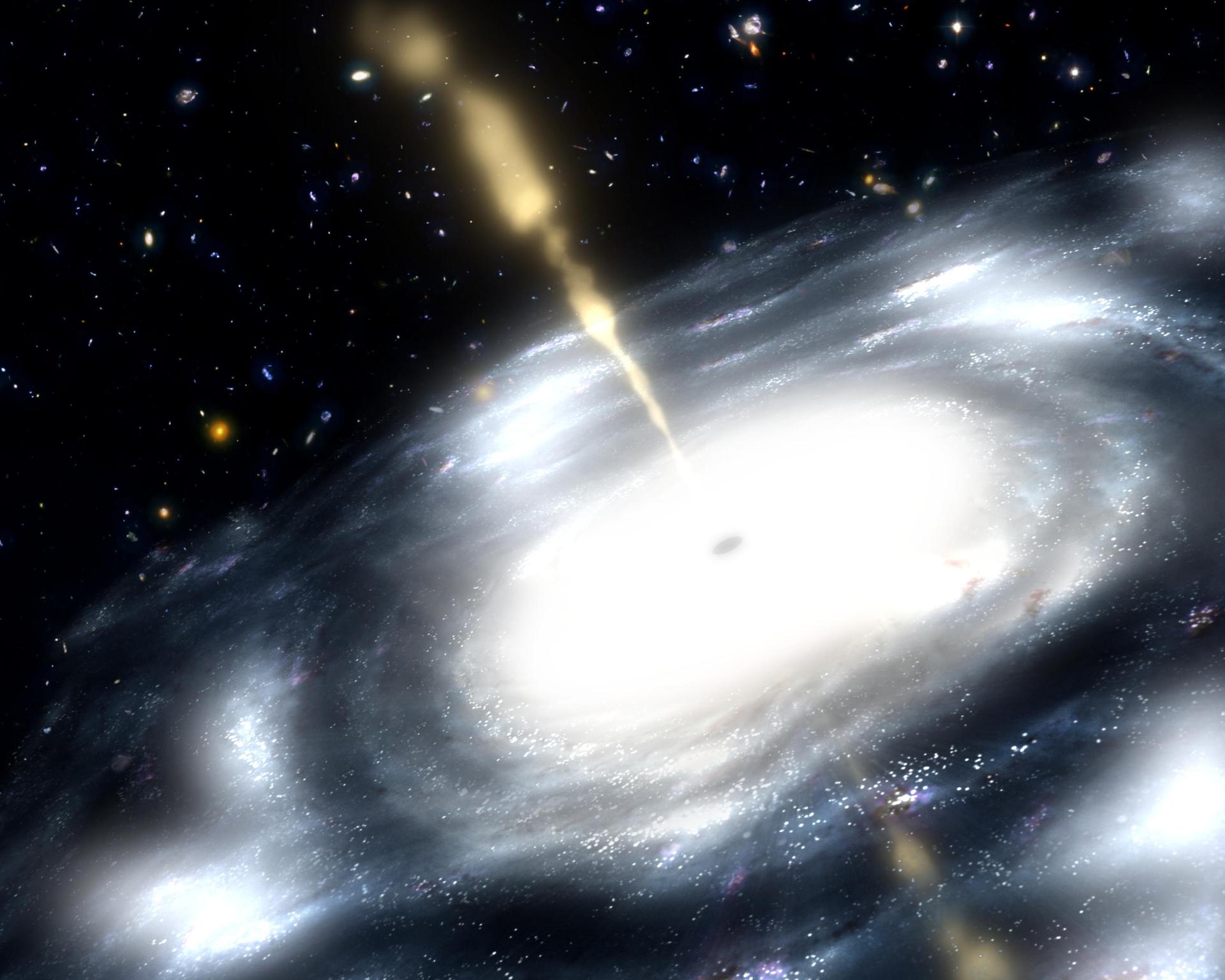
For three years, the little red dots have been one of the most stubborn puzzles in James Webb Space Telescope data: compact, intensely red sources scattered across the early universe that refuse to fit neatly into any familiar category. Are they galaxies stuffed with impossibly mature stars? Dust-choked starbursts? A new kind of object entirely? A run of work published in June 2026 is now pushing hard toward a single answer — and it is the one that, until recently, sounded the most exotic. The little red dots, this emerging consensus holds, are young supermassive black holes caught in the act of feeding far faster than textbook physics is supposed to allow.
The headline result comes from a study posted May 29, 2026 as an arXiv preprint (DOI 10.48550/arxiv.2605.31077), led by Yangyao Chen of Nanjing University and Houjun Mo of the University of Massachusetts. Their model does something the field badly needed: it explains how you build a black hole of a hundred thousand to a million solar masses early enough, and fast enough, to light up as a little red dot — without demanding that early-universe cosmology be quietly thrown out.
What the dots actually look like
Before getting to the mechanism, it helps to be precise about the observational fingerprint, because it is the fingerprint that has frustrated easy explanations.
Little red dots — LRDs in the literature — share a distinctive set of traits. Their spectra show a characteristic V-shape: bright in both ultraviolet and optical light but with a dip in between, rather than following the smooth profiles you would expect from an ordinary galaxy or a dust-reddened starburst. They display broad emission lines, the spectral signature of gas whipping around at high velocity, which is a classic tell of material orbiting close to a massive black hole. And yet they conspicuously lack the things that usually accompany a feeding black hole: there is no strong X-ray emission, no radio counterpart, and no telltale infrared signature.
That combination is the crux of the problem. Broad lines say "black hole." The missing X-rays say "not the kind of black hole we know how to model." For a while, that contradiction kept the door open to star-only explanations and left the whole population looking like a possible crack in the standard picture of how the cosmos assembled its first structures.
The black hole in a cocoon
The interpretation now gathering momentum closes that gap by wrapping the black hole in gas. A peer-reviewed analysis indexed in PubMed Central frames little red dots as young, comparatively low-mass supermassive black holes embedded in dense, ionized cocoons, where the radiation we see is reprocessed by a thick shroud of surrounding material rather than streaming directly out.
That single picture accounts for an unusual amount of the data at once. The cocoon explains the compact apparent size, because we are seeing a small, shrouded engine rather than an extended galaxy. It explains the red colors, because the dense gas reshapes the emerging light. It explains the broad emission lines, because the gas is moving fast in the black hole's grip. And critically, it explains the absence of strong X-rays: the surrounding cocoon absorbs and reprocesses, through photoelectric absorption in the dense gas, the high-energy radiation that would otherwise betray an actively feeding black hole. The thing that made LRDs look broken — black hole signatures without black hole X-rays — becomes a natural consequence of the cocoon rather than a contradiction.
Feeding past the Eddington limit
The cocoon explains what we see. The Chen and Mo model explains how it gets built in the time available — and this is where the physics gets genuinely aggressive.
There is a long-standing speed limit on how fast a black hole can grow: the Eddington limit, the point at which the outward push of radiation from infalling matter balances the inward pull of gravity and chokes off further accretion. Grow steadily at the Eddington rate and you still need a long time to assemble a supermassive black hole. The early universe does not offer a long time.
The new model gets around this with episodic violence. In its picture, black hole seeds form at redshift greater than 20 — when the universe was less than 200 million years old. These seeds then grow not through slow, steady feeding but through short, intense "nuclear burst" episodes of accretion, triggered by mergers or close encounters, in which the black hole gorges at up to roughly ten times the Eddington limit. By stacking these super-Eddington bursts, a seed can climb to between 100,000 and 1,000,000 solar masses and show up as a little red dot at redshift around 5 — roughly a billion years after the Big Bang.
The merger trigger matters. Rather than requiring a black hole to somehow drink continuously at a steady fast rate for hundreds of millions of years, the model lets it stay relatively quiet and then briefly run wild whenever a merger or close encounter funnels fresh gas to the center. Growth happens in spurts, which is both more physically plausible and a better match to a population that appears at a specific cosmic epoch.
Why It Matters
The deeper significance is reassurance. When the first little red dots turned up, one live worry was that JWST had found objects too massive, too early — a sign that the standard timeline of cosmic structure formation might be wrong. A model that grows a million-solar-mass black hole inside a billion years using known ingredients — seeds in the first 200 million years, mergers, and bursts of super-Eddington accretion inside an obscuring cocoon — is a strong signal that early-universe cosmology is not broken. The strangeness of the little red dots can be accommodated by understanding black hole feeding better, not by tearing up the framework.
It also reframes the LRDs themselves. If this picture holds, these objects are not anomalies but a window onto a phase of black hole growth we had never directly observed: the chaotic, shrouded infancy of the supermassive black holes that now anchor galaxies like our own. The convergence of an arXiv model and an independent peer-reviewed cocoon analysis within the same month is what makes June 2026 feel like a turning point — multiple lines of work pointing at the same interpretation rather than a single suggestive paper.
None of this is a closed case. The model still rests on a preprint, super-Eddington accretion sustained at ten times the limit is physically demanding, and the field will want more direct spectral evidence before declaring victory. But the explanation that once sounded the most far-fetched — black holes feeding past the limit inside dense cocoons — is now doing the most work to explain what Webb actually sees.
