
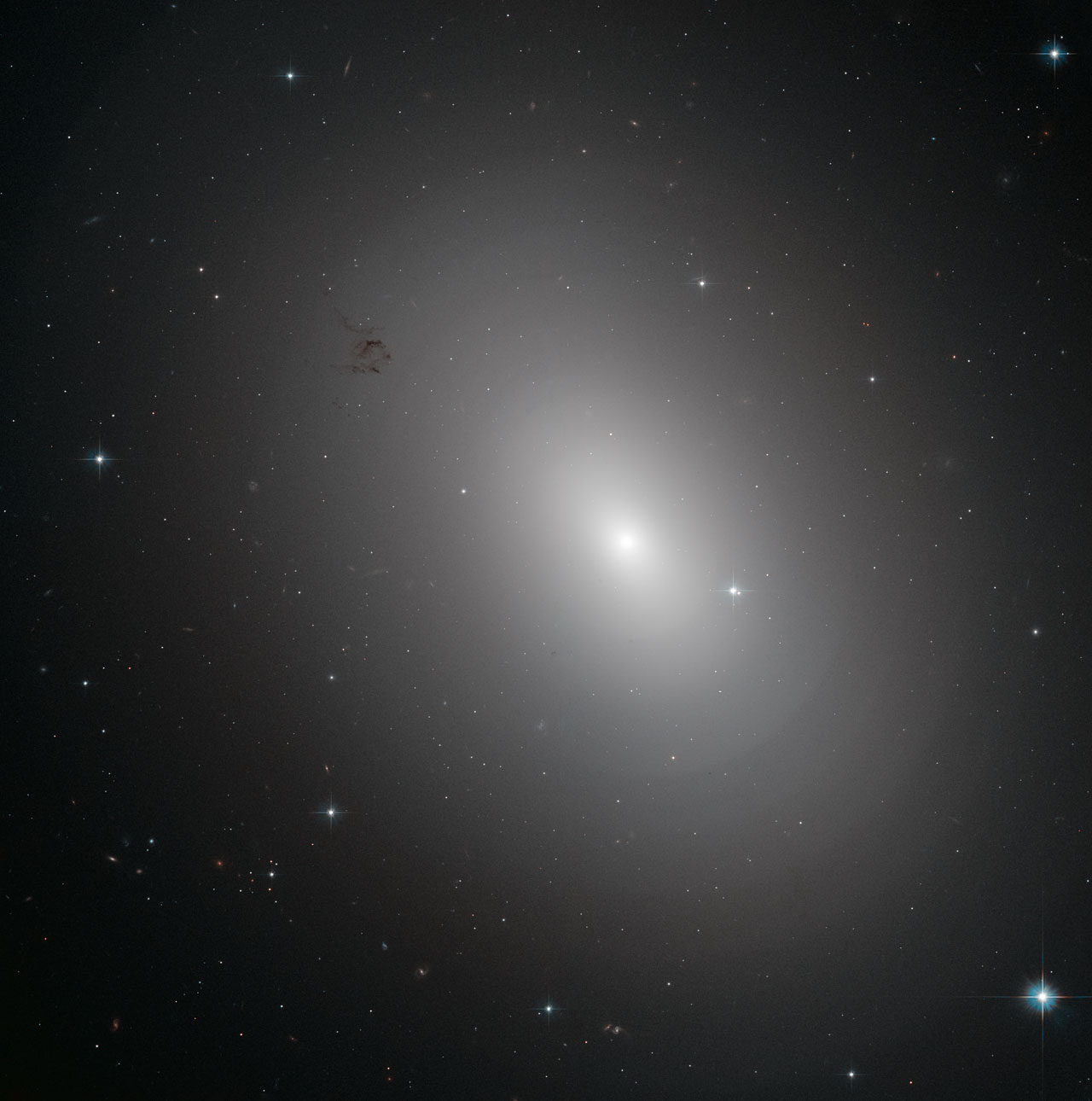
IC 1101 has had a reputation for decades. Sitting at the heart of the galaxy cluster Abell 2029, it's routinely name-dropped as "the largest galaxy in the universe" in documentaries and listicles. The trouble is that nobody had actually measured where it ends. Its outer light is so faint that it fades into noise long before instruments can confirm a true boundary, so every past size estimate has really been an estimate of how far a telescope could see before giving up — not a measurement of the galaxy itself.
A new study, led by Carlos Marrero-de la Rosa of the Instituto de Astrofísica de Canarias and accepted for publication in Astronomy & Astrophysics, closes that gap. Using the Wide Field Camera on the Isaac Newton Telescope, the team pushed imaging depth to a surface brightness of magnitude 30 per square arcsecond — deep enough to trace light far fainter than anything previous surveys of the galaxy had reached. That depth let them do something previous surveys couldn't: actually find the edge.
How do you measure a galaxy that fades into nothing?
The core technical obstacle wasn't the galaxy — it was everything in front of it. Any deep image of IC 1101's halo is contaminated by the glow of hundreds of foreground stars in our own galaxy, scattered light that can easily be mistaken for the galaxy's outskirts. The researchers modeled and subtracted more than 250 of these foreground stars individually before they could trust what remained.
What remained was a galaxy considerably larger than any casual estimate had suggested, but with a boundary that, for the first time, the data could actually pin down. The main stellar body extends to a semi-major axis of about 260 kiloparsecs — a diameter of roughly 520 kiloparsecs, or about 1.7 million light-years. For scale, the Milky Way's disk is about 30 kiloparsecs across, meaning IC 1101 is roughly 17 times wider. Laid over our own galaxy, IC 1101 would swallow not just the Milky Way but most of the space between us and our nearest large neighbors.
The team also derived a total stellar mass of 3.4 trillion solar masses for IC 1101. That figure — stars alone, not counting any dark matter of its own — already outweighs the Milky Way's entire mass, dark matter included, which is estimated at only 1 to 1.5 trillion solar masses. In other words, IC 1101's stars alone amount to more than double the mass of our entire galaxy, all packed into a single object rather than spread across a cluster.
A galaxy still under construction
IC 1101 is what astronomers call a brightest cluster galaxy, or BCG — the dominant, centrally located galaxy that sits at the bottom of a cluster's gravitational well and slowly cannibalizes smaller galaxies that wander too close. That process doesn't stop once a galaxy gets big; if anything, the largest BCGs are among the best places to catch it still happening.
That's exactly what the ultra-deep imaging picked up in IC 1101's outskirts. The researchers identified eight faint structural features in the galaxy's outer regions — arcs, clumps, and asymmetries in the stellar light that don't fit a smooth, settled distribution. The most likely explanation, according to the study, is a merger with another galaxy group that occurred 2 to 3 billion years ago and whose debris is still being incorporated into IC 1101's halo. In other words, the "largest known galaxy" title isn't describing a finished object. It's a snapshot of an ongoing process of a giant absorbing its neighbors, one that has been running for billions of years and, going by the disturbed outer light, hasn't fully settled yet.
Why It Matters
Superlatives like "biggest galaxy" tend to get repeated long after the number behind them has gone stale, mostly because nobody revisits the measurement. This study matters less for crowning a record-holder and more for showing how that record was actually established: by systematically removing foreground contamination and imaging deep enough to find a real physical edge, rather than the edge of an instrument's sensitivity. That's a methodological upgrade that can be applied to other brightest cluster galaxies, many of which have their own unresolved, unmeasured outskirts.
The merger evidence also matters on its own. BCGs are thought to grow largely through the accretion of smaller galaxies over cosmic time, a process that's central to models of how galaxy clusters evolve. Catching a specific, datable merger event in a galaxy this large gives researchers a rare, concrete data point for testing those growth models — a snapshot of a well-understood theoretical process actually caught in the outskirts of the real thing.
What's next
The paper itself, submitted to arXiv on July 16, 2026 and now accepted at Astronomy & Astrophysics, focuses on the imaging and mass measurements of IC 1101 specifically. The technique — deep Wide Field Camera imaging paired with careful foreground-star subtraction — is the more transferable result. Applying it to other BCGs in other clusters would let astronomers finally compare like with like: real measured edges instead of a grab-bag of estimates limited by whatever depth each past survey happened to reach.
