
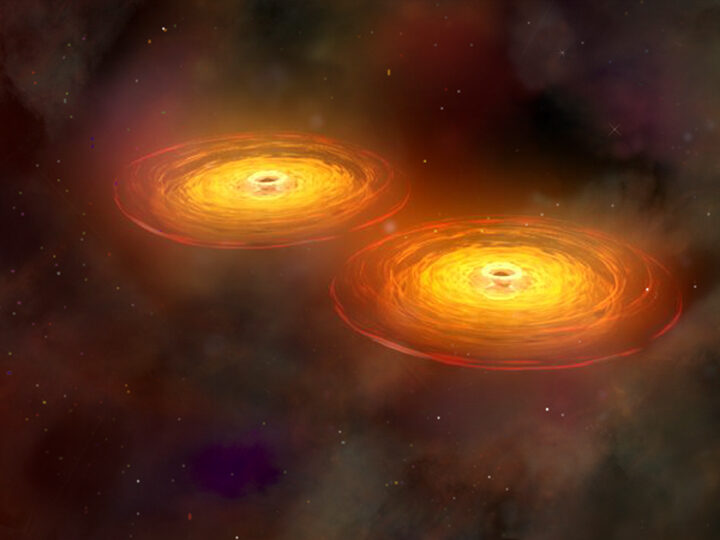
Every black hole astronomers had ever confirmed shared the same origin story: it was the corpse of a massive star that collapsed at the end of its life. A gravitational wave signal recorded by the LIGO detectors is now testing the limits of that story, and reviving a decades-old idea that has stubbornly refused to die — that some black holes are not the remnants of stars at all, but relics of the universe's earliest moments.
The signal, captured in November 2025, came from the collision and merger of two black holes, the kind of event LIGO has detected many times. What makes this one provocative is the combination of masses and properties involved, which sit awkwardly against expectations for black holes forged by stars. That awkward fit has pushed some researchers toward an alternative explanation: that the objects were primordial black holes.
What a primordial black hole is
Primordial black holes would have formed not from collapsing stars but directly from dense patches in the hot, smooth soup of the very early universe — in the first fraction of a second after the Big Bang, long before the first star ever shone. Because they could form at a wide range of masses, including values that stellar collapse struggles to produce, they offer a tidy escape hatch whenever a detected black hole looks like it should not exist.
The idea carries a tantalizing bonus. Dark matter — the invisible stuff that outweighs ordinary matter roughly five to one and whose gravity holds galaxies together — remains unidentified despite decades of searching. If primordial black holes exist in sufficient numbers, they could account for some or even all of that missing mass. That would mean dark matter is not an exotic undiscovered particle but something far more familiar in kind: black holes, just ones that have been hiding since the dawn of time.
A case, not a verdict
It is important to be precise about what the signal does and does not show. It is suggestive, not decisive. A single merger with unusual parameters can be explained in more than one way, and conventional astrophysics has its own mechanisms — dense star clusters, hierarchical mergers — for producing odd black holes without invoking the Big Bang. The primordial interpretation is a hypothesis competing against more familiar ones, and it will rise or fall on whether more events like it turn up.
That is where the next few years matter. As gravitational wave detectors grow more sensitive and catalog ever more mergers, a population of black holes that genuinely cannot be explained by stars would build a far stronger case than any single event can. The same period is seeing related hints elsewhere: researchers studying gamma rays near the center of the Milky Way and modeling the earliest supermassive black holes have independently found reasons to take a fresh look at dark matter and at black holes that predate ordinary structure.
The statistics are what make the moment promising. Since the first detection of gravitational waves in 2015, the LIGO–Virgo–KAGRA network has logged a rapidly growing catalog of black hole and neutron star collisions, now numbering in the hundreds, and each upgrade to the detectors widens the volume of space they can survey. A single oddball merger proves little; a whole sub-population of black holes whose masses and spins defy stellar explanations would be much harder to dismiss. With detection rates climbing toward several events a week during observing runs, the sample needed to settle the question is being assembled faster than ever before.
None of this amounts to proof. But the November 2025 signal has done something useful: it has taken an idea long parked at the speculative edge of cosmology and dragged it back into the realm of testable science. If primordial black holes are real, the instruments to find them are finally listening — and the prize, a solution to the dark matter puzzle, is large enough to justify the attention.
