
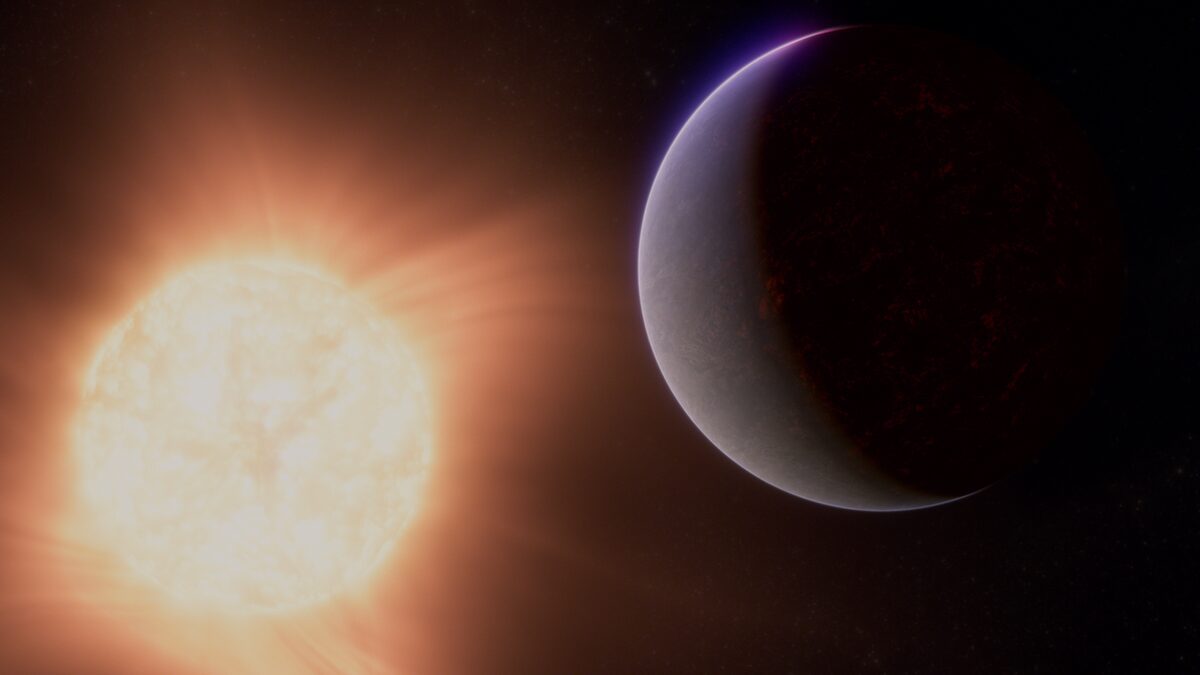
Sometimes the most informative result in science is a flat line. Astronomers using the James Webb Space Telescope to examine LHS 3844b — a rocky planet a little larger than Earth, orbiting a small red star — came away with a spectrum that shows a dark, featureless surface and no convincing evidence of an atmosphere. Published in Nature Astronomy, the observation describes a world that is, as far as JWST can tell, simply bare rock baking under its star.
That might sound like a non-result. It is the opposite. One of the defining questions of exoplanet science right now is which small, rocky worlds can hold onto an atmosphere and which cannot — and the planets most easily studied are exactly the ones least likely to keep their air.
The red-dwarf problem
Most rocky exoplanets accessible to current telescopes orbit red dwarfs, the small, cool, abundant stars that make up the bulk of the galaxy's stellar population. Red dwarfs are convenient targets: a planet blocks more of a small star's light, and tight, fast orbits give astronomers many transits to observe. But red dwarfs are also temperamental in youth, flaring with radiation that can erode and strip a planet's atmosphere over time. Whether rocky worlds around such stars typically end up airless is one of the field's most consequential open questions, because it bears directly on where to look for habitable planets.
LHS 3844b is a worked example on the harsh end. It hugs its star on a blistering orbit, and JWST's mid-infrared instrument measured how its surface radiates heat. A planet wrapped in a thick atmosphere would redistribute that heat and imprint telltale features on its spectrum; a naked rock would not. The data point to the latter — a surface that absorbs and re-emits starlight like dark stone, with no atmospheric blanket smoothing things out.
Reading a dead world
A bare surface is not a disappointment so much as a different kind of evidence. The composition and darkness of the rock carry information about what the planet is made of and what may have happened to any atmosphere it once had. And every airless world JWST confirms helps calibrate the bigger statistical picture: as the count of studied rocky planets grows, scientists can start to say with confidence what fraction of small worlds around red dwarfs retain atmospheres and what fraction are scoured clean.
LHS 3844b also comes with history. It was one of the first rocky exoplanets ever to have its surface temperature mapped, years ago, by the now-retired Spitzer Space Telescope. That earlier work measured how heat moved — or rather failed to move — across the planet and concluded it most likely had little or no atmosphere, with a dark, basalt-like surface reminiscent of cooled lava. JWST's far sharper mid-infrared spectroscopy now revisits the same world with much more capable eyes, and it broadly confirms the earlier verdict while adding detail about the rock itself. The progression is a small case study in how exoplanet science advances: a tentative result from one generation of telescope, then a firmer answer from the next. Because red dwarfs are by far the most common stars in the galaxy, the verdict on worlds like this one effectively sets the odds for the majority of rocky planets that exist at all.
That statistical answer is the real prize. The dream targets — temperate rocky planets that might host life — are mostly red-dwarf worlds, and their promise depends entirely on whether such planets can keep an atmosphere through their stars' violent early years. LHS 3844b, too hot and too exposed to be a habitability candidate itself, serves as a control case: this is what the bare-rock outcome looks like in JWST's data. Each one like it sharpens the line between the worlds worth dreaming about and the ones the galaxy has stripped to stone.
