
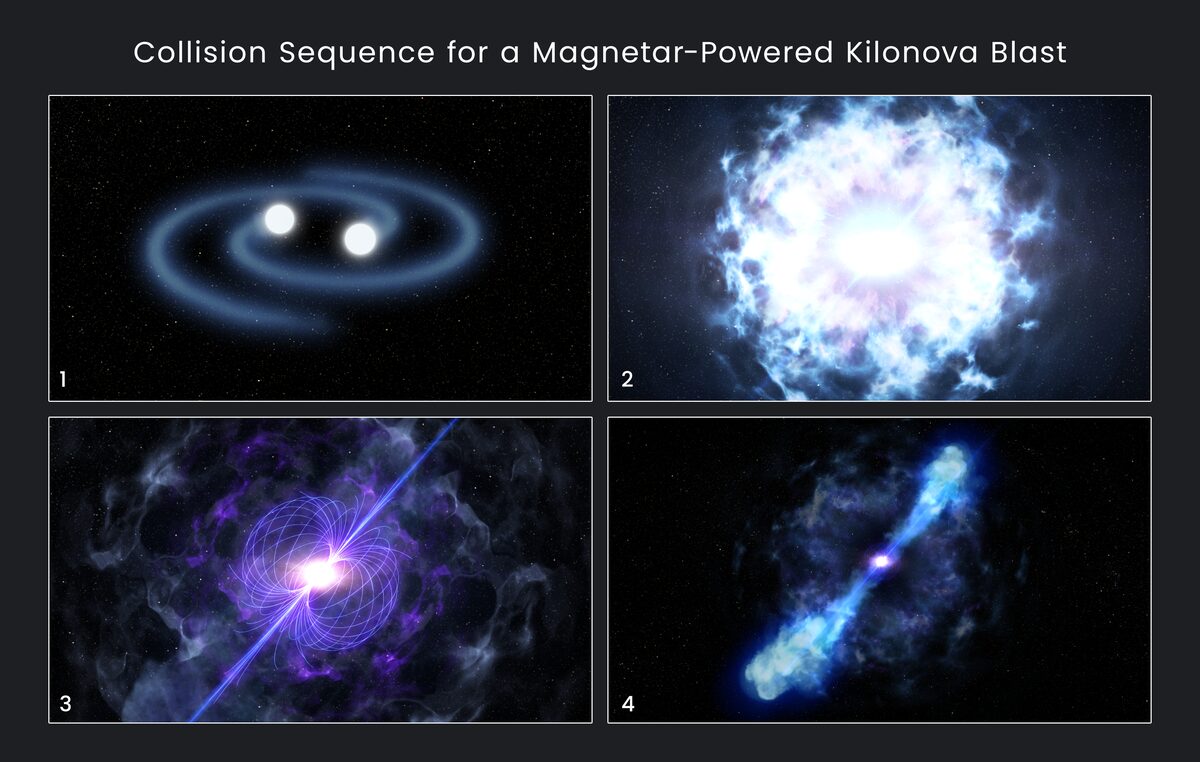
The question of where the elements come from is older than modern astrophysics. Hydrogen and helium were made in the Big Bang. Carbon, nitrogen, oxygen, and most of the elements up to iron are made in the cores of stars and scattered by supernovae. But elements heavier than iron — gold, platinum, uranium, iodine, barium, and dozens of others — require a process that supernovae alone cannot explain. They require rapid neutron capture: a nucleus absorbing neutrons faster than the unstable isotopes can decay. The conditions for this r-process require an extremely high neutron flux, far beyond what a stellar interior can provide. The most plausible site, theorized since the 1950s but never confirmed directly, is the collision and merger of two neutron stars. On August 17, 2017, the LIGO and Virgo detectors heard exactly that, and two seconds later a gamma-ray burst arrived.
The gravitational wave event GW170817 was detected simultaneously by all three interferometers — the first multi-messenger detection in history. The two seconds between the gravitational wave arrival and the short gamma-ray burst recorded by the Fermi and INTEGRAL satellites was consistent with predictions: the merger creates a brief accretion disk that generates jets, and the gamma-ray burst arrives slightly after the gravitational wave signal because it requires the jet to punch through the ejected material. Within hours, 70 telescopes on six continents and in space had located the optical counterpart in the galaxy NGC 4993, 130 million light-years away.
The kilonova
What they found in NGC 4993 was a rapidly fading blue transient that evolved over days into a red, slowly fading source. This two-component behavior — blue and red — matched detailed predictions for a kilonova powered by the radioactive decay of freshly synthesized heavy elements. The blue component corresponds to light r-process elements (strontium, barium) that interact strongly with blue light; the red component corresponds to heavier r-process elements (gold, platinum, lanthanides) with rich opacity in the red. The spectral signatures that emerged over the subsequent days — broad absorption features blurred by the rapid expansion of the ejecta — were consistent with strontium and other r-process elements at the expected temperatures and velocities.
The ejecta from GW170817 is estimated to have contained between 0.03 and 0.05 solar masses of material — a significant fraction of which was processed by the r-process into heavy elements. Extrapolating from a single event, and combining with estimates of the neutron star merger rate in the universe, the production of r-process elements from neutron star mergers is roughly consistent with the observed cosmic abundances of heavy elements. The implication is direct and quantifiable: the gold in every piece of jewelry, the platinum in every catalytic converter, and the iodine that regulates every thyroid gland were forged in the violent collision of dead stellar cores, billions of years before Earth formed.
What LIGO O4 is adding
The LIGO-Virgo-KAGRA network's fourth observing run, which began in 2023, has detected dozens of binary black hole mergers and is searching for additional neutron star events. Each neutron star merger detected with an electromagnetic counterpart adds constraints on the r-process yield and the rate of such events in the local universe. The neutron star equation of state — the relationship between density and pressure inside a neutron star — can be constrained by the merger's gravitational wave signal, which encodes the tidal deformability of each star. GW170817 provided the first such constraint. Future multi-messenger events will progressively refine the picture of what happens when the densest objects in the universe collide. Each detection is also a measurement of the Hubble constant: the gravitational wave signal gives the luminosity distance, while the recession velocity of the host galaxy gives the redshift. Several dozen neutron star mergers would provide a Hubble constant independent of both the CMB and the distance ladder, potentially resolving the Hubble tension through a third measurement that neither of the first two can cross-check.
Sources
- NASA NSSDC — Astrophysics archive: neutron stars, gravitational wave events, and multi-messenger astronomy
- GW170817 — Wikipedia (detection, kilonova, r-process nucleosynthesis, and multi-messenger context)
- Kilonova — Wikipedia (heavy element synthesis, blue and red components, and neutron star merger rate)
