
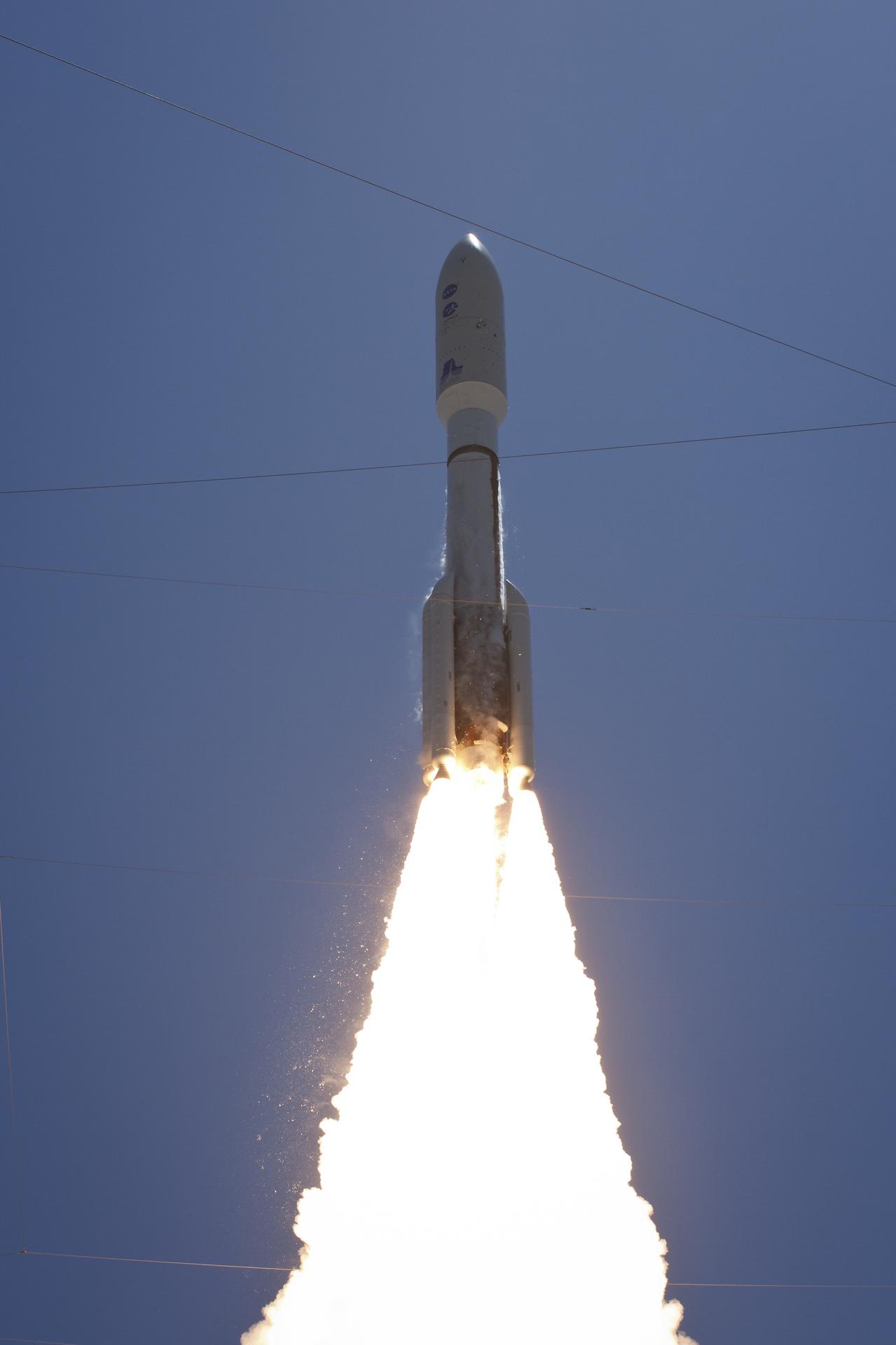
At 12:30 a.m. EDT on July 2, a United Launch Alliance Atlas V 551 lifted off from Space Launch Complex-41 at Cape Canaveral Space Force Station carrying 29 Amazon Leo broadband satellites. It was a routine-looking launch with an unroutine footnote: it was the last time this particular Atlas V configuration — the version bristling with five solid rocket boosters — will ever fly a commercial payload. Every remaining Atlas V in ULA's inventory is now spoken for by Boeing's Starliner crew capsule.
The mission, designated Amazon Leo 8 (LA-08), was also ULA's eighth dedicated launch for Amazon's satellite internet constellation, bringing the rocket family's delivered total to 224 satellites with a 100% success rate across those eight missions. With this launch, Amazon Leo now has more than 390 satellites in orbit.
According to SpaceNews, the 29 satellites launched on this flight weighed a combined 18 tons, tying the record for the heaviest payload ever flown on an Atlas V. It was, in other words, a rocket going out at the top of its game. From here, Amazon Leo's remaining ULA missions shift to Vulcan, the company's newer launch vehicle, which ULA has been ramping up as Atlas V production winds down.
An Atlas Era Ends
The Atlas V has flown for more than two decades, and the 551 variant — five solid boosters, a five-meter payload fairing, and a single-engine Centaur upper stage — has been one of the workhorse configurations for heavy national security and commercial payloads. Its retirement from open commercial service isn't a surprise; ULA has been winding down Atlas V production for years while ramping up Vulcan. But watching the transition play out satellite-launch by satellite-launch, with Amazon Leo as the last customer standing, gives the moment a clear marker: after LA-08, the 551's job is done, and its remaining airframes will fly government astronauts to the International Space Station instead of Amazon hardware to low Earth orbit.
For Amazon, the timing has real teeth. The company doesn't have the luxury of a leisurely victory lap for its launch partner — it has a federal clock running.
The FCC Deadline
Amazon Leo, launched under the name Project Kuiper, was authorized by the FCC in July 2020 to build a constellation of 3,236 non-geostationary satellites, a number later adjusted to 3,232. That license came with milestones: 50% of the constellation — 1,616 satellites — had to be deployed by July 30, 2026, with the full fleet required by July 30, 2029. With that first deadline just weeks away, Amazon Leo is nowhere near the 1,616-satellite mark despite passing 390 total satellites after the July 2 launch. The company went to the FCC's Space Bureau for relief, and on June 5, 2026, the agency granted a conditional limited waiver. Under the order, satellites Amazon launches after the July 30 deadline won't lose their license outright, but they will temporarily lose spectrum priority — a regulatory backseat — until Amazon either deploys and operates 50% of its constellation or 20 months pass (until March 30, 2028), whichever comes first.
That's a meaningful concession, but not a free pass. Spectrum priority determines who gets protected against interference when multiple operators' satellites are jockeying for the same frequencies in the same orbital neighborhood. Falling into a lower-priority tier, even temporarily, is the kind of thing a broadband operator wants to avoid once it starts signing up paying customers.
What Comes Next
That's where the CNBC reporting from July 2 gets interesting: Amazon says it has now deployed enough satellites to begin offering commercial broadband service later in 2026. The rollout plan described is not a simultaneous global switch-on — it starts with coverage bands in the northern and southern hemispheres, then expands toward the equator and the poles as more satellites reach orbit and the constellation's geometry fills in.
That approach makes engineering sense: a partially built constellation naturally provides better, more consistent coverage at certain latitudes before others, depending on orbital planes and inclination. But it also means Amazon Leo's first paying customers will likely be concentrated in specific geographic bands rather than everywhere at once, even as the company races to fill out the rest of the license before the regulatory clock fully runs out.
Why It Matters
This launch sits at the intersection of two stories that are usually told separately — a launch vehicle's retirement and a satellite operator's regulatory deadline — and here they're inseparable. ULA closing out the Atlas V 551 removes a proven, if aging, workhorse from Amazon's toolkit right as the company needs launch cadence more than ever; the shift to Vulcan is a bet that a newer rocket can pick up where an old one is stepping aside.
Meanwhile, the FCC's conditional waiver is a reminder that satellite mega-constellations don't just compete on hardware and launch contracts — they compete on paperwork and orbital real estate, too. Losing spectrum priority, even temporarily, could complicate Amazon Leo's ability to protect its network from interference just as it tries to convert a partially deployed constellation into an actual commercial service. How quickly Amazon can close the gap between 390 satellites and the 1,616 required for its interim milestone will shape not just its regulatory standing but the real-world coverage map its earliest broadband customers experience this year.
Sources
- FCC Order DA 26-553 — In the Matter of Kuiper Systems LLC, Application for Extension or Waiver of the Milestone Deadline
- Atlas V rocket launches 29 Amazon Leo broadband satellites to orbit from Florida
- Final Atlas 5 Amazon Leo mission launches
- Amazon has deployed enough satellites to launch Leo service later this year
