
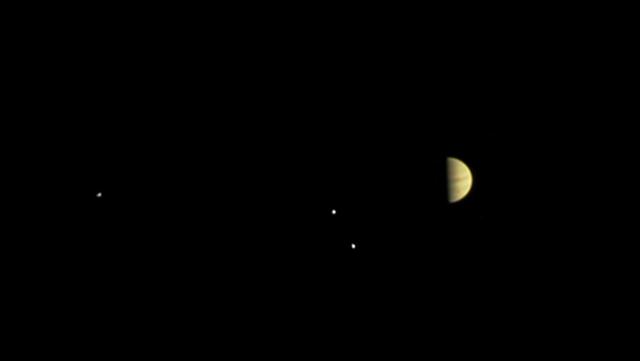
There is a moment, maybe twenty minutes after you first aim a telescope at Jupiter, when the planet stops being a concept and becomes a place. The two dark equatorial belts snap into focus. A small reddish oval — the Great Red Spot, a storm that has raged continuously for at least three and a half centuries — drifts toward the center of the disk. Four points of light arranged in a line near the planet's equatorial plane are not stars at all, and you know that, and yet knowing it intellectually is entirely different from seeing Io and Europa and Ganymede and Callisto arrayed there like a miniature solar system, which is exactly what they are. Jupiter at opposition is, for the backyard observer, one of the few moments in astronomy where the gap between knowing a thing and experiencing it nearly closes.
Opposition occurs when Earth passes between Jupiter and the Sun, placing the giant planet directly opposite the Sun in our sky. Because Jupiter's orbit is much larger than Earth's, this alignment happens roughly every 13 months — not every year, which means it shifts through the calendar over time. At opposition, Jupiter rises at sunset, reaches its highest point around local midnight, and sets at sunrise. More importantly, it is at its minimum distance from Earth, which in 2026 puts it at approximately 4.9 astronomical units away — close enough that its apparent disk spans about 46 arcseconds. That is not a number that means much in isolation, but for context: the Moon is roughly 1,800 arcseconds across. Jupiter at opposition is Jupiter at its absolute best for any given year, and the difference between opposition and conjunction (when Jupiter is on the far side of the Sun) is the difference between a 46-arcsecond disk and a 32-arcsecond disk. You will notice it.
What the atmosphere is actually doing
Jupiter is 1,400 Earths by volume, but it has no surface to speak of. What you are looking at through a telescope is cloud structure in an atmosphere that extends thousands of kilometers deep before pressures reach levels we might loosely call "surface." The visible layer is a complex banded structure driven by differential rotation — Jupiter does not rotate as a rigid body, so the equatorial zone completes one rotation in about 9 hours and 50 minutes, while the temperate bands take a few minutes longer. This shear creates the planet's characteristic alternating belt-and-zone pattern: the dark belts are regions where material descends and warms, suppressing cloud formation, while the bright zones are where cooler, ammonia-ice clouds rise and billow.
The two most prominent features are the North Equatorial Belt (NEB) and the South Equatorial Belt (SEB), both visible in any telescope above 60mm aperture with even modest magnification. These belts are not static — the SEB periodically "fades," turning white over months-long intervals before dramatic revival events restore its dark appearance. The NEB has historically been Jupiter's most consistently dark feature, though it shows significant variation in width and internal structure over years-long cycles. Careful observers drawing Jupiter at the eyepiece have tracked these changes for generations; the continuity of that record, running from the nineteenth century through today, gives planetary scientists a time series no spacecraft can fully replace.
Then there is the Great Red Spot. The GRS is an anticyclonic storm — high pressure, winds rotating counterclockwise in Jupiter's southern hemisphere — that has been continuously observed since the 1870s, and there are credible (if contested) sketches suggesting it predates that by two centuries. At its largest, it was once wide enough to swallow three Earths. It has been shrinking. Current measurements from the Juno spacecraft put its diameter at roughly 14,000 kilometers, down from about 25,000 kilometers in the 1970s when Voyager 1 and 2 flew past. The mechanism of its longevity is still debated — it appears to be fed by smaller vortices that merge into it — but it remains by far the largest storm in the solar system and, under good seeing conditions with a telescope in the 150mm aperture class, unmistakably visible as a salmon-pink to brick-red oval embedded in the southern equatorial belt.
The moons and what to look for
Galileo observed four moons of Jupiter in January 1610 and understood almost immediately what he was seeing: smaller bodies orbiting a larger one, a solar system in miniature that demolished the geocentric model's claim that all celestial bodies orbit Earth. Io, Europa, Ganymede, and Callisto — the Galilean moons — are among the most geologically interesting objects we know of, and tracking them through a small telescope connects you to one of the pivotal moments in the history of science.
What you can actually observe depends on patience and aperture. The moons themselves appear as sharp points of light, not disks, in most amateur telescopes. But their configuration changes hour to hour, night to night, in patterns governed by their orbital periods: Io orbits in 1.77 days, Europa in 3.55 days, Ganymede in 7.15 days, and Callisto in 16.69 days. Io and Europa are in a 1:2:4 orbital resonance that continuously flexes their interiors through tidal forces — in Io's case producing the most volcanically active surface in the solar system, in Europa's case maintaining a liquid saltwater ocean beneath an icy shell that NASA's Europa Clipper mission, launched in October 2024, is currently en route to investigate.
The more interesting phenomena are the dynamic events. When a moon passes in front of Jupiter's disk, you can watch a shadow transit — a small circular shadow crawling across the cloud tops — in any telescope above 80mm. The shadow appears as a sharp, perfectly circular black dot, darker than any feature on the planet itself, and its motion is perceptible in real time if you watch for fifteen minutes or so. When a moon passes behind the planet, it disappears into occultation; when it moves into Jupiter's shadow, it dims into eclipse. Jupiter's shadow extends well beyond the disk itself, so eclipses and re-emergences can occur at some distance from the planet's limb. Predicting these events requires software — Sky & Telescope publishes monthly tables, and apps like Stellarium and SkySafari show the current configuration in real time — but the payoff is watching astronomy become mechanics, watching the clockwork.
Practical observing strategy
The single biggest variable in planetary observing is atmospheric seeing — the steadiness of the air column above your telescope. Jupiter at 46 arcseconds will show nothing useful through a churning atmosphere, while the same planet on a night of exceptional seeing can reveal detail at the limit of what physics permits for your aperture. High humidity and temperature inversions tend to produce poor seeing; stable, dry air masses, often following the passage of a cold front, frequently deliver the steady skies planetary observers prize. Jupiter's altitude in your sky matters too: the more atmosphere you observe through, the worse the seeing. Wait until Jupiter clears 30 degrees of elevation before pushing magnification.
Start at low magnification — 75x to 100x — to get oriented, then push to 150x to 200x once the seeing lets you. The equatorial belts will be visible at 75x in almost any conditions; the GRS requires good seeing and a bit of timing, since Jupiter's 10-hour rotation means the spot transits the central meridian roughly twice a day. Online calculators give transit times to the minute. Lunar and planetary imaging with even a smartphone held to the eyepiece has gotten surprisingly capable — a technique called "eyepiece projection" using a cheap planetary camera and stacking software like AutoStakkert can pull detail out of a modest 130mm reflector that would have required a large observatory 40 years ago.
Jupiter's 2026 apparition places it in a part of the sky favorable for northern hemisphere observers, clearing the horizon earlier in the evening and reaching a decent altitude by mid-evening. If you have been waiting for a low-effort, high-reward reason to get a telescope out — or to finally buy one — this is it. The planet will not be notably closer again for a few years. The GRS is still there, still shrinking, still not fully understood. The shadow transits run on schedule. The moons continue their resonant orbits. Jupiter is, reliably, the best show in the night sky for anyone with an eyepiece and an hour to spare.
