
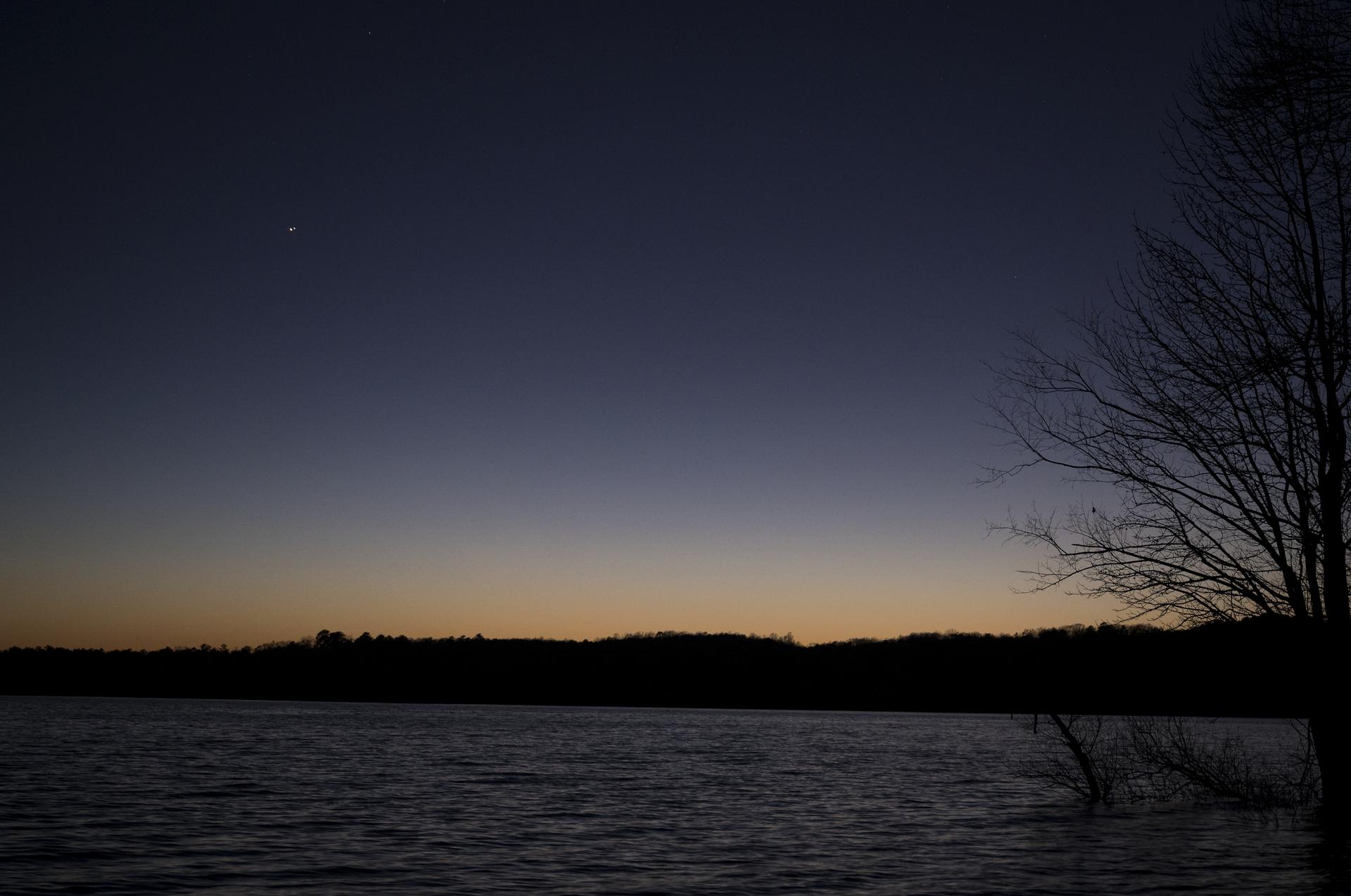
The two planets have been closing in on each other in the morning sky for weeks. This weekend Jupiter and Mars reach their closest apparent pairing, sitting a little over 1 degree apart in Leo, close to the bright star Regulus. If you are willing to get up before sunrise, this is an easy planetary event to see: no telescope, no dark-sky site and no special timing beyond being up before dawn.
There is one catch for North American observers. The exact moment of closest approach happens while the planets are below our horizon.
When is the conjunction, exactly?
According to figures from In-The-Sky cited by Space.com, Jupiter and Mars reach their closest apparent separation at 9:04 p.m. EST on Nov. 15, which is 0204 GMT on Nov. 16. At that moment both planets are still below the horizon across the United States. They rise in the east around midnight local time.
That matters less than it sounds. Planets in a conjunction move slowly against the background stars, so the gap barely changes over a few hours. By the time the pair has climbed high enough to see clearly, before dawn, the separation is still roughly the same: a little over 1 degree. Space.com compares that to the width of your little finger held at arm's length, while NASA puts it at about 1.2 degrees.
Where and when to look
The three sources broadly agree on the viewing window:
- NASA recommends looking southeast before sunrise on the mornings of Nov. 15 and 16 to catch Mars and Jupiter close together, in its November skywatching guide.
- EarthSky widens the window to the mornings of Nov. 15 to 17 and places the pair in the east before sunrise, according to its November planet guide.
- Space.com notes that the planets clear the eastern horizon around local midnight, which leaves several hours of darkness before dawn to find them.
In practice, the hour or two before morning twilight is a good time to look. The planets are well above the horizon, and the sky is still dark enough for good contrast.
How to tell which is which
Identification is easy. Jupiter is the brighter of the two. Mars is fainter and reddish; NASA describes it as reddish and EarthSky calls it red. Regulus, the brightest star in Leo, sits nearby, so you will see a small, uneven grouping of three points of light. Stars twinkle more than planets do, so a moment of patient watching usually separates the star from the planets.
EarthSky also points out that this pairing is not the whole show. Venus is up before dawn as well, following bright Jupiter and red Mars across the sky as the sun rises. If your eastern horizon is clear, you can line up three bright planets in one morning.
Binoculars and small telescopes
The pair is a naked-eye target, but optics add a lot. NASA says both planets are easy to see with the unaided eye, and Space.com notes that Mars and Jupiter are close enough to share the field of view of a pair of 10x50 binoculars, so you can frame the two worlds together and compare their colors side by side.
Telescope owners get a bonus. Space.com reports that Jupiter's Great Red Spot rotates into view in the predawn hours of Nov. 16, and that it is visible through a backyard telescope with an aperture of just 4 inches. Aim for that morning if you can only go out once.
Why It Matters
Conjunctions are line-of-sight effects. NASA notes the planets are still far apart in space and only appear almost side by side from Earth, and nothing about this event changes either planet. What makes it worth your time is rarity and accessibility. According to Space.com, the two planets will drift apart over the coming weeks and will not appear this close again for another 2.5 years. The next comparable pairing comes in July 2029, in the constellation Virgo.
Events like this are also one of the best ways to get people looking up. A bright planet pair beside a named star needs no equipment, no star chart skills and no light-pollution-free site. It should work from a suburban driveway or a city balcony with a clear view toward the east or southeast. For anyone who has never knowingly seen Mars or Jupiter, a conjunction makes them easy to pick out. For people with a small telescope, it is a simple target with a real payoff in the Great Red Spot.
It also fits into a busy month. NASA's November guide covers the Taurid and Leonid meteor showers and the month's supermoon on Nov. 24. It also marks a milestone far beyond the planets: Voyager 1 becoming the first human-made object to travel one light-day from Earth. The Jupiter-Mars pairing is the most immediate and easiest to see of these.
Quick checklist
- Dates: mornings of Nov. 15, 16 and 17
- Closest approach: 9:04 p.m. EST Nov. 15 (0204 GMT Nov. 16), below the horizon for the US
- Direction: east to southeast, before sunrise
- Separation: a little over 1 degree (NASA: about 1.2 degrees)
- Landmark: Regulus, in Leo
- Gear: naked eye works; 10x50 binoculars frame both; a 4-inch scope can show the Great Red Spot predawn Nov. 16
- Next chance: July 2029, in Virgo
