
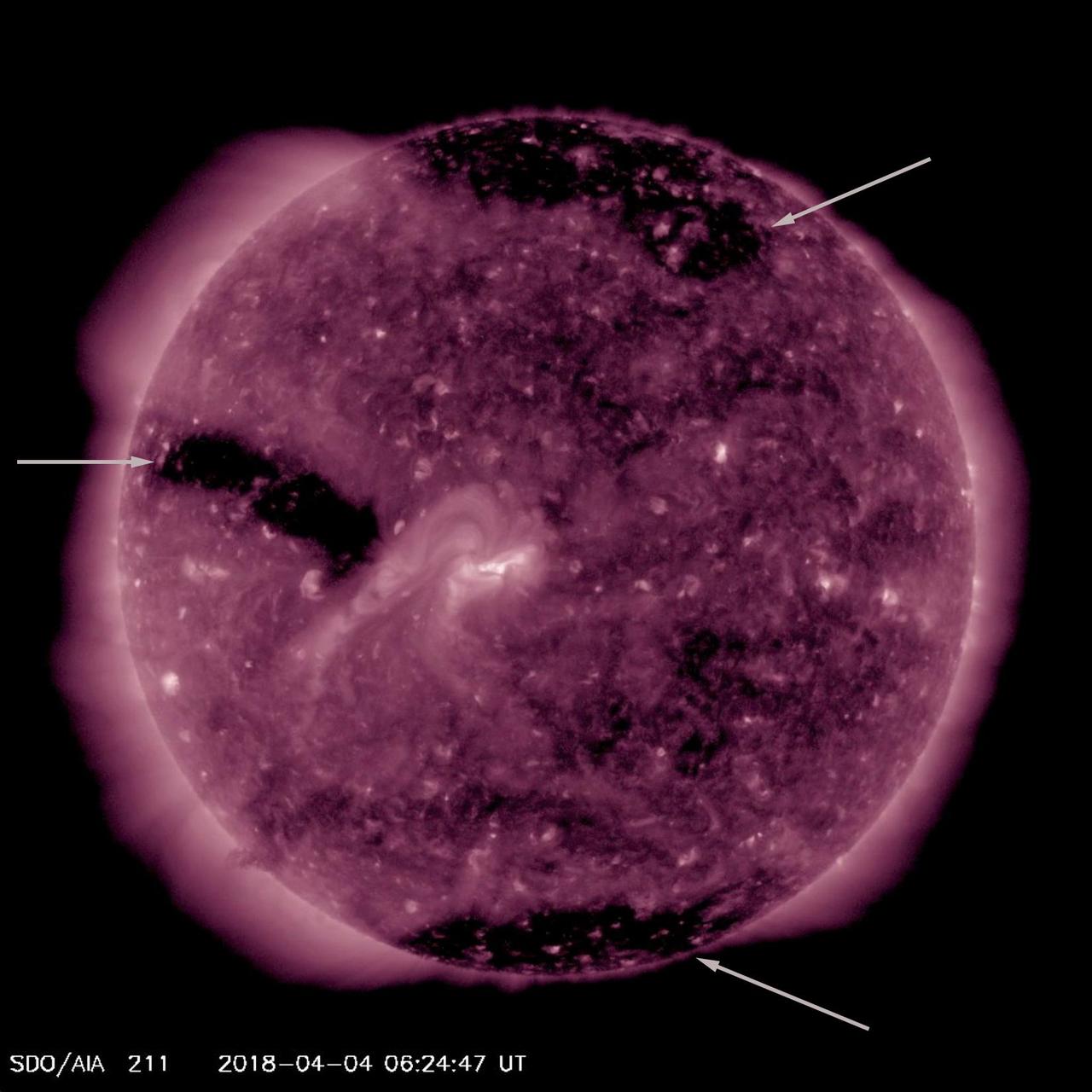
This weekend's auroras did not come from an eruption. No coronal mass ejection was aimed at Earth. Instead, a steady stream of fast solar wind poured out of a coronal hole, an opening in the Sun's magnetic field, and it was enough to keep the planet's magnetic field disturbed through the weekend. At the same time, a sunspot group called AR4566 has become the most active spot on the visible Sun and keeps producing flares.
The two are separate problems. The coronal hole sets your chances of seeing an aurora tonight. The sunspot decides whether the week stays quiet.
What Happened Over the Weekend
According to EarthSky's Nov. 9 roundup, the solar wind peaked near 814 kilometers per second. That is well above typical background speeds and fast enough to drive geomagnetic activity to G1, the lowest level on NOAA's five-step storm scale. Auroras showed up on the University of Alaska Fairbanks all-sky camera, as expected that far north. They also reached northern Minnesota over the weekend, and EarthSky expects tonight's displays to be less widespread than that weekend show.
NOAA's Space Weather Prediction Center confirms the storm level. In its 3-Day Forecast issued at 0030 UTC on Nov. 9, the agency reported that the greatest Kp index of the previous 24 hours was 5, which it rates as G1.
On Monday the wind had slowed a little but was still fast. SpaceWeather.com listed a solar wind speed of about 701 km/s and a low density of 1.4 protons per cubic centimeter. Speed matters more than density here. A thin wind moving that fast can still push hard on Earth's magnetosphere.
The Forecast: One More Round of G1
NOAA expects a greatest Kp of 4.67 over the Nov. 9–11 forecast window, which it rates as G1. The peak is forecast for the 03–06 UT block on Nov. 9. The agency's reasoning is short: G1 levels are likely on Nov. 9 because of the continued influence of a negative-polarity coronal hole high-speed stream. After that, NOAA's forecast Kp falls to 3.67 or lower on Nov. 10 and 2.67 or lower on Nov. 11, and EarthSky says aurora chances drop further on Nov. 10 as the stream fades.
The 03–06 UT block fell on the evening of Nov. 8 in the continental United States, so it had already passed by Monday. For tonight, NOAA's forecast Kp stays at 3.67 or below, and EarthSky says people at high latitudes should keep an eye out. Kp 4.67 would not have guaranteed an overhead display, and tonight's levels are lower, so expect a modest show at best, mostly for those at northern latitudes.
Practical advice for a modest storm: get away from city lights, face north, and use a phone camera. Phone sensors often pick up a faint green or red glow that the eye reads as gray haze.
AR4566: The Wild Card
The coronal hole sets the baseline. Sunspot AR4566 is what could change the outlook. EarthSky calls it the most complex region on the Sun and reports that it produced 19 of the 20 flares recorded in a 24-hour period. The strongest was an M1.1 at 18:27 UTC on Nov. 8, which caused a brief R1 radio blackout.
The flare counts depend on who is tallying and over what window. SpaceWeather.com lists a 24-hour X-ray maximum of M1 at 1537 UT on Nov. 8 and a six-hour maximum of C2 at 0859 UT on Nov. 9. NOAA's forecast separately notes that the largest R1 radio blackout it logged was at 0746Z on Nov. 8. The details differ, but the overall picture is the same: frequent C-class activity with occasional M-class flares.
The bigger concern is the spot's magnetic structure. SpaceWeather.com, citing NASA's Solar Dynamics Observatory imagery, reports that Sunspot 4566 has a beta-gamma-delta magnetic field, which it says "harbors energy for X-class solar flares." EarthSky also says the region is the main threat for stronger flares, with a slight chance of an X-class flare. It adds that the region has crossed the center of the Sun's face, so any big eruption from it would aim more directly at Earth.
NOAA's numbers reflect this. The agency gives a 60 percent chance each day of R1–R2 (minor to moderate) radio blackouts and a 15 percent daily chance of R3 or greater, which corresponds to X-class flaring. The chance of an S1 solar radiation storm is 15 percent each day.
Why It Matters
For skywatchers, the takeaway is simple. This is a modest aurora opportunity, and it comes from a wind stream rather than a single eruption. Conditions are expected to settle toward midweek.
For everyone else, AR4566 is the one to watch. Radio blackouts from M- and X-class flares hit high-frequency communications on the dayside of Earth, because the X-rays travel at the speed of light. A 60 percent daily chance of R1–R2 blackouts means some disruption this week is more likely than not.
There is also a longer-term risk. In the latest period EarthSky reports, analysts found no Earth-directed coronal mass ejections. But with AR4566 now facing Earth and carrying a beta-gamma-delta field, a large eruption from it would change the aurora forecast entirely. For now the forecast is one more night of G1-edge conditions and a sunspot that forecasters will keep watching closely.
