
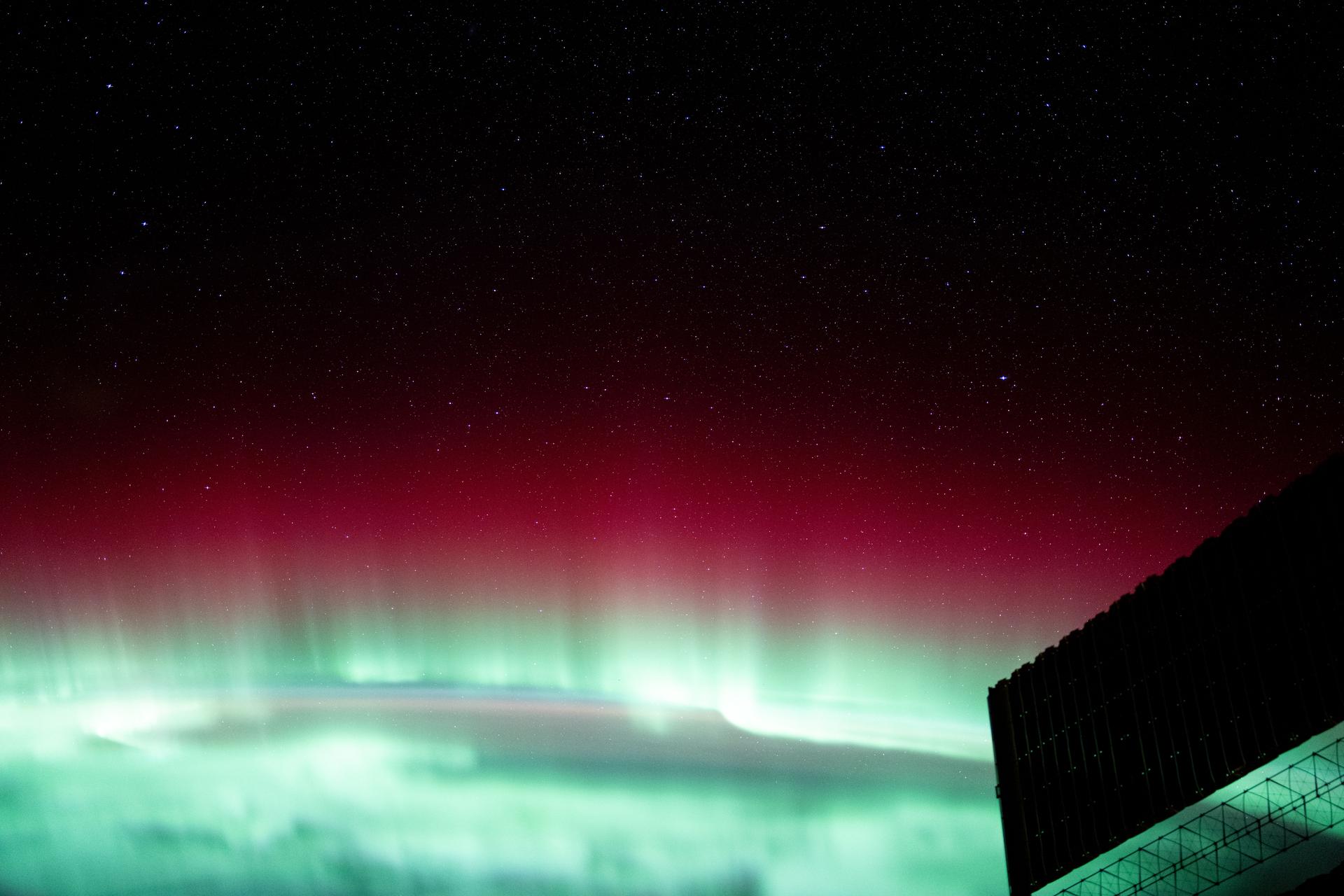
There is a cloud of solar plasma headed our way, and for once the timing is convenient. A coronal mass ejection that erupted from the Sun on June 26, 2026 is forecast to reach Earth around June 30, and NOAA's Space Weather Prediction Center (SWPC) has responded the way it does when a glancing blow looks likely: it posted a geomagnetic storm watch and told everyone to keep an eye on the magnetometers.
The watch, posted June 28, calls for G1 (Minor) geomagnetic storm conditions. SWPC does not expect any storming on June 28 itself, but flags G1 conditions as likely on June 29 and June 30 as the CME arrives and its magnetic field begins to interact with Earth's own. SWPC is the official U.S. government source for these watches, so when the .gov product line lights up, that is the forecast of record.
What's Actually Happening on the Sun
The driver behind all of this is a pair of busy sunspot regions. The headline group is AR4478, currently classified as a beta-gamma-delta magnetic configuration — the most powerful magnetic class a sunspot region can carry, and the kind of structure that has the energy budget to produce significant flares. Nearby, AR4475 is a beta-gamma region and has been the more prolific of the two lately, churning out frequent C-class flares.
The strongest recent event was a C7.5 flare from AR4475 at 21:06 UTC on June 27. A C7.5 is a moderate flare — energetic enough to register clearly but well short of the X-class monsters that make headlines — and it fits the overall picture of a Sun that is active and crackling rather than violently erupting. The CME now en route left the Sun a day earlier, on June 26, and is one of the slower ejections drifting Earthward from the mid-to-late June run of solar activity.
How Strong Could the Storm Get?
The official watch is for G1, but forecasters are leaving room for more. The June 26 CME is projected to arrive in a window roughly between 6:00 and 11:01 UTC on June 30, and depending on how its embedded magnetic field is oriented when it hits, it could drive geomagnetic storming anywhere in the G1 to G2 range. G1 is "minor," G2 is "moderate" — one step up.
The deciding factor is the direction of the CME's magnetic field. If the field turns southward when the cloud arrives, it couples efficiently with Earth's magnetosphere and dumps energy into the system, pushing the storm toward the stronger end. If it stays northward, the same cloud can slide past with comparatively little effect. That is why a forecast can legitimately span two storm levels: the cloud's speed and arrival time are fairly predictable, but its internal field orientation generally is not, until solar-wind monitors upstream of Earth actually measure it.
In planetary-index terms, the Kp index could reach 4 to 5 during the event. A Kp of 5 corresponds to G1-level storming and is roughly the threshold at which the auroral oval expands far enough south to give mid-latitude observers a genuine shot at seeing it.
Where the Aurora Might Be Visible
If the storm materializes as hoped, the aurora could be visible from mid-northern locations rather than just the high Arctic. EarthSky lists Seattle and Minneapolis in the United States, and the Scottish Highlands across the Atlantic, as places that could catch the lights during this event.
None of that is guaranteed — visibility from any of those latitudes depends on the storm reaching the upper end of the forecast, on clear skies, and on getting away from city light pollution. But the practical advice is simple: if you are in the northern tier of the U.S. or at a comparable latitude, find a dark spot with an unobstructed view to the north late on June 29 into June 30, and check the real-time conditions before you commit to standing outside in the dark.
For that real-time picture, SpaceWeather.com has been tracking the slow CMEs from mid-and-late June as they deliver glancing blows to Earth's magnetic field, and provides live solar-wind data, the current Kp index, and aurora-visibility context. Those are the numbers worth watching as the arrival window approaches, because they will tell you whether the field actually turned southward — the single thing that separates a quiet night from a memorable one.
Why It Matters
Geomagnetic storms at the G1-G2 level are not dangerous events for the average person. They sit at the mild end of NOAA's five-step scale and pose little risk beyond the occasional minor effect on power grids and satellite operations that grid and spacecraft operators routinely manage. What they offer is access: a chance for people well south of the usual auroral zone to see the northern lights without traveling to the Arctic Circle.
This particular event is also a clean, dated example of how modern space-weather forecasting works — a flare-prone active region, a CME with a measurable launch date, a transit-time estimate, and a hedged storm forecast that explicitly hinges on a magnetic-field orientation no one can confirm until the cloud is almost here. And the timing is genuinely useful: with the CME due around June 30, the watch hands sky-watchers in the northern U.S. an actionable observing window right as the holiday weekend gets underway. Keep an eye on the SWPC alerts and the live solar-wind data, and let the southward-or-not question resolve itself.
