
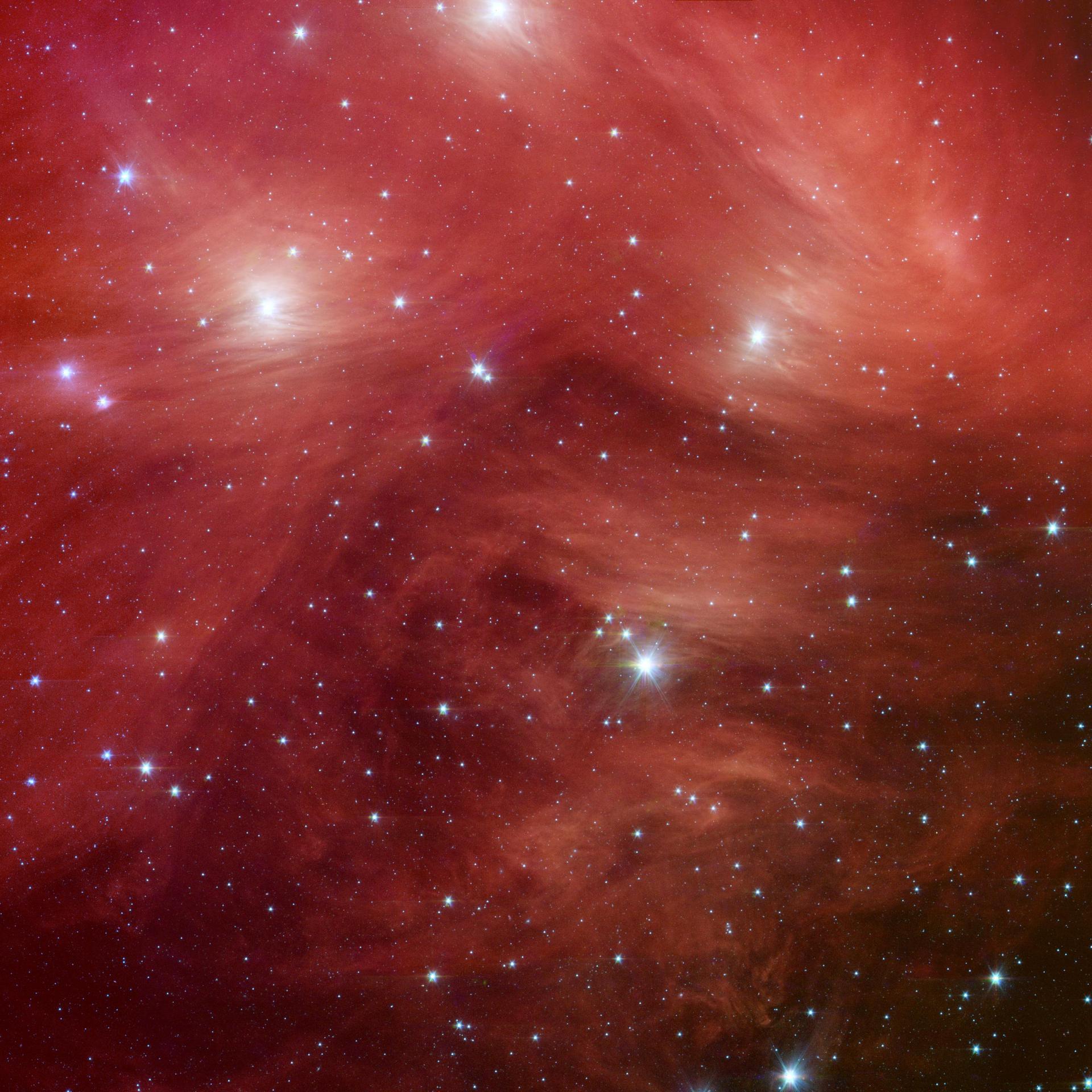
If you have been waiting for a reason to set an alarm before sunrise, the last few mornings of June 2026 supply one. Mars, the unmistakable rusty point of light that has been climbing the dawn sky, is gliding past the Pleiades star cluster — the tight little dipper-shaped knot of blue stars that has caught human eyes for as long as there have been people to look up. The pairing is followed within days by the Full Strawberry Moon and the start of a Mercury retrograde, capping a week worth getting outside for.
Here is the practical rundown, with the dates and where to point your eyes.
The Main Event: Mars Meets the Pleiades
On the mornings of June 27 through 29, 2026, Mars appears close to the Pleiades — also catalogued as M45 — low in the pre-dawn eastern sky. The closest visual approach falls around June 28, when reddish Mars sits roughly 4 degrees and 24 arcminutes from the cluster, both of them riding in the constellation Taurus. That separation is a little less than the width of three fingers held at arm's length, which means the two will not merge into a single eyeful, but they sit comfortably together in the same patch of sky.
You do not need a telescope for this one. The conjunction is a naked-eye target under reasonably dark skies, and it is genuinely striking through binoculars, which pull in the fainter members of the Pleiades and frame them alongside the steady amber glow of Mars. The contrast is the appeal: the Pleiades are hot, young, blue-white stars hundreds of light-years away, while Mars is a small rocky neighbor catching sunlight from just down the street, cosmically speaking. Seeing the two together is a tidy lesson in scale, all in one binocular field.
Timing and a clear horizon are everything. Because the pairing sits low in the east before dawn, you want an unobstructed view in that direction and a look in the window before morning twilight washes the sky out. Get out while the sky is still dark, find Mars first — it will be the brightest steady reddish point in that region — and the Pleiades will be the soft smudge just beside it. People who have never consciously noticed the cluster before tend to be surprised by how distinctly it resolves into individual sparks once binoculars are involved.
Then the Strawberry Moon
The Moon takes over as headliner at month's end. NASA's monthly skywatching notes place the full Moon on June 29, 2026, and the popular almanac name for June's full Moon is the Strawberry Moon. Across the night of June 29-30 it rises into Sagittarius, sliding near the Teapot asterism — the genuinely teapot-shaped pattern of stars that anchors that part of the southern summer sky. By the night of June 30, the just-past-full Moon drifts on near Nunki, one of Sagittarius's brighter stars.
A full Moon is a mixed blessing for observers. It is gorgeous in its own right, especially as it clears the horizon looking swollen and golden, but its glare also floods out fainter targets. If you are chasing the deep-sky objects below, plan around it: the nights on either side of full will be brighter, and the Moon's position near the Sagittarius Teapot puts it right in the neighborhood of the Milky Way's densest star fields.
And a Mercury Retrograde, for the Record
Mercury begins a retrograde apparition on June 29 — that is, the innermost planet starts its periodic apparent backward drift against the background stars. To be clear about what that is and is not: retrograde motion is a line-of-sight illusion produced as Earth and Mercury move along their orbits at different speeds, not any real reversal of the planet's path, and it carries no physical effect on anything down here. It is, however, a useful reminder that the planets are in constant motion, and a marker worth noting in your observing log.
While You're Up: The Summer Triangle and Its Treasures
The pre-dawn planet show is the reason to be out early, but the evening sky has quietly handed observers its summer signpost. With the June 21 solstice marking the start of astronomical summer and the longest day of the year now behind us, NASA points to the Summer Triangle as the season's defining pattern after dark. Its three corners are bright stars in three different constellations: Vega, Altair and Deneb. Once you learn the triangle, it becomes a reliable map for finding fainter things.
And there are fainter things worth finding. NASA highlights a cluster of showpiece deep-sky objects framed by or near the Summer Triangle:
- The Ring Nebula — a planetary nebula, the glowing shell cast off by a dying Sun-like star.
- The Dumbbell Nebula — another, larger planetary nebula, often an easier first catch in modest instruments.
- The Veil Nebula — the lacework remnant of a supernova, a star that did not go quietly.
- The North America Nebula — a vast star-forming cloud whose shape genuinely echoes the continent.
These reward dark skies and patience far more than expensive gear. Under a moonless country sky, the summer Milky Way's bright core climbs into view after nightfall, draping through Sagittarius and Scorpius and pointing the way toward the galaxy's heart. That band of light is the combined glow of countless stars in our own galaxy's disk, and it is the single best argument for driving away from city lights at this time of year.
A Quick Observer's Checklist
- June 27-29, pre-dawn: Mars beside the Pleiades, low in the east. Best around June 28, separation ~4.4 degrees. Naked eye or binoculars.
- June 29-30, evening into night: Full Strawberry Moon rising into Sagittarius near the Teapot; near Nunki on June 30.
- June 29: Mercury starts retrograde.
- All week, after dark: Summer Triangle (Vega, Altair, Deneb) overhead, framing the Ring, Dumbbell, Veil and North America nebulae, with the Milky Way core rising late.
Why It Matters
None of this requires a subscription, an app purchase or a four-figure telescope. A naked-eye conjunction, a full Moon and a handful of binocular-friendly nebulae are exactly the kind of events that turn a casual glance upward into a habit — and that habit is how most lifelong observers got started. Conjunctions like Mars passing the Pleiades are also small, free lessons in how the solar system actually works: the planets are not fixed decorations but moving bodies, sliding past the distant background stars night after night on schedules we can predict to the minute. Catching Mars and a distant star cluster in the same binocular field, on a specific morning, is a reminder that the sky is a clock as much as a spectacle. And with the solstice just past, this is the season when the Milky Way's core returns to dark skies — the best stretch of the year to step outside and see, with your own eyes, the galaxy we live inside.
