
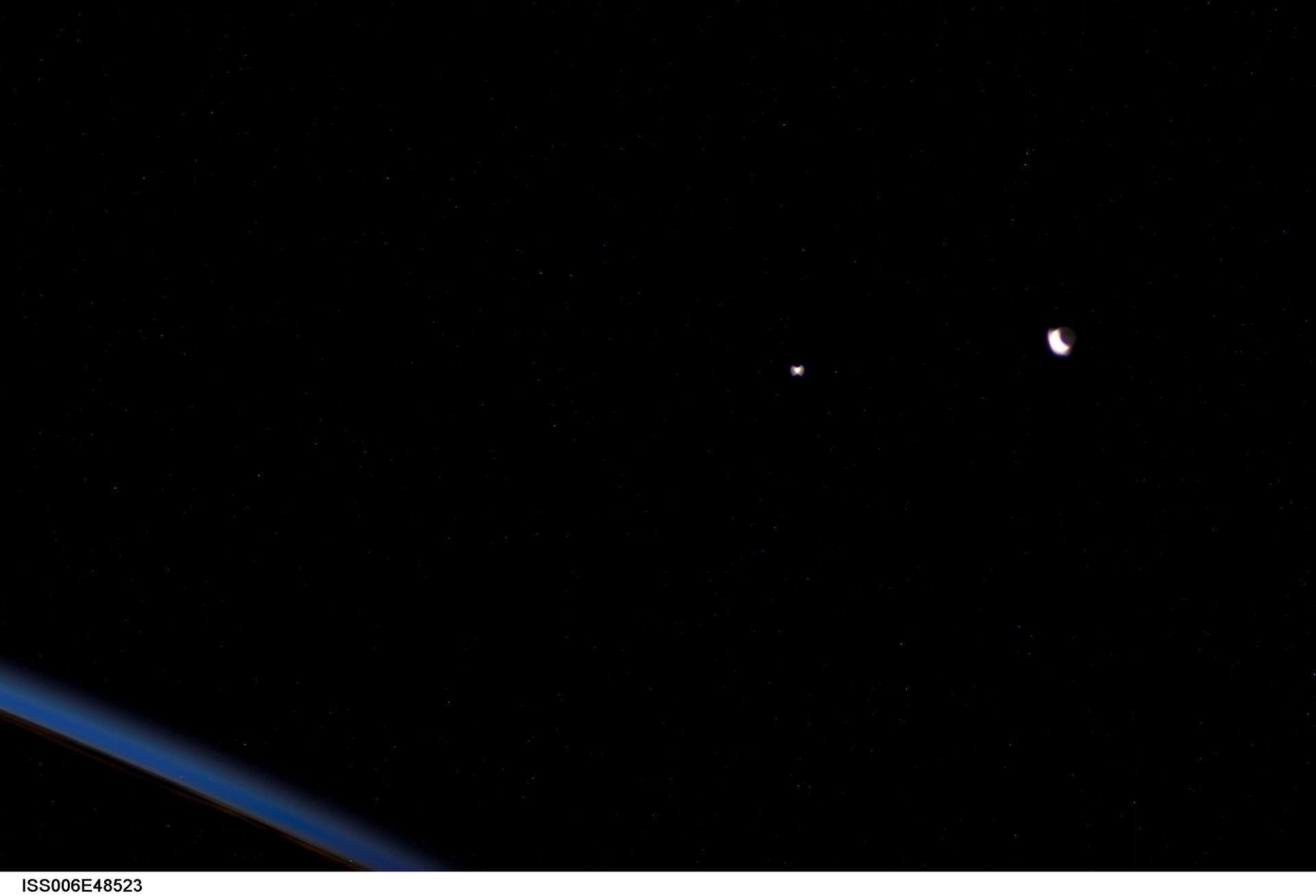
If you only step outside for one thing this month, make it Venus. Through July 2026 our sister planet sits at roughly magnitude -4, bright enough to outshine every star in the sky and, on a clear evening, to hold its own against the deepening blue of dusk. It is the easiest planet to find — no chart, no app, no squinting required — and it lingers, hanging in the west for up to two hours after the Sun goes down. That generous window is what makes July such a forgiving month for casual skywatchers: you do not need to wait for full darkness, and you do not need to be an early riser to catch the headline act.
But Venus is only the anchor. July packs in a tight planetary near-miss, a named full Moon, a glowing view straight into the heart of our galaxy, and a two-for-one meteor finale that rewards anyone willing to stay up past midnight at month's end. Here is how the month unfolds, and what is actually worth your time.
The evening show: Venus, Regulus, and a crescent Moon
Start with the easy wins. Look west after sunset on any clear July evening and Venus will be unmistakable — a steady, brilliant point that does not twinkle the way stars do. The planet's brightness comes from a thick, highly reflective cloud deck, and at magnitude -4 it is currently the brightest object in the night sky aside from the Moon.
Two dates sharpen the view. On July 8 and 9, Venus glides close to Regulus, the brightest star in the constellation Leo. The pairing offers an instant brightness lesson: Regulus is a genuinely luminous star, yet next to a nearby planet catching full sunlight it looks distinctly dim. A week later, on July 16 and 17, a slender crescent Moon joins Venus low in the evening sky — the kind of wide, photogenic conjunction that needs nothing more than your eyes and a clear western horizon. If you own a camera and a tripod, those are the nights to use them.
Before dawn on July 4: Mars threads the needle with Uranus
The month's most technically impressive event is also its most demanding. In the predawn hours of July 4, rusty Mars passes extraordinarily close to the far fainter, more distant planet Uranus — separated by just 0.11 degrees. For scale, that is roughly a fifth of the apparent width of the full Moon. The two sit near the Pleiades star cluster, which makes a useful signpost for finding the patch of sky to scan.
A word of honest expectation-setting: this is not a naked-eye spectacle the way Venus is. Mars will be visible without aid as a reddish point, but Uranus, much fainter, really wants binoculars or a small telescope to pull out of the twilight. The payoff is the rarity of seeing two planets that close together at all — a fleeting alignment caused by our differing orbital geometries, not any real proximity in space. Mars is a neighbor; Uranus is nearly two billion miles farther out.
The Full Buck Moon
The Full Buck Moon — named for the season when male deer begin regrowing their antlers — reaches fullness on July 29. As with any full Moon, the most rewarding views come right at moonrise, when the disk sits low on the southeastern horizon and an optical illusion makes it appear swollen and golden. Because the Moon reaches peak illumination during daylight (10:36 a.m. Eastern), the Old Farmer's Almanac advises catching it after sunset on July 29, as it rises into the southeastern sky. Find an unobstructed southeastern view, arrive a few minutes early, and let the Moon do the work.
That bright Moon is also the month's complication, as the meteor section below makes clear.
Looking into the galaxy itself
July is prime season for the Milky Way's core. On moonless nights, away from city lights, the band of our galaxy arcs overhead with its densest, most luminous region — the direction of the galactic center — riding high in the southern sky. This is the glittering, mottled glow that photographers chase all summer. The enemy is light pollution, both artificial and lunar, so the best core views come in the darker stretches of the month, well before the Buck Moon brightens the sky toward month's end.
For those with a small telescope and patience, there is a bonus target. Comet 10P, a periodic comet on a roughly five-year orbit, is visible near the constellation Capricornus early in July. It is not a naked-eye object — plan on optical aid and a dark site — but it is a satisfying find for anyone who enjoys tracking down fainter quarry.
The finale: twin meteor showers on July 30-31
The month closes with two meteor showers peaking on the same predawn nights of July 30 and 31, and they make an interesting contrast.
The Southern Delta Aquariids are the more productive of the pair, capable of delivering up to about 20 meteors per hour under genuinely dark skies. The Alpha Capricornids are sparser — roughly 5 per hour — but they punch above their numbers. This shower is known for bright fireballs, the slow, brilliant meteors that can briefly light up the surroundings.
That distinction matters this year because of timing. With the Full Buck Moon arriving on July 29, moonlight will be washing out the sky during the very nights the showers peak, and that glare will erase most of the fainter Delta Aquariid streaks. The Alpha Capricornids' fireballs, however, are bright enough to punch through moonlight — which means the less numerous shower may well steal the show. If you go out, face away from the Moon, give your eyes 20 to 30 minutes to adapt, and be patient: a single Capricornid fireball is worth a dozen faint flashes.
Why It Matters
July 2026 is a reminder that meaningful skywatching does not require equipment or expertise. A magnitude -4 Venus lingering two hours after sunset is about as accessible as astronomy gets — a genuine spectacle you can catch on a weeknight walk, and a low-friction way to get children, or anyone, to look up. The month also quietly teaches real astronomy: the Venus-Regulus pairing demonstrates the difference between reflected and intrinsic brightness; the 0.11-degree Mars-Uranus conjunction shows how line-of-sight alignments compress vast distances into a single eyepiece view; and the moonlit meteor finale is a practical lesson in why observing conditions, not just the calendar, determine what you actually see. The interplay between the bright Buck Moon and the two showers is the kind of trade-off seasoned observers plan around — and a good prompt to think about light pollution, the one variable most of us can partly control by choosing where we stand.
Sources
- 8 night sky events to see in July, from twin meteor showers to the Milky Way's glittering core — National Geographic
- What's Up: Skywatching Tips from NASA — NASA Science
- Visible planets and night sky guide for June and July — EarthSky
- Night Sky for July 2026: Look for Brilliant Venus After Sunset — The Old Farmer's Almanac
