
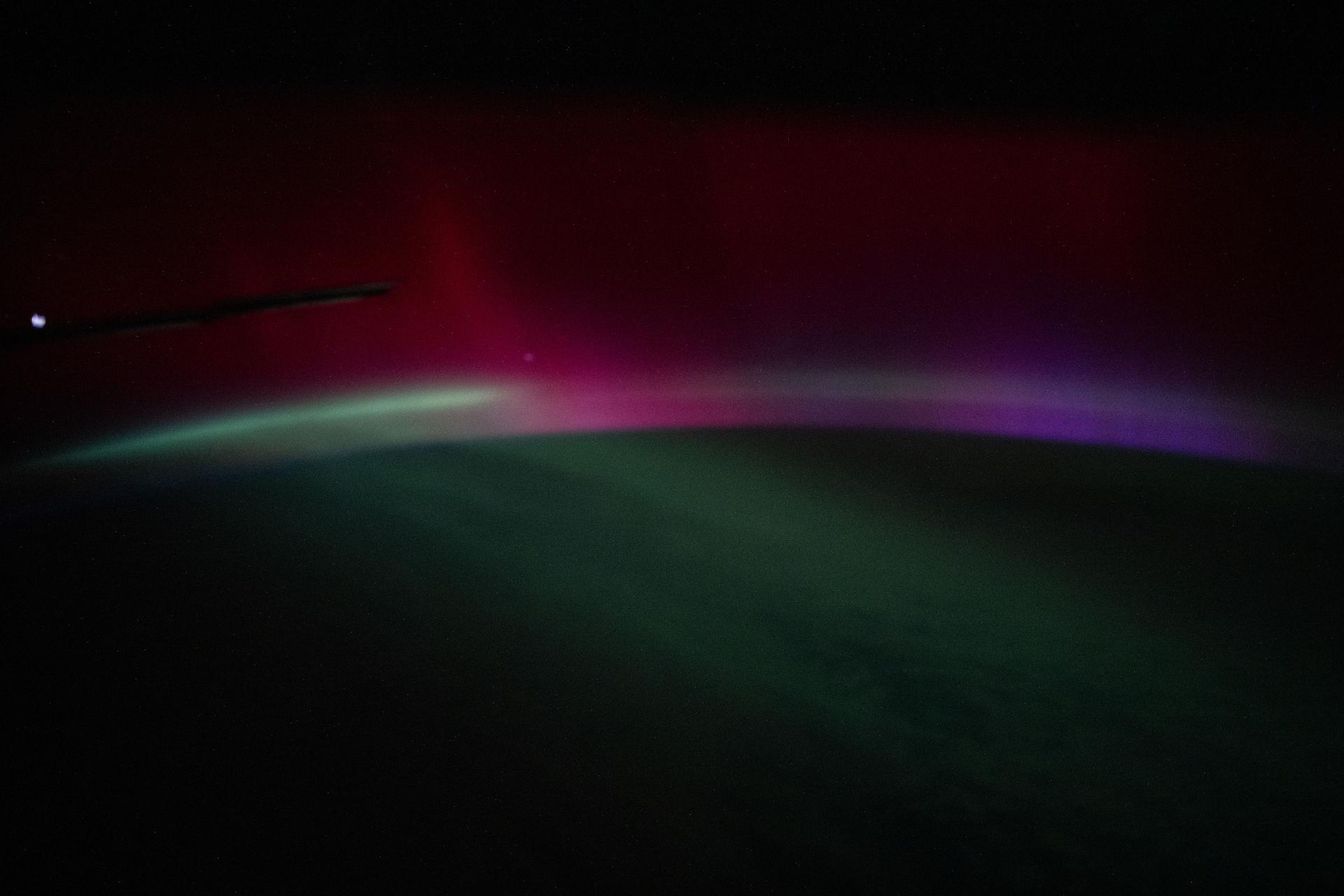
If you were watching the Kp index in the small hours of June 25, 2026, the jump caught a lot of people off guard. At 4:43 UTC, Earth's magnetic field tipped over the threshold for a G1 (minor) geomagnetic storm on the NOAA scale — modest by space-weather standards, but enough to seed auroras for anyone in the right place at the right time. The catch this week was that "the right time" was in short supply.
This was not a storm anyone had circled on the calendar. The trigger wasn't a dramatic, Earth-directed eruption but the quieter combination that produces a surprising share of minor storms: a stream of fast solar wind flowing out of a coronal hole, piling into the slower wind ahead of it to form what forecasters call a co-rotating interaction region, or CIR. That compressed boundary dragged a knot of tangled magnetic field past Earth, and our magnetosphere responded. There may also have been a glancing contribution from a coronal mass ejection that left the Sun back on June 20 — a sideswipe rather than a direct hit, arriving late and off-center.
A new sunspot region makes itself known
While the magnetosphere was busy, so was the Sun's surface. In the 24 hours ending at 11 UTC on June 25, solar observers logged 16 C-class flares — the lowest tier of the flares forecasters bother to count individually, but a clear sign of an active disk. The standout came from a freshly numbered region, AR4478, which fired a C4.3 flare at 0:22 UTC and went on to produce 10 of those 16 C-class events on its own. A single region accounting for the majority of the day's flaring is a useful tell: this is a sunspot group worth keeping an eye on as it rotates across the visible face of the Sun over the coming days.
None of this is dangerous, to be clear. C-class flares are routine, and a G1 storm sits at the bottom of the geomagnetic scale. But the pairing — a coronal-hole stream stirring the magnetosphere while a new active region wakes up — is exactly the kind of setup that keeps space-weather forecasters refreshing their dashboards, because it can be a prelude to something larger if AR4478 grows or if a better-aimed CME follows.
Why the aurora was hard to catch
Here's the frustrating part for skywatchers in the Northern Hemisphere: the storm landed at the worst possible time of year. Late June is solstice season, which means the shortest nights of the year up north. Even when the geomagnetic activity is there, you need darkness to see the glow, and across much of the northern auroral zone the sky simply never got dark enough. The storm was real; the viewing window was not.
The Southern Hemisphere had the better hand. It's deep winter below the equator, with long nights to work with, and the best prospects fell to observers in Tasmania, the South Island of New Zealand, and southern Australia — the high-latitude southern locations that catch the aurora australis when conditions cooperate. If you were under clear winter skies in those regions, this was your night.
What the forecast says next
Forecasters flagged unsettled-to-active conditions in the storm's wake, with the Kp index expected to wander in the 2–4 range and further storming possible through June 26–27. That's the signature of a coronal-hole stream that hasn't fully passed: rather than one sharp spike, you get a stretch of elevated, jittery activity as Earth plows through the high-speed wind. It means a second or third chance for auroras over the following nights — again, weighted heavily toward southern, winter-dark latitudes.
A quick word on reading these forecasts, because the jargon trips people up. The G-scale (G1 through G5) measures the geomagnetic storm — how hard Earth's magnetic field is being shaken. The Kp index is the planetary number behind it, running 0 to 9; roughly speaking, Kp 5 corresponds to a G1 storm, and each step up the G-scale is another step up in Kp. The flare classes (A, B, C, M, X) are a separate measurement entirely, tracking X-ray brightness on the Sun, not conditions at Earth. A day can be loud in one and quiet in the other, which is exactly what June 25 delivered: plenty of C-class flaring on the Sun, only a minor storm at Earth.
Why It Matters
Minor storms rarely make headlines, and a G1 won't knock out a power grid or scramble GPS. But June 25 is a clean teaching case in how space weather actually works — and how to read it. The storm wasn't caused by a single cinematic eruption; it came from a coronal hole and a CIR, the unglamorous, recurring driver behind a large fraction of the auroras people actually see. The aurora's near-invisibility in the north, despite genuine storm conditions, is a reminder that geomagnetic activity and visible displays are two different things: darkness and latitude decide whether a storm becomes a show. And the debut of AR4478 — one new region responsible for most of the day's flares — is a marker worth tracking, because today's quiet C-class group can be next week's source of something stronger. For anyone learning to use space-weather forecasts, this was a low-stakes, high-clarity dress rehearsal.