
There is a peculiar tension at the heart of planetary science: the most compelling destinations in the solar system are precisely the ones that take the longest to reach. JUICE — the Jupiter Icy Moons Explorer, built by the European Space Agency — launched in April 2023 atop an Ariane 5 rocket from Kourou, French Guiana, and won't reach Jupiter until July 2031. Eight years of cruise time for a mission whose primary science phase lasts just over three years. By any honest accounting, JUICE is a generational commitment.
But the cruise phase is not dead time. The spacecraft is already returning data. Its suite of ten instruments — magnetometers, particle detectors, spectrometers, a radar sounder, an ultraviolet imaging spectrograph, and more — have been commissioned and verified against calibration sources. Several instruments have been opportunistically trained on targets of interest during the transit, including Earth itself during a gravity assist flyby in August 2024. That encounter, combined with a lunar flyby, gave mission scientists the first interplanetary double gravity assist ever conducted on the same day. The maneuver wasn't just fuel-efficient trajectory mechanics — it was a chance to calibrate JUICE's instruments against a world whose properties are well characterized. When you eventually want to measure the faint magnetic signature of a subsurface ocean on Ganymede, it helps to have verified your magnetometer against a planet with a known, well-mapped field.
Why These Moons, and Why Now
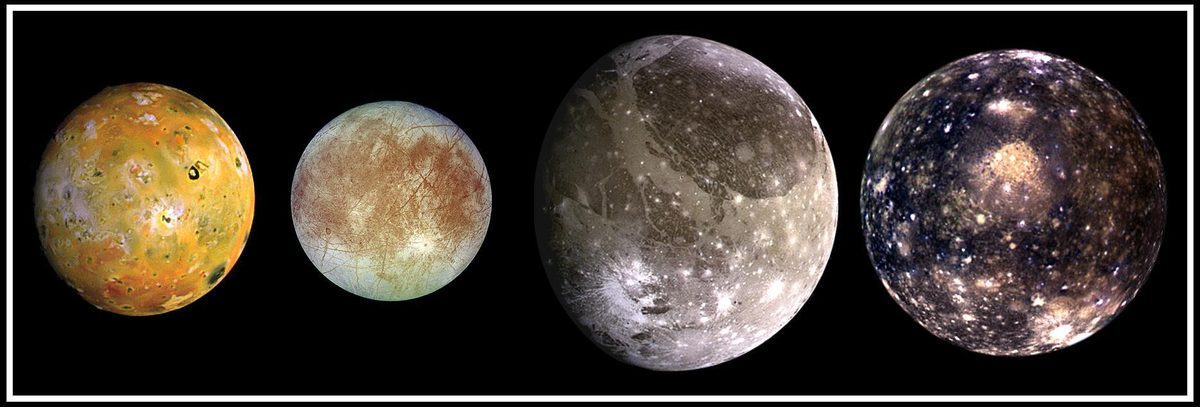
The Jovian system is arguably the most scientifically rich destination in the outer solar system this side of Enceladus. Jupiter's four Galilean moons — Io, Europa, Ganymede, and Callisto — represent a compressed survey of planetary diversity. Io is the most volcanically active body in the solar system, perpetually kneaded by tidal forces from Jupiter and orbital resonances with its siblings. Europa almost certainly harbors a liquid-water ocean beneath its fractured ice shell, kept liquid by the same tidal heating that drives Io's volcanism, just more gently applied. Ganymede is the largest moon in the solar system — larger than Mercury — and the only one known to generate its own magnetic field, a product of a convecting iron core. Callisto, the outermost of the four, is so heavily cratered it looks like a record of every impact event since the solar system's formation, yet it too may harbor a subsurface ocean.
NASA's Galileo spacecraft orbited Jupiter between 1995 and 2003 and fundamentally rewrote our understanding of all four moons. But Galileo was built to 1970s and 1980s specifications — its main antenna famously failed to fully deploy, forcing engineers to relay data through a low-gain antenna at a fraction of planned bandwidth. The science was extraordinary given the constraints. JUICE operates under no such limitations. Its high-gain antenna can transmit data at rates Galileo's team could only dream of, and its instrument suite reflects three additional decades of sensor miniaturization, detector sensitivity, and signal-processing capability.
The mission's sequencing matters as much as the destination. JUICE will arrive at Jupiter in 2031, spend roughly two and a half years conducting 35 flybys of the icy moons — Ganymede (12 flybys), Callisto (21 flybys), and Europa (2 flybys) — before executing the orbital insertion burn around Ganymede in 2034. The Europa flyby count is low by design: the moon sits deep in Jupiter's radiation belts, which would degrade JUICE's instruments if it lingered. ESA's mission designers have threaded a needle, getting enough close passes over Europa's surface to sample its space environment and image its geology without accumulating a fatal radiation dose.
The Ganymede Endgame
The Ganymede orbital phase is where JUICE transitions from reconnaissance to sustained investigation. No spacecraft has ever orbited a moon other than Earth's, and Ganymede presents challenges that make the engineering achievement non-trivial. The moon's own magnetic field is embedded within Jupiter's far more powerful magnetosphere, producing a nested, dynamic electromagnetic environment that JUICE's magnetometer suite will map in detail. Understanding Ganymede's interior structure — whether it has a subsurface ocean, what the ocean's depth and salinity might be, how it interacts with the rocky mantle above and below it — requires separating the moon's intrinsic magnetic signal from Jupiter's background field. That separation is a data analysis problem as much as an instrument problem.
JUICE carries the GALA instrument — Ganymede Laser Altimeter — which will construct a topographic map of the moon's surface at meter-scale vertical precision. The altimeter data, combined with measurements of Ganymede's gravitational field from Doppler tracking of the spacecraft's radio signal, will let scientists construct models of the moon's interior density distribution. If a subsurface ocean exists, it would create a detectable signature in both the gravity field and the tidal deformation of the surface. The ice shell flexes measurably under Jupiter's gravitational pull as Ganymede orbits; how much it flexes tells you how thick the ice is and how salty the water beneath it might be.
The RIME instrument — Radar for Icy Moon Exploration — is perhaps the most technically audacious sensor aboard. It is a radar sounder operating at 9 MHz, capable of penetrating up to nine kilometers into icy surfaces. On Europa and Ganymede, RIME could detect the boundary between the ice shell and the liquid ocean beneath it — a direct, unambiguous measurement of ocean existence rather than an inference from magnetic or gravitational data. The instrument's antenna is 16 meters long, deployed in two 8-meter sections after launch. Getting a 16-meter radar antenna to survive launch, deploy correctly in interplanetary space, and function at Jupiter-level radiation environments is exactly the kind of engineering challenge that makes planetary missions simultaneously expensive and irreplaceable.
The Broader Context: A Fleet Approaching Jupiter
JUICE does not arrive in an empty neighborhood. NASA's Europa Clipper spacecraft launched in October 2024 and is on a trajectory to arrive at Jupiter in April 2030 — a full year before JUICE. Europa Clipper is a focused mission: its entire purpose is Europa, and it will conduct approximately 50 flybys of that moon, each lasting a few hours, building up a systematic map of the surface, ice shell, and plasma environment. The two missions are scientifically complementary. Clipper will characterize Europa in far more depth than JUICE's two flybys permit; JUICE will provide the broader Jovian system context and deliver the sustained Ganymede investigation that Clipper cannot.
There has been coordination between ESA and NASA on instrument design and data sharing, though the missions are independently operated. The prospect of two sophisticated spacecraft in the Jovian system simultaneously — even briefly, before Clipper's mission concludes — opens possibilities for joint observations that neither mission could achieve alone. A measurement of Ganymede's magnetosphere by JUICE while Clipper simultaneously samples the plasma environment elsewhere in the system, for instance, could disentangle local from system-wide magnetic variations.
What makes the outer solar system science of this decade genuinely exciting is not any single measurement but the convergence of multiple lines of evidence arriving at the same time. JUICE's radar, gravity, and magnetic data on Ganymede; Clipper's mass spectrometry sniffing Europa's plumes for organic compounds; Earth-based radio telescopes tracking the plasma torus around Io. The answer to whether any of these icy moons could support life — or has ever supported life — will not come from one instrument on one spacecraft. It will emerge from the intersection of everything these missions collectively accumulate, interpreted by a scientific community that has spent decades preparing the analytical tools to make sense of the data.
JUICE is seven years from its destination and already doing science. That, more than any single measurement it will eventually make, is a fitting summary of how planetary exploration actually works.
