
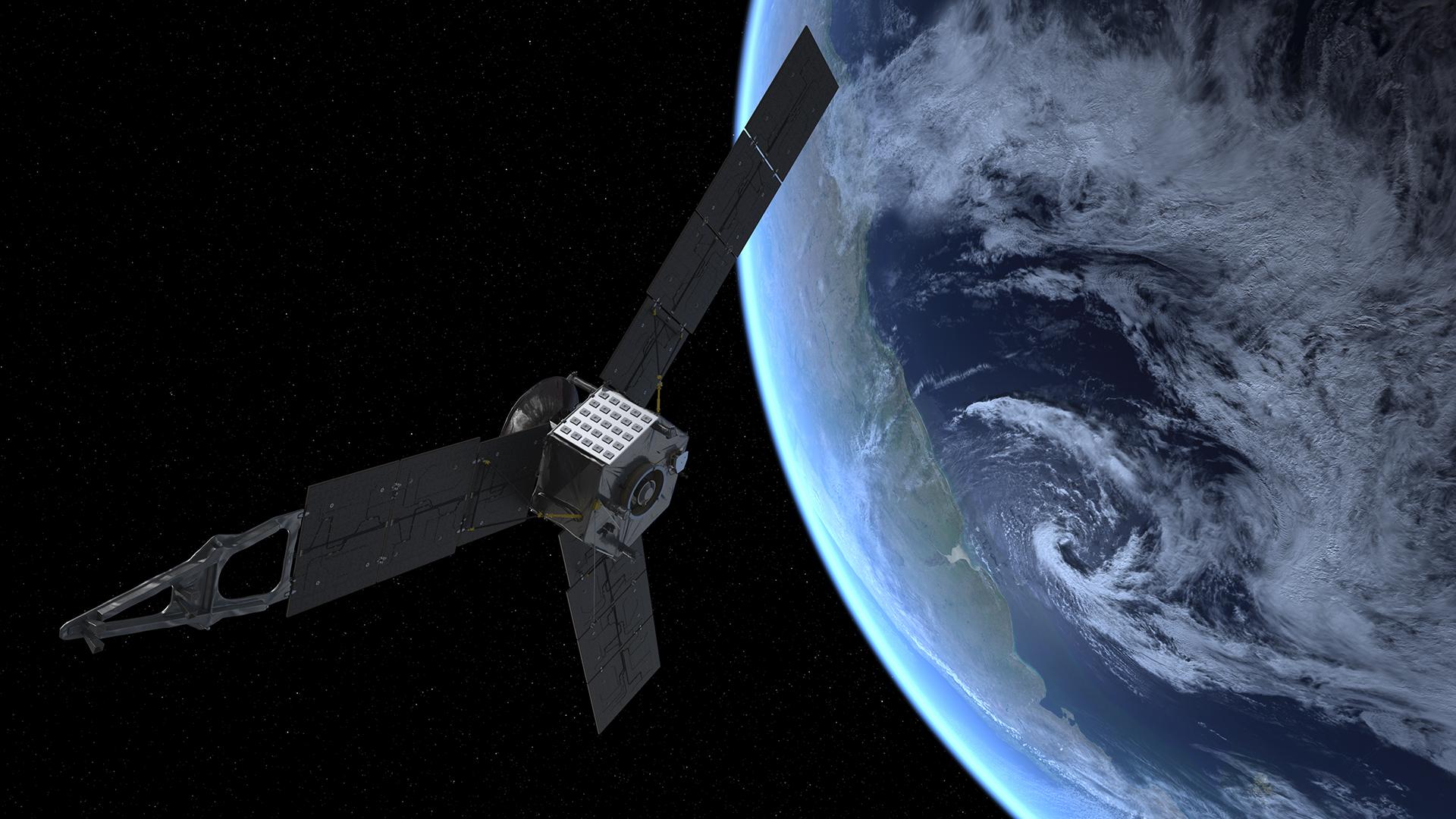
The European Space Agency's Juice spacecraft has swung past Earth and come out the other side faster and better aimed. On 28 September 2026, the Jupiter-bound probe made its closest approach at 13:45 CEST (11:45 UTC), passing 8,640 kilometres above the Indian Ocean. The encounter deflected its path by 20 degrees and raised its velocity by 3.5 kilometres per second, according to ESA.
That is a large change for a spacecraft that used very little fuel to get it. A gravity assist borrows momentum from a planet rather than burning fuel, and this one was the third such manoeuvre since Juice launched from French Guiana in April 2023.
The Numbers
- Closest approach: 13:45 CEST, or 11:45 UTC, on 28 September (about 7:45 am EDT)
- Altitude: 8,640 km (5,369 miles) above the Indian Ocean
- Deflection: 20 degrees
- Velocity gain: 3.5 km/s
A Quiet Approach
The flyby was tracked with extra care from 17 August to 10 October. In the four weeks before the encounter, only one of six trajectory nudges was used. Angela Dietz, Spacecraft Operations Manager, said in ESA's account that the flyby needed only a small amount of the propellant reserved for it, leaving more to use at Jupiter.
Juice's route is a chain of these encounters. The earlier ones were the lunar-Earth flyby in August 2024 and a Venus flyby in August 2025. Only one more Earth flyby remains, in January 2029, before the spacecraft is due at Jupiter in July 2031.
ESA also notes that the spacecraft's 10 science instruments were scheduled with care, with operations teams spending months planning which to switch on and when, because spacecraft resources are tight.
Testing the Instruments on Real Targets
The flyby also served as a working rehearsal. ESA describes the calibration of Juice's instruments as the third opportunity to test them on a real surface in space, after the 2024 lunar-Earth flyby and the 2025 observations of Comet 3I/ATLAS.
Cameras were running throughout. EarthSky reports that the navigation camera captured the Moon about eight hours before closest approach, and an image of Madagascar two minutes after it. ESA says the JANUS camera also took high-resolution images of the Moon and Earth, and that those are expected in the coming weeks.
Through the Magnetotail
Juice also spent several days in Earth's magnetotail, the part of Earth's magnetic field that stretches out away from the Sun. ESA notes that the European-Chinese Smile mission watched the aurora at the same time. Two spacecraft studying the same system from different vantage points is a useful arrangement, though the sources do not report any results from the pairing yet.
Why It Matters
Jupiter is far away, and each gravity assist trades a brief, precisely aimed pass near a planet for speed and direction that would otherwise cost propellant. Getting this flyby right, with only one of six trajectory nudges needed in the run-up, left propellant in reserve. In Dietz's words, that gives the team more to use at Jupiter to carry out observations of the planet's icy moons.
The payoff comes at the destination. ESA says Juice is planned to make 35 flybys of Ganymede, Europa and Callisto, and describes the Earth flyby as relatively straightforward by comparison. The course correction and propellant saved now are part of the groundwork for that later work.
The instrument checks matter in a similar way. ESA's project scientist Claire Vallat said the journey to Jupiter offers only a few opportunities to calibrate and validate the instruments under well-understood conditions. Testing on the Moon, a comet and now Earth gives the team practice with the instruments well before Jupiter arrives in 2031.
What Comes Next
The near-term milestone is the release of the JANUS images. After that, the spacecraft coasts toward the final Earth flyby in January 2029, then on to Jupiter in July 2031.
