
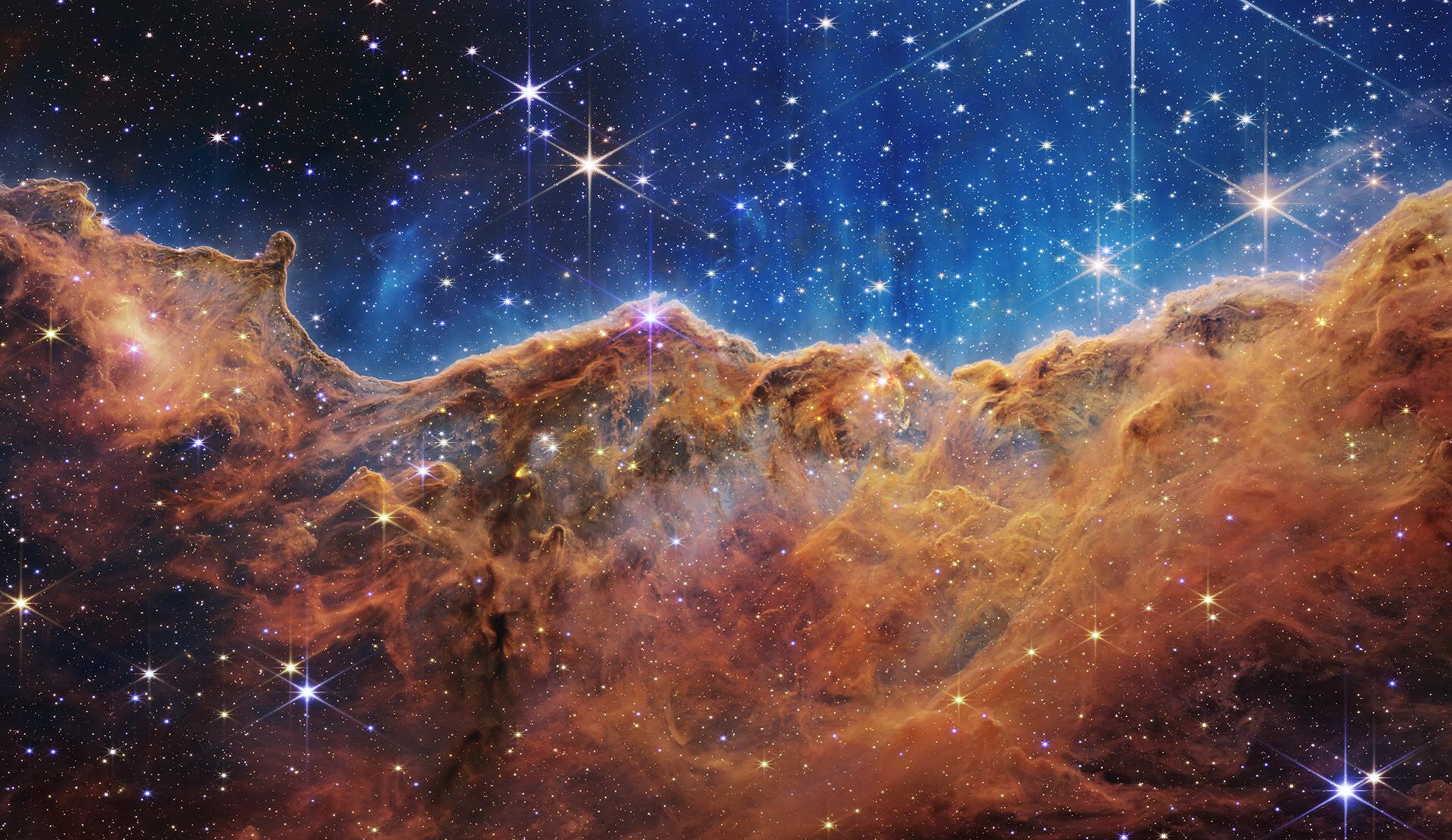
Since it began science operations in mid-2022, the James Webb Space Telescope has produced results faster than most astronomers expected and stranger than most models predicted. Sorting genuine milestones from routine news-cycle hype takes some care, so this list sticks to findings confirmed by NASA, ESA, or peer-reviewed publication — including one high-profile claim that has since been seriously disputed, because an honest accounting of Webb's record has to include what didn't hold up.
1. The most distant confirmed galaxy: JADES-GS-z14-0
In January 2024, Webb's NIRSpec instrument obtained a spectrum of a galaxy cataloged as JADES-GS-z14-0, confirming a redshift of 14.32 — light that left the galaxy roughly 290 million years after the Big Bang, per NASA's official announcement. That alone would be notable, but the galaxy's size was the real surprise: at over 1,600 light-years across and several hundred million solar masses, it is far too big and too bright to match standard models of how quickly galaxies should assemble that early in cosmic history. NASA's own release called the implications for early-galaxy formation rates "profound." We've covered several of Webb's other early-universe surprises, including a surprisingly grown-up barred spiral galaxy found even further back than expected.
2. "Little red dots": black holes that grew too big, too fast
Deep survey after deep survey, Webb kept turning up small, extremely red point sources in the early universe — thousands of them, dubbed "little red dots." Follow-up spectroscopy has increasingly identified them as compact, overmassive black holes wrapped in dense cocoons of ionized gas, some estimated at 100,000 solar masses or more essentially from birth, rather than growing gradually from stellar-mass seeds. As peer-reviewed analyses have noted, if these objects are as common as current samples suggest, existing models of how the universe's first supermassive black holes formed need real revision. We covered one striking example directly: a black hole that grew too big, too fast, too early.
3. First unambiguous carbon dioxide detection on an exoplanet
In 2022, Webb's NIRSpec instrument captured the transmission spectrum of WASP-39 b, a Saturn-mass planet 700 light-years away, as it passed in front of its star. The result, confirmed by NASA and published in Nature, was the first clear, unambiguous detection of carbon dioxide in the atmosphere of a planet outside our solar system — a molecule earlier telescopes had only hinted at. Lead researcher Natalie Batalha noted the clean signal "bodes well for the detection of atmospheres on smaller, terrestrial-sized planets," and the finding opened the door to Webb's now-routine work reading the chemical fingerprints of alien atmospheres, which we've tracked in exoplanet atmosphere coverage since.
4. A cosmic web mapped across 13.7 billion years
The COSMOS-Web survey used Webb to map roughly 164,000 galaxies spread across cosmic time, tracing the filamentary large-scale structure — the "cosmic web" — in unprecedented detail. It's less a single made-for-headlines discovery than a foundational dataset: a three-dimensional scaffold that other Webb findings, including the little red dots and the earliest galaxies, can be placed into context against. We covered the survey's release in detail when Webb mapped 164,000 galaxies across 13.7 billion years.
5. Confirming the Hubble tension is real, not a measurement error
For over a decade, two independent methods of measuring the universe's expansion rate — one anchored to the cosmic microwave background, the other to Cepheid variable stars and supernovae in the local universe — have disagreed by about 9%, a discrepancy known as the Hubble tension. One long-standing explanation was that ground- and space-based telescopes might be unable to resolve individual Cepheids in crowded, distant host galaxies, subtly biasing their brightness measurements. Nobel laureate Adam Riess's team used Webb to re-observe more than 1,000 Cepheids across multiple galaxies and, in a peer-reviewed 2024 paper in The Astrophysical Journal Letters, ruled out unrecognized crowding as an explanation at better than 8-sigma confidence. That doesn't resolve the tension — it deepens it, by eliminating the most popular systematic-error explanation. We've covered the underlying Hubble tension and the distance-ladder methods behind it in depth.
6. A star-filled new view of the Pillars of Creation
In 2022, Webb's NIRCam instrument returned a landmark infrared portrait of the Pillars of Creation, the towering columns of gas and dust in the Eagle Nebula roughly 6,500 light-years away made famous by Hubble in 1995. Where Hubble's visible-light image showed opaque pillars, Webb's infrared view sees straight through the dust, revealing thousands of newly formed stars glowing as bright red points, many still actively ejecting jets of material as they form — turning an iconic image into an active laboratory for studying star birth, according to NASA's release.
7. A disputed biosignature claim on K2-18 b
Not every headline holds up, and a complete accounting of Webb's record should say so plainly. In 2023 and again in April 2025, a Cambridge-led team reported detecting dimethyl sulfide (DMS) — on Earth, produced almost exclusively by marine life — in the atmosphere of K2-18 b, a sub-Neptune 124 light-years away, at roughly 3-sigma confidence. It made global headlines as a potential biosignature. But independent reanalyses since have pushed back hard: multiple groups using different statistical binning of the same Webb MIRI data failed to reproduce the DMS signal, one peer-reviewed study concluded the atmosphere "does not meet the standards of evidence for life," and a NASA-led follow-up analysis found no conclusive evidence of DMS at all. We laid out the underlying debate over what a biosignature claim actually requires in our coverage of exoplanet biosignatures. The episode is a useful case study in how extraordinary claims get tested — and often narrowed or withdrawn — under scrutiny.
Why It Matters
Webb was sold to the public on a handful of marquee promises — see the first galaxies, read exoplanet atmospheres, sharpen our view of star formation — and on the evidence so far it has delivered on all three, then complicated them. The earliest galaxies turned out to be brighter and more massive than models allowed. Exoplanet atmospheres turned out to be readable in exactly the way scientists hoped, which is both exciting and a double-edged sword: the same sensitivity that found unambiguous CO2 on WASP-39 b is sensitive enough to generate biosignature claims that don't survive independent scrutiny, as K2-18 b shows. And the confirmation that the Hubble tension isn't a Cepheid measurement artifact means one of cosmology's most stubborn open problems is not going away quietly. Four years into science operations, Webb's real legacy so far isn't any single image — it's a research program producing results precise enough to be wrong in interesting, checkable ways, which is exactly what good science is supposed to do.
Sources
- NASA's James Webb Space Telescope Finds Most Distant Known Galaxy — NASA Science
- NASA's Webb Detects Carbon Dioxide in Exoplanet Atmosphere — NASA Science
- NASA's Webb Takes Star-Filled Portrait of Pillars of Creation — NASA Science
- JWST Observations Reject Unrecognized Crowding of Cepheid Photometry as an Explanation for the Hubble Tension at 8σ Confidence — The Astrophysical Journal Letters
- K2-18b Does Not Meet the Standards of Evidence for Life — The Astronomical Journal
- Little red dots as young supermassive black holes in dense ionized cocoons — Nature
