
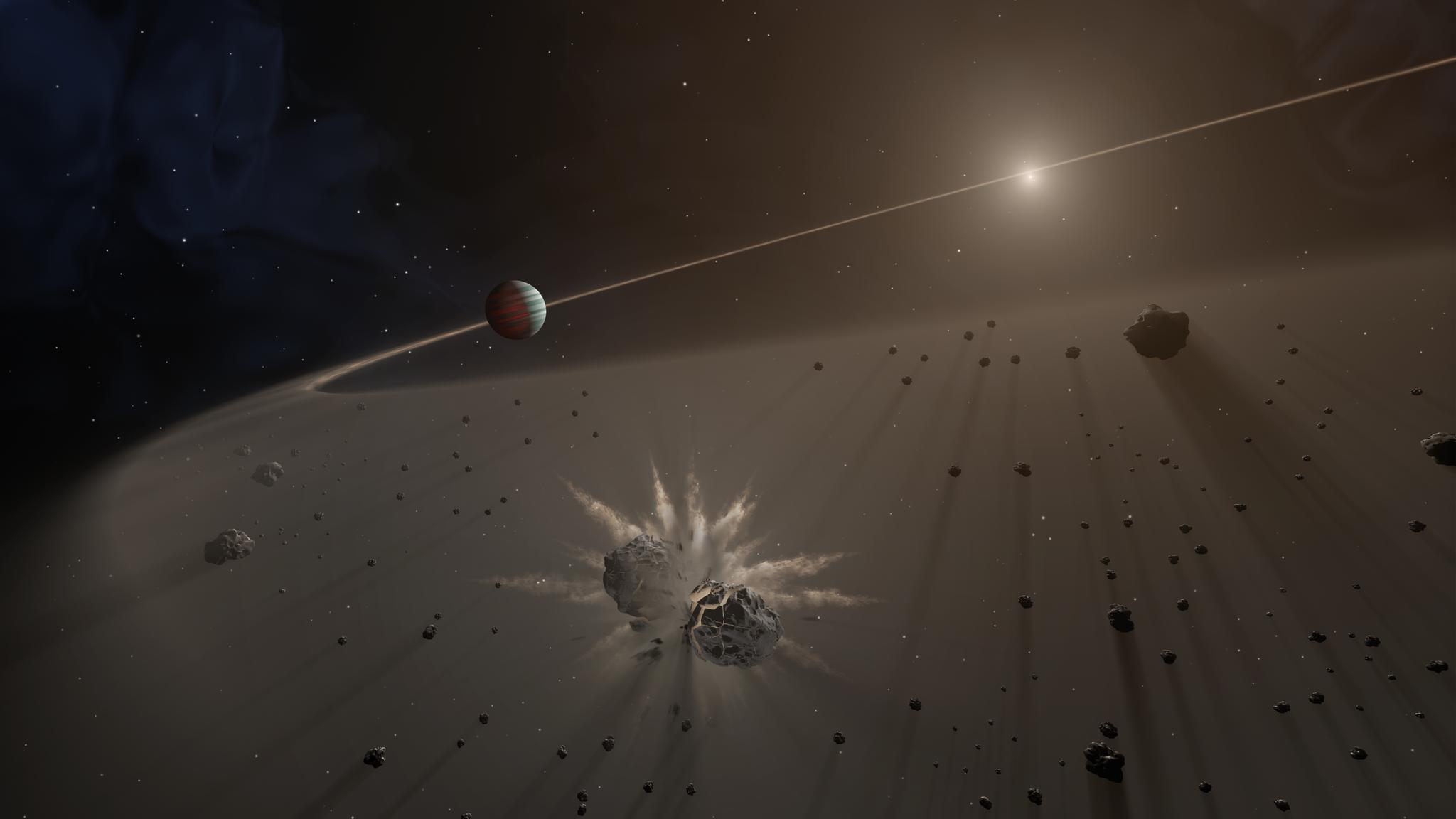
In the southern constellation Pictor, a young star still swaddled in the dusty debris of planet formation just got a little more crowded. On July 9, NASA's Exoplanet Archive — the community's authoritative catalog of confirmed worlds, maintained by Caltech/IPAC — added Beta Pictoris d to its rolls, formally confirming a third planet around the star Beta Pictoris. That makes the system only the second directly imaged multi-planet system known to host more than two confirmed worlds, a distinction that puts it in genuinely rare company.
Beta Pictoris d wasn't the only addition. The same weekly update brought three other newly confirmed planets — NGTS-38 b, TOI-2147 b, and TOI-6019 b — along with parameter updates for 14 previously known planets and fresh atmospheric spectra for 21 more. The update drew on data from two papers, Suttlief et al. (2026) and Gibbs et al. (2026). One previously listed candidate, TOI-1272 c, was quietly stripped of its status and reclassified as a false positive after a published refutation.
It's a routine week, in other words, for the archive — except that "routine" now includes expanding one of astronomy's most closely watched planetary systems.
Why Direct Imaging Is the Hard Way to Find a Planet
Most confirmed exoplanets are found indirectly: astronomers watch a star's light dim as a planet transits in front of it, or track the star's subtle wobble as a planet's gravity tugs it back and forth. Direct imaging is different, and far more difficult — it means actually capturing photons from the planet itself, separating a point of light thousands or millions of times fainter than its host star from the star's overwhelming glare.
That's why directly imaged planets tend to be young, still glowing with residual heat from their formation, and orbiting far enough from their stars to be optically separable. Beta Pictoris has long been a favorite target for exactly this reason: the star is astronomically young, still surrounded by a visible debris disk, and was one of the first stars ever shown to host a directly imaged planet, Beta Pictoris b. A second planet, Beta Pictoris c, was confirmed some years later.
Beta Pictoris d's confirmation pushes the system to three confirmed planets. According to the Exoplanet Archive's own summary of the update, the discovery of Beta Pictoris d makes Beta Pictoris only the second directly imaged system known to host more than two confirmed planets — a bar that very few systems have cleared.
The Rest of the Update: New Worlds and a Demotion
Beyond Beta Pictoris, the archive's July 9 batch reflects the steady grind of exoplanet science: confirmation, refinement, and occasional correction.
- NGTS-38 b — a newly confirmed planet cross-referenced in Wikipedia's running list of 2026 exoplanet discoveries, consistent with the archive's timeline.
- TOI-2147 b and TOI-6019 b — two more new confirmations, both originally flagged by NASA's Transiting Exoplanet Survey Satellite (TESS), as their "TOI" (TESS Object of Interest) designations indicate.
- 14 planets had their orbital or physical parameters updated based on new measurements, including eps Ind A b, GJ 367 b, HAT-P-5 b, HAT-P-32 A b, HAT-P-38 b, K2-25 b, Kepler-79 d, LHS 1140 b, TOI-1272 b, TOI-1694 b, TOI-1694 c, WASP-7 b, WASP-72 b, and WASP-127 b.
- 21 planets gained newly published atmospheric spectra — data that lets researchers start probing what these worlds' skies are actually made of, rather than just where they are and how big.
- TOI-1272 c, previously carried as a planet candidate, was reclassified as a false positive following a published refutation — a reminder that not every promising signal survives scrutiny.
That demotion is a useful corrective to any narrative that exoplanet discovery is a one-way ratchet of ever-growing numbers. The Exoplanet Archive's job isn't just to add names to the list; it's to keep the list honest, and that means occasionally removing entries that don't hold up. NASA's broader exoplanet science communications emphasize that the agency has now confirmed more than 6,000 exoplanets out of the billions believed to exist — a running tally that only grows because entries like TOI-1272 c also get pulled back out when the evidence doesn't hold up.
Why It Matters
Multi-planet systems confirmed by direct imaging are scientifically valuable out of proportion to their rarity. Because astronomers can see these planets' light directly rather than inferring their presence from a star's dimming or wobbling, they can — at least in principle — study the planets' own atmospheres, temperatures, and orbital dynamics as standalone objects rather than shadows cast on their star. A system with three such planets, all young enough to still be radiating formation heat and all orbiting a star with a visible debris disk, is close to a laboratory for testing theories of how gas giants form and migrate over tens of millions of years — the kind of timescale that's otherwise almost impossible to observe directly.
Beta Pictoris was already one of the best-studied planetary systems outside our own precisely because it offers this rare combination: a young star, a resolvable disk, and planets bright enough to image. Adding a third confirmed world doesn't just pad a statistic — it gives modelers a more complete architecture to test orbital stability calculations against, and gives observers a third target to compare atmospheric spectra across as instruments like next-generation ground- and space-based coronagraphs come online. Systems like this are also useful stress tests for the Exoplanet Archive's own confirmation pipeline, the same pipeline that, in the same week, caught and corrected a false positive in TOI-1272 c. Both outcomes — a confirmation and a retraction — are signs the process is doing its job.
