
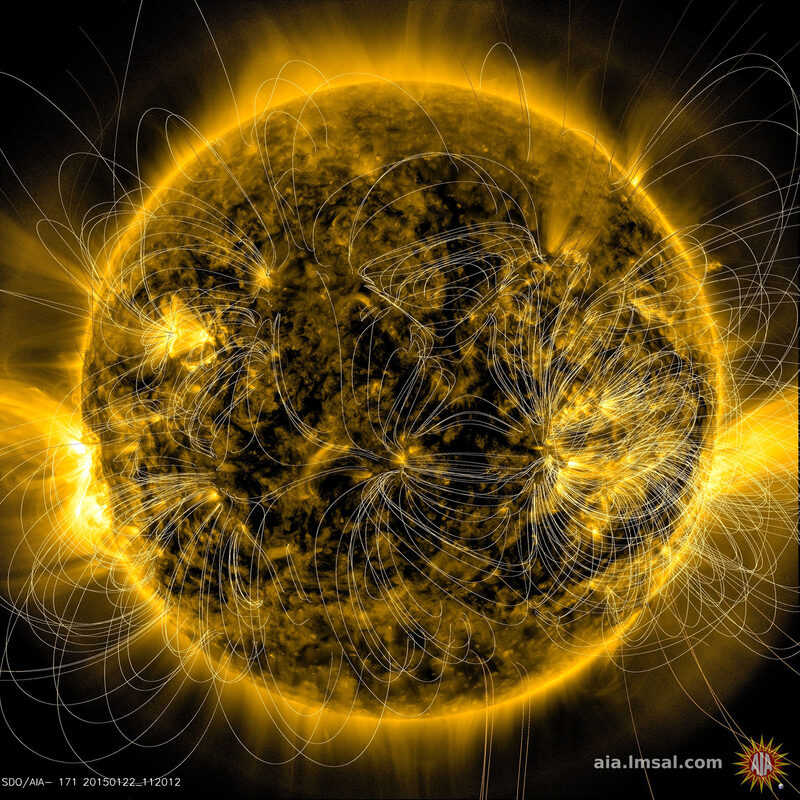
Somewhere beneath the Sun's visible surface, deep in its interior, there's a boundary that shouldn't exist in the shape it does. It's called the tachocline, and it separates two very different regions of the solar interior: the radiative zone below and the convective zone above, where plasma churns and circulates. Squeezed between them is a shear layer so thin that, by the Sun's own vast standards, it barely counts as a layer at all.
That thinness has bothered solar physicists for decades. Standard models of stellar fluid dynamics predict that a shear layer like the tachocline should spread out over time, smearing into a thick, diffuse transition zone as the rotational mismatch between the two regions bleeds outward. Instead, observations have consistently shown the tachocline staying remarkably, stubbornly thin. Nobody had a solid mechanism to explain why — until now.
A team working under NASA's COFFIES Science Center — Consequences Of Fields and Flows in the Interior and Exterior of the Sun — says it has finally cracked the puzzle. The findings, published July 7, 2026, describe a newly identified two-way synergy: the tachocline helps generate the Sun's magnetic field, and that fluctuating magnetic field, in turn, is what keeps the tachocline pinned thin. Each half of the system sustains the other.
How you simulate something you can't see
You can't stick a probe into the Sun's interior. Everything known about the tachocline comes from indirect methods — primarily helioseismology, which infers interior structure from how sound waves ripple across the solar surface — combined with theoretical modeling. For years, those models have been simplified approximations, because simulating the full three-dimensional interplay of rotation, convection, and magnetism across a star-sized volume is one of the most computationally punishing problems in astrophysics.
The COFFIES team, led by researchers at UC Santa Cruz — including Nicholas Brummell, professor of applied mathematics, postdoctoral scholar Loren Matilsky, and former UCSC graduate student Lydia Korre — took a different approach: global simulations built to mimic actual solar dynamics more closely than prior models, rather than relying on the stripped-down assumptions earlier work depended on. That fidelity came at a steep price. The project consumed hundreds of millions of hours of processing time on NASA's most powerful supercomputer — a scale of computation that itself signals how stubborn this problem has been.
What emerged from all that number-crunching was the synergy: the tachocline is essential in driving the Sun's large-scale magnetic field through the solar dynamo, the process responsible for sunspots. But the relationship isn't one-directional. A fluctuating magnetic field generated by that dynamo action loops back and is key to keeping the tachocline's signature thinness intact, preventing the diffusion that simpler models predicted. Remove the field from the equation, and the layer should spread. Keep it in, and the layer stays razor-thin — matching what helioseismology has actually observed.
The research was published in The Astrophysical Journal, and COFFIES — a Phase II DRIVE Science Center hosted at Stanford — has flagged tachocline dynamics as one of its three core research themes, with this result building on a broader body of dynamo-confinement modeling work the center has been developing. Funding for the work came through NASA's COFFIES program, along with an NSF postdoctoral fellowship supporting Matilsky.
Why It Matters
The tachocline isn't an obscure structural curiosity — it's widely regarded as the engine room of the solar dynamo, the process that generates the magnetic field responsible for sunspots, solar flares, and coronal mass ejections. Those eruptions are the root cause of space weather, which can affect astronaut safety, satellite communications, and global navigation systems.
Forecasting space weather has long been held back by an incomplete picture of what's actually happening inside the Sun to generate that magnetic activity in the first place. A model that correctly explains why the tachocline behaves the way it does — rather than just describing that it does — gives researchers a more physically grounded foundation for predicting how the dynamo, and by extension the solar cycle, will evolve. NASA's own framing of the result ties it directly to that practical stake: better understanding of the tachocline's confinement mechanism feeds into better tools for anticipating the kind of solar activity that affects astronaut safety, satellite operations, and navigation infrastructure.
What's still open
A single simulation result, however computationally expensive, doesn't close the book on a decades-old problem. The COFFIES publication record shows this tachocline result sitting inside a larger, ongoing research theme rather than standing as an isolated paper — the center's public highlights page points to a continuing thread of dynamo-confinement modeling that this work builds on and will presumably continue to refine. Global magnetohydrodynamic simulations of stars are notoriously sensitive to resolution and to the approximations still baked in even in "more realistic" models, so independent replication and comparison against future helioseismic observations will matter for how firmly this feedback-loop explanation holds up.
Still, the two-way synergy described here is the kind of mechanism that solar physicists have been circling for a long time without pinning down: not just an ad hoc fix that keeps the layer thin, but a self-reinforcing loop that falls naturally out of the same physics that produces the magnetic field in the first place. That kind of internal consistency is usually a good sign a model is capturing something real about how the Sun actually works.
