
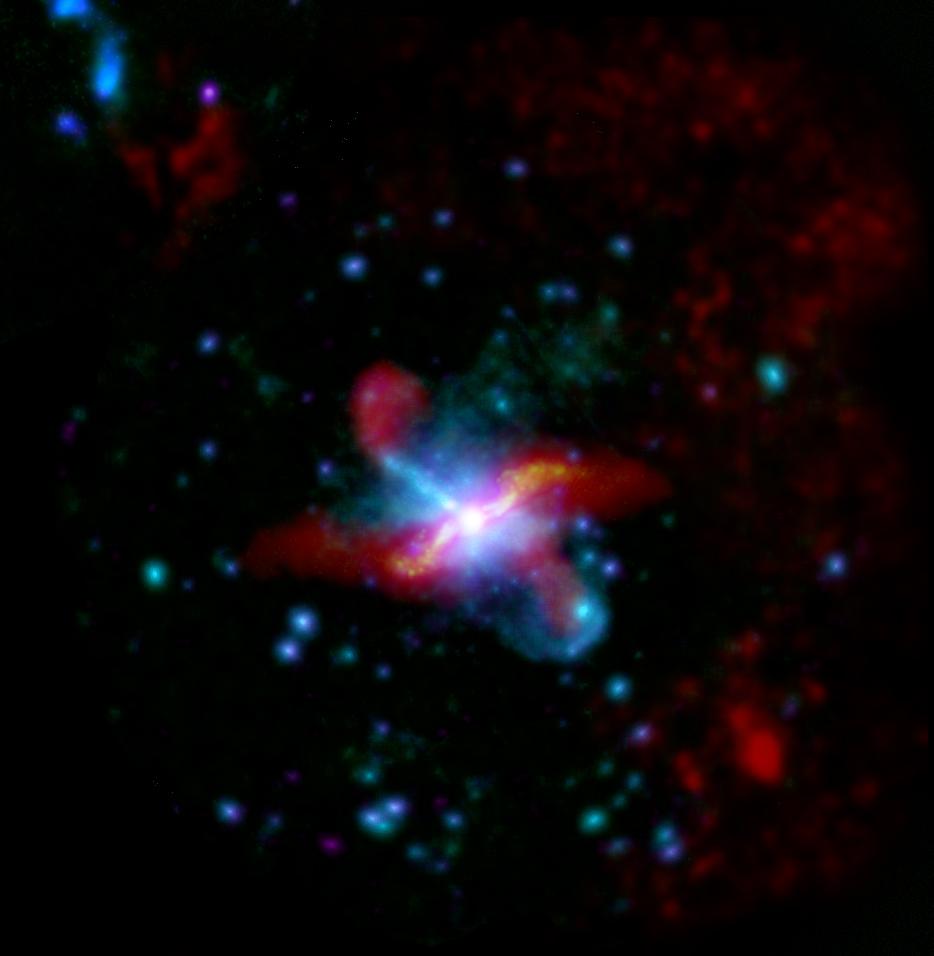
Four years ago this month, NASA unveiled the first public images from the James Webb Space Telescope — a set of pictures that reset expectations for what infrared astronomy could deliver. To mark the anniversary, the agency has released a new Webb view of Centaurus A, one of the closest and most disturbed galaxies to our own, and it does something optical telescopes have never managed: it looks straight through the dust choking the galaxy's core and picks out individual stars, one by one, in a region that has stayed stubbornly opaque for as long as astronomers have pointed instruments at it.
Centaurus A is not a quiet galaxy. It carries the visible scars of a major collision that astronomers date to roughly 2 billion years ago, and its supermassive black hole is actively feeding — pulling in gas and dust while launching jets of material outward. That combination of an active nucleus, a thick dust lane, and a violent merger history has made Centaurus A a favorite target for decades. It has just never been easy to see clearly.
Why the dust mattered
Visible-light images of Centaurus A show a bright elliptical galaxy sliced across the middle by a dark, mottled band of dust — the leftover debris of the collision that reshaped the galaxy. That band has long obscured the galactic nucleus and much of the star-forming activity happening behind it. According to Sci.News, the Hubble Space Telescope, which relies on visible light, could not reveal the central region of Centaurus A because dust blocked the view, and even the infrared-capable Spitzer Space Telescope — while able to trace the galaxy's larger-scale structures — lacked the resolution to pick out individual stars there.
Webb's advantage is that it observes primarily in near- and mid-infrared light, wavelengths that pass through interstellar dust far more readily than visible light does. According to reporting from Sci.News on the release, that infrared reach is what let Webb cut through the dust lanes obscuring Centaurus A's nucleus and resolve individual stars there for the first time — turning a smudged, dust-choked core into a field of distinguishable points of light. Space.com's coverage adds that Webb's combined mid- and near-infrared imaging, gathered with its MIRI and NIRCam instruments, brings out a dense field of millions of stars in the galaxy that earlier telescopes could only render as an unresolved glow.
Reading a 2-billion-year-old collision, star by star
Being able to resolve individual stars is not just a resolution flex. It gives astronomers a way to date different phases of the galaxy's history directly from its stellar populations, rather than inferring the merger timeline from bulk properties like overall color or brightness. Older stars formed long before the collision look different — in temperature, color, and evolutionary stage — from stars that were triggered into formation by the collision's aftermath, and Webb's imaging is detailed enough to sort them apart.
That star-by-star accounting is what Sci.News describes as a form of "galactic archaeology" that helps astronomers date the phases of Centaurus A's roughly 2-billion-year-old merger history — including when older stars first formed, when that early activity slowed, and when a fresh burst of star formation was triggered by the collision and its aftermath. NASA's release describes the same dynamic from the structural side: the collision's aftermath is still visible today, both in the galaxy's unusual structure and in the ongoing star formation it triggered. Put together, the picture is of a galaxy where the past isn't really past — the merger keeps announcing itself through fresh star formation and a black hole that is still actively feeding.
Space.com's coverage frames that black hole activity as central to the story: the merger supplied Centaurus A's supermassive black hole with an abundant supply of gas and dust to feed on, powering what astronomers call an active galactic nucleus that blasts out high-speed jets of plasma. Webb's data shows fast-moving ionized gas being pushed outward by that black hole activity, along with a warped, rotating disk of warmer molecular hydrogen near the galaxy's heart — evidence that the same black hole can both trigger bursts of star formation by condensing surrounding gas and, over time, choke off future star birth by depleting the raw material those stars need. This isn't a snapshot of a settled, quiet galaxy — it's a system still visibly processing a collision that happened long before humans existed.
A birthday image with a purpose
NASA timed the release to align with the fourth anniversary of Webb's first public images. As Space.com reports, "July 2026 marks four years since NASA's James Webb Space Telescope (JWST) images were first revealed to the general public, marking a new era for astronomy." Anniversary releases are partly about celebration, but this one also functions as a demonstration of what four years of operational maturity look like. Shawn Domagal-Goldman, division director of Astrophysics at NASA Headquarters, said in a statement carried by Space.com: "No single telescope tells the whole story. Discoveries build over time, and new observatories expand on the foundations laid by earlier missions. The JWST represents the most powerful step forward yet, opening a window into wavelengths and details never before accessible. This allows astronomers to examine structures and processes that other telescopes could not see."
Centaurus A sits at a relatively close distance in cosmic terms among giant elliptical galaxies with active nuclei, which is part of why it keeps getting revisited by new instruments as they come online. Each generation of telescope has added detail to the same basic story: a galaxy that merged with a companion, disrupted its own structure, and is still working through the consequences via a feeding black hole and clouds of newly forming stars. Webb's contribution is resolution — the ability to stop treating the core as a single blurred glow and start treating it as a population of individual stars that can be aged and classified.
Even with that leap in resolution, mysteries remain. Space.com reports that Webb's mid-infrared imaging also turned up a curious S-shaped feature near the galaxy's core whose origin scientists have not yet explained, including whether the active black hole played a role in shaping it.
Why It Matters
Centaurus A works as a nearby laboratory for a process that shaped much of the universe: galaxy mergers. Large galaxies, including the Milky Way, are generally now understood to have grown partly through collisions and absorptions of smaller companions over billions of years. Because Centaurus A is close enough for Webb to resolve individual stars in it, astronomers can build a detailed, dated timeline of how one such merger actually unfolded — which stars formed before the collision, which were triggered by it, and how the disturbance has fed the central black hole over time. That kind of star-by-star reconstruction is difficult or impossible in more distant merging galaxies, where even Webb can only resolve blurred light from entire clusters rather than single stars. Centaurus A, in other words, is close enough to serve as a calibration case — a way to ground-truth models of galaxy evolution that otherwise rely on statistics from thousands of more distant, less legible systems.
