
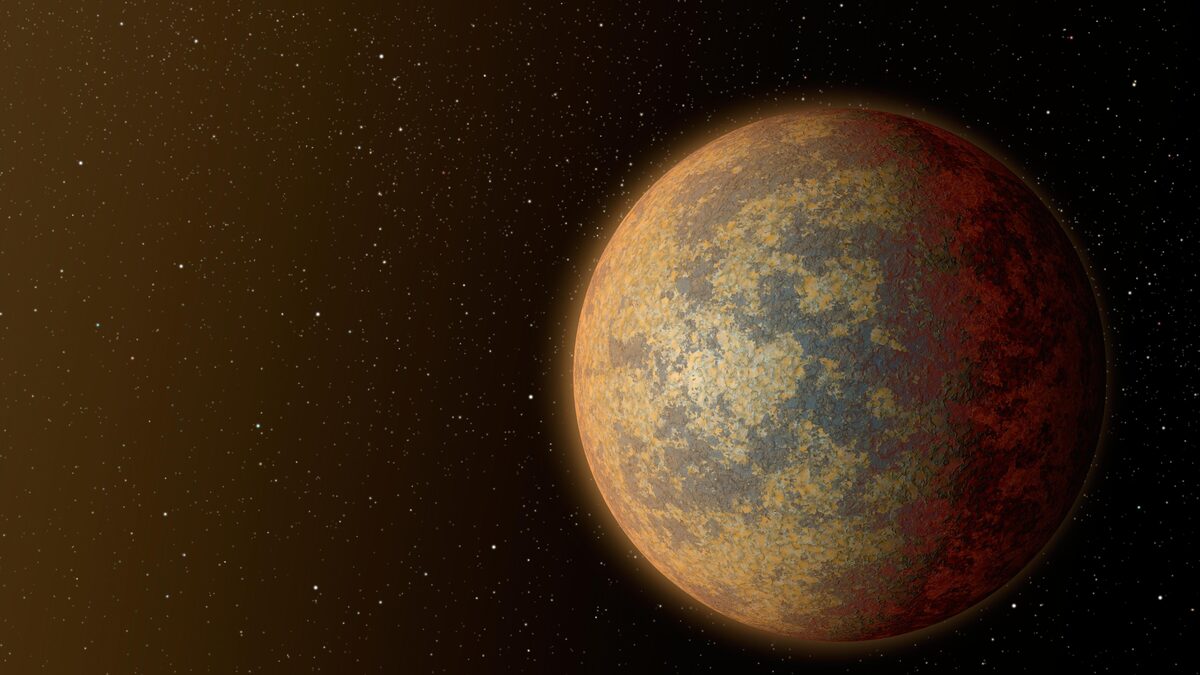
Somewhere around a red dwarf roughly 52 light-years from Earth sits a planet about 1.75 times as massive as our own, baking under 17 times the sunlight Earth receives. For a couple of years now, astronomers have been pointing the James Webb Space Telescope at it, waiting to see whether it holds onto any air. On July 9, 2026, the Space Telescope Science Institute announced the answer: no. GJ 3929 b, STScI said, is the first fully completed target in JWST's Rocky Worlds Director's Discretionary Time program, and the data say it's a bare, airless rock.
That might sound like an anticlimax — space telescope finds nothing there — but for the scientists running Rocky Worlds, a clean non-detection is exactly the kind of result the program was built to produce. It's the first time the initiative has taken a target from first eclipse to final, statistically confident verdict, and it establishes the playbook for roughly eight more rocky worlds still waiting in the queue.
What Rocky Worlds Is Actually Testing
The Rocky Worlds DDT program is a joint JWST/Hubble campaign built around a single, deceptively simple question: do small, rocky planets orbiting red dwarf stars keep their atmospheres, or does the intense radiation and stellar activity of those stars strip them bare? The concept guiding the hunt is what astronomers call the "cosmic shoreline" — a rough dividing line, plotted against a planet's escape velocity and the amount of radiation it absorbs, that separates worlds with atmospheres from worlds without them. Every planet the program observes becomes a data point testing where that shoreline actually falls.
GJ 3929 b is a good stress test. It's a super-Earth roughly 1.75 times Earth's mass, orbiting close enough to its red dwarf host to soak up about 17.3 times the instellation Earth gets from the Sun. If any planet were going to have had its atmosphere sandblasted away by stellar radiation, this is a strong candidate.
The technique itself is indirect but effective: secondary eclipse photometry. As the planet swings behind its star, the combined brightness of star-plus-planet dips by a tiny amount — the "eclipse depth" — corresponding to the heat the planet itself is radiating. Measure that dip precisely enough, at the right infrared wavelength, and you can back out a dayside temperature. A planet with a thick atmosphere redistributes heat around its surface and runs cooler on the dayside than the raw physics of direct sunlight would predict. A planet with no atmosphere at all has nothing to spread the heat around, so its dayside runs hot — close to what you'd calculate for a bare rock with no insulation.
Four Eclipses, One Answer
The newly completed dataset, described in a preprint posted to arXiv (2606.07511), combines four separate MIRI secondary-eclipse observations at 15 microns — the full observing sequence Rocky Worlds allotted to this target. The joint fit across all four eclipses lands on an eclipse depth of 118±22 parts per million and a dayside brightness temperature of 641 K, with an uncertainty of +59/-64 K. That temperature is consistent with an airless, heat-retaining rock and inconsistent — at greater than 3-sigma confidence — with a thick CO2 atmosphere that lacked a thermal inversion.
Coverage from Universe Today framed the result plainly: GJ 3929 b "lies well on the airless side of many proposed versions of the cosmic shoreline." The Rocky Worlds team found no sign of the kind of thick, heat-redistributing atmosphere that would make the planet a candidate for habitability. What's left is the picture of a dark, sun-scorched world with essentially nothing standing between its rocky surface and its star.
This isn't actually the first look at GJ 3929 b's dayside — it's the confirming one. An earlier analysis published in The Astrophysical Journal Letters, based on just two of the four eclipses, had already floated the bare-rock hypothesis, measuring a dayside brightness temperature of 782±79 K and ruling out CO2-rich atmospheres thicker than 100 millibars at greater than 3-sigma confidence. The two numbers — 782 K from the partial dataset, 641 K from the complete one — don't quite agree, a reminder that eclipse photometry from a small rocky planet around a faint star is a genuinely hard measurement, sensitive to stellar variability and systematics that only average down with more visits. What both analyses agree on, independently, is the conclusion: no thick atmosphere, in either direction.
Why It Matters
Rocky Worlds exists because the search for potentially habitable exoplanets keeps running into the same bottleneck: red dwarfs are the most common stars in the galaxy and host plenty of Earth-sized planets in convenient, short-period orbits — but nobody knows whether those stars' youthful flaring and high-energy radiation environments leave any of those planets with air. GJ 3929 b is the program's proof of concept for actually answering that question with real data rather than theoretical extrapolation. It shows that JWST, stacking multiple MIRI eclipses on a single target, can deliver a statistically decisive verdict on whether a rocky exoplanet has an atmosphere at all.
That matters for two reasons. First, it sharpens the empirical cosmic shoreline — every confirmed airless world at a given instellation and escape velocity narrows down where the survivable boundary actually sits, which in turn tells astronomers which of the remaining ~8 Rocky Worlds targets (and which exoplanets beyond the program) are worth the expensive follow-up needed to search for biosignatures. Second, it's a methodological victory: STScI's own announcement describes the observation as opening a "new era in exoplanet studies," with lessons from the GJ 3929 b campaign — how many eclipses are needed, how eclipse depths refine as data accumulate, how to fold in prior partial results — directly shaping how the harder, fainter targets still on the list will be scheduled and analyzed. A single airless rock, in other words, is how the program calibrates its aim for the atmospheres it hasn't found yet.
Sources
- First Completed Rocky Worlds Program Observations Open New Era in Exoplanet Studies — STScI Press Release 2026-406
- GJ 3929 b as the First Complete Rocky Worlds DDT Data Set — arXiv:2606.07511
- Another Earth-like Exoplanet Crossed Off The List: The JWST Shows That GJ 3929b Has No Atmosphere — Universe Today
- The JWST Rocky Worlds DDT Program Reveals GJ 3929b to Likely Be a Bare Rock — ApJ Letters / IOPscience
